Part VI · DESK BODY PAIN PATTERNS
Low-Back Pain Pattern
Low-back pain is the world’s leading cause of disability, and the desk worker knows it well. This chapter assembles its mechanics, confronts the widespread fear and misunderstanding that surround it, sets out the warning signs that genuinely matter, and makes the evidence-based case for an active, confident approach. It describes a common pattern — it does not diagnose the reader.
18.1 The Pattern
No discomfort of the desk body carries more weight, or more fear, than low-back pain. Low-back pain is the single leading cause of disability worldwide, affecting the great majority of people at some point in their lives, and it is among the commonest reasons desk workers seek help (Hartvigsen et al., 2018). Yet despite its prevalence, it is one of the most misunderstood of all conditions, surrounded by frightening beliefs and outdated advice that often make it worse. This chapter aims to set the record straight.
Drawing together the mechanics of Chapter 8, on the desk worker’s low back, with the hip and gluteal material of Chapters 10 and 11, it assembles a clear picture of the pattern and, just as importantly, of what it is not. The two framing points of this part apply with particular force here. First, this is an educational account of the common pattern, not a diagnosis of any individual. Second — and this is the single most important message of the chapter — the overwhelming majority of low-back pain is what clinicians call non-specific: it cannot be attributed to any serious disease or identifiable structural damage, and it has a generally favourable outlook (Maher et al., 2017). A small minority of cases do involve specific conditions or warning signs that need attention, and these are set out carefully later; but for most people, most of the time, the back is far more robust, and the outlook far more hopeful, than fear suggests.
18.2 The Typical Presentation
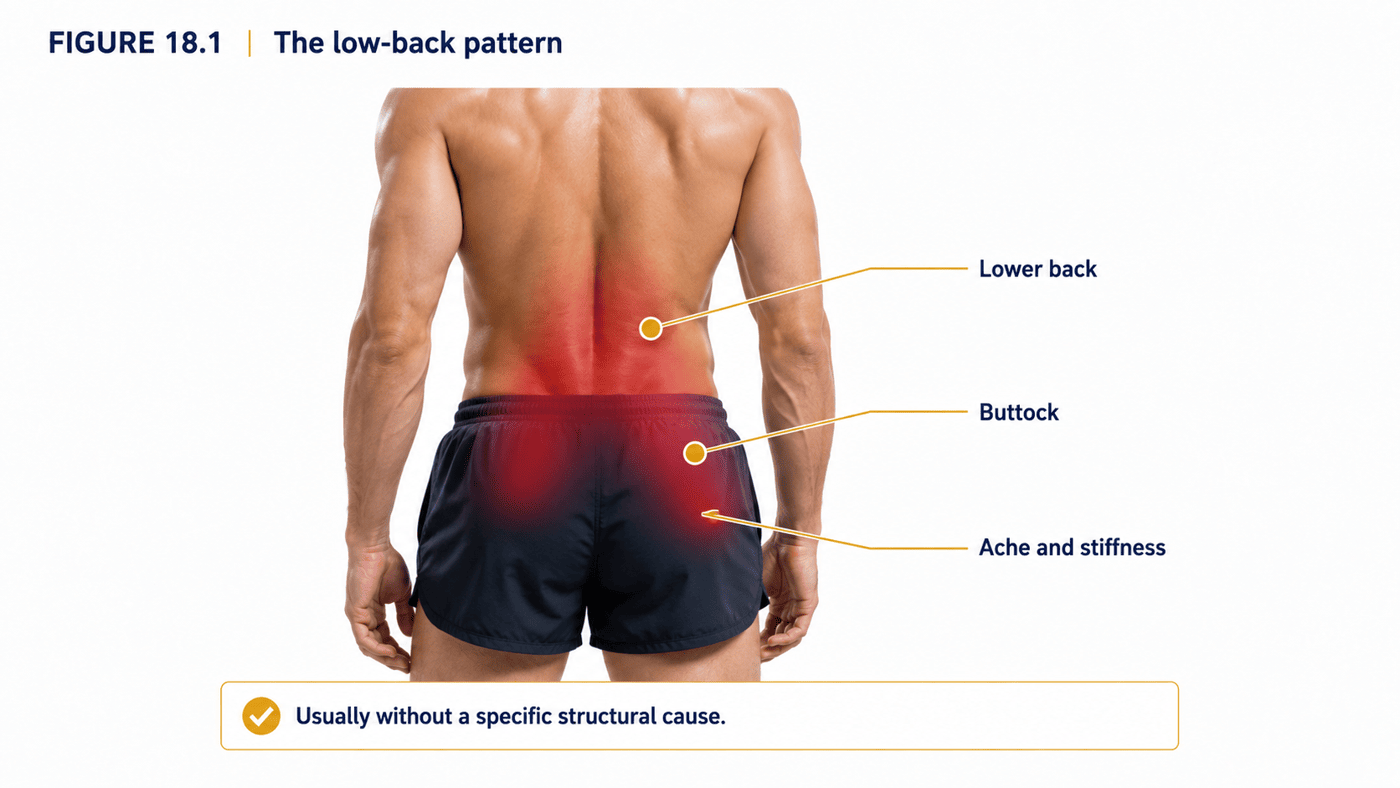
The desk-related low-back pattern, shown in Figure 18.1, is usually felt across the lower back — around the belt line and the small of the back — sometimes spreading into one or both buttocks. The quality is typically an ache, a stiffness or a tightness, often worse after prolonged sitting and eased by standing, walking or changing position; for some it is the reverse, easier sitting and worse on standing. Stiffness on first rising, or after a long period in one position, is common, as is a fluctuating course in which the pain varies from day to day and week to week.
This behaviour — worse with sustained posture, changeable, eased by movement — is again that of a loaded, sensitised system rather than a damaged structure. A back that aches after an hour of sitting and feels better once you walk is reporting sustained load and stiffness, not announcing injury. The fluctuation itself is reassuring: damaged structures do not improve and worsen with posture and activity the way the common pattern does. Understanding the presentation as load-related rather than damage-related is the first step toward managing it without fear.
18.3 The Mechanical Contributors
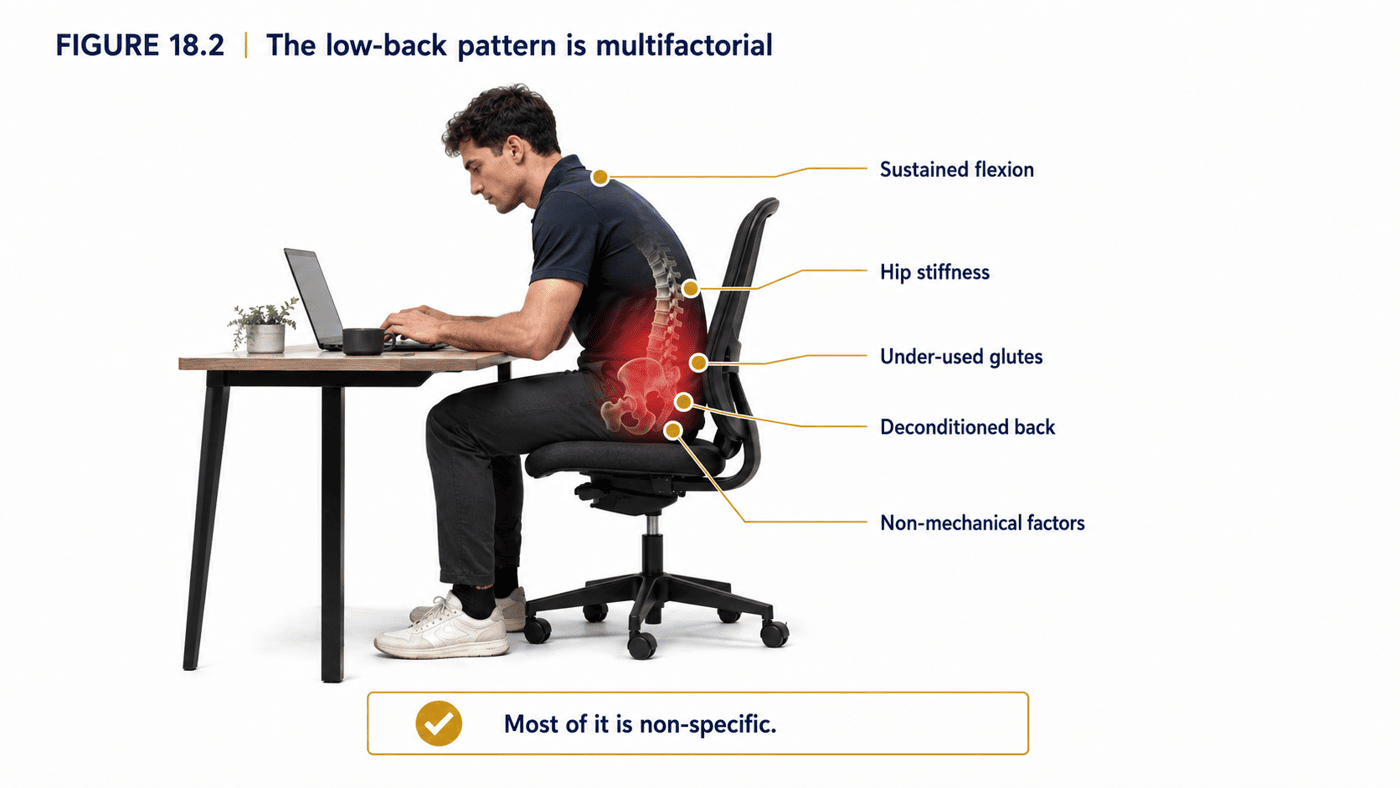
Several mechanical factors from earlier in the book converge on the low back, and Figure 18.2 sets them alongside the powerful non-mechanical factors discussed next. The sustained flexed posture of sitting, examined in Chapter 8, loads the lumbar tissues continuously and lets the slow deformation of creep accumulate. The hip stiffness of Chapter 10 — the loss of hip extension from hours in flexion — means that movements which should occur at the hip are often demanded of the lower back instead. The under-used glutes of Chapter 11 leave the back’s powerful partners quiet, so that the back is less well supported in the tasks of lifting and moving. And the general deconditioning of an under-loaded back lowers its capacity to meet even ordinary demands.
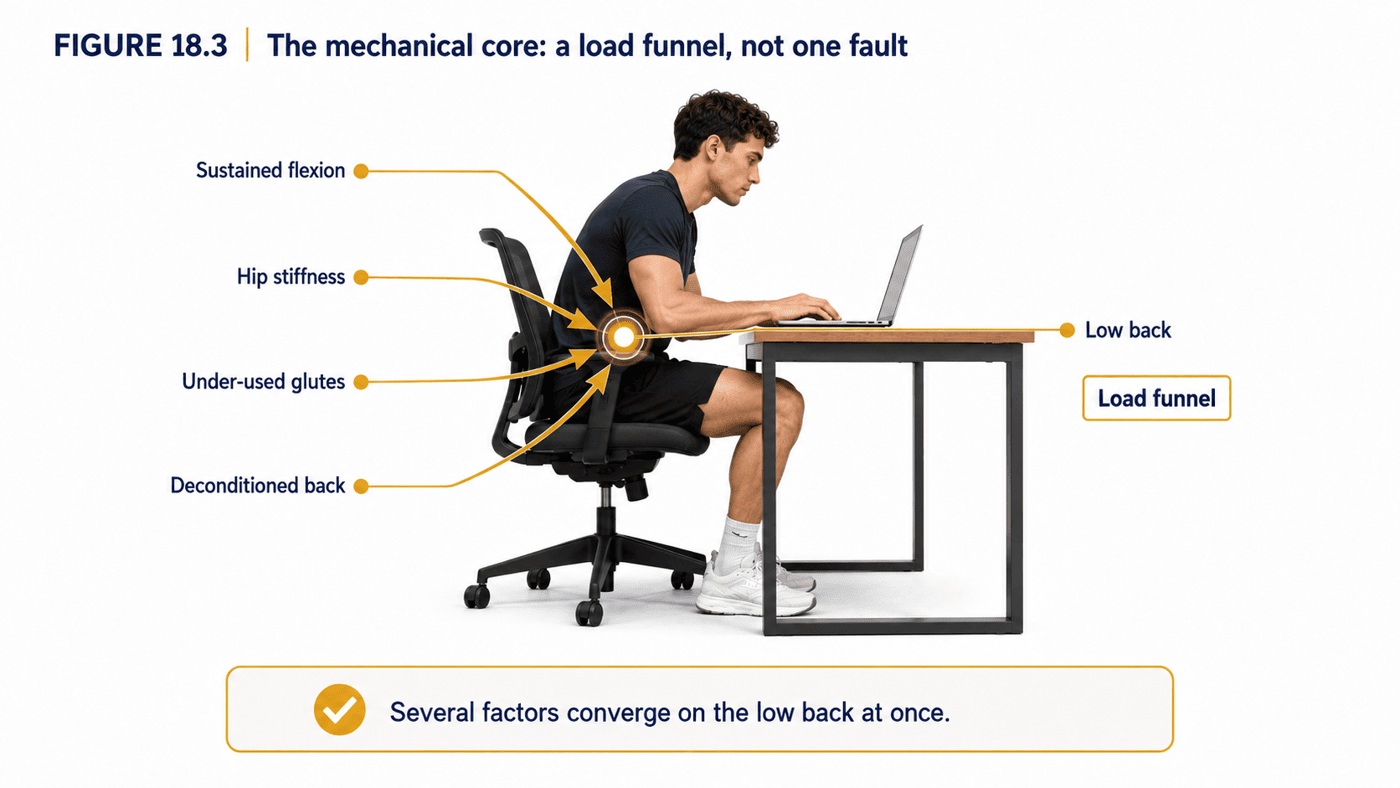
The crucial point about these mechanical contributors is captured in Figure 18.3: they act together, funnelling load onto a low back of reduced capacity, rather than any one of them being ‘the cause’. This is why the common question — ‘what one thing is wrong with my back?’ — is usually the wrong question. The pattern emerges from the convergence of several ordinary factors on a back that has lost some of its robustness, not from a single identifiable fault. It follows that the remedy is not to find and fix one broken part, but to reduce the converging load and rebuild the back’s capacity — a theme the management section develops.
18.4 The Non-Mechanical Contributors
Of all the regions in this part, the low back is the one where non-mechanical factors have been most thoroughly shown to matter, and where ignoring them most reliably leads management astray. The modern, evidence-based understanding of low-back pain is firmly biopsychosocial: psychological and social factors are not minor addenda but central determinants of who develops persistent pain and disability (Hartvigsen et al., 2018; O’Sullivan et al., 2018).
Several such factors feed the pattern. Psychological stress and low mood amplify pain and lower the threshold at which the back complains. Poor sleep worsens pain and slows recovery. But the most important non-mechanical contributor of all, and the one most specific to the back, is belief — in particular, the fear that back pain signals serious damage. This fear, often inadvertently instilled by frightening labels and alarming interpretations of scans, drives a cascade of guarding, avoidance and deconditioning that is among the strongest predictors of pain becoming persistent and disabling. The way a person thinks and feels about their back pain shapes its course as powerfully as anything happening in the tissues — which is why reassurance and understanding are not bedside manner but active treatment.
18.5 The Fear-Avoidance Cycle
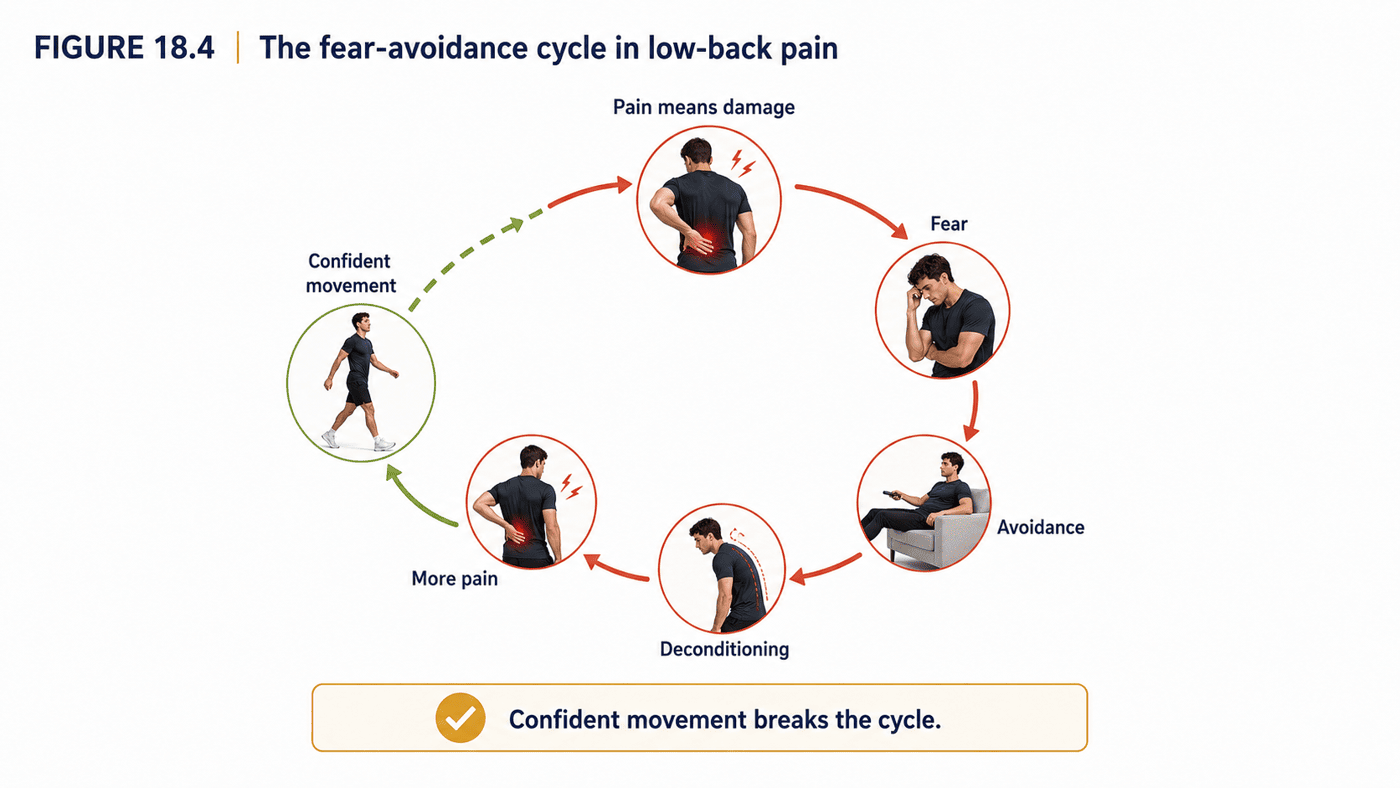
The central role of fear is best understood through the fear-avoidance cycle, one of the most important ideas in the whole of pain science, shown in Figure 18.4 (Vlaeyen & Linton, 2000). It works as follows (Moseley & Butler, 2015). Pain is experienced; the pain is interpreted as a sign of damage, provoking fear; the fear leads to avoidance of movement and activity, and to guarding and bracing; the avoidance and disuse lead, over time, to deconditioning, stiffness, weakness and heightened sensitivity; and these in turn produce more pain and reinforce the original fear. Round and round the cycle turns, each loop deepening both the disability and the conviction that the back is fragile.
The significance of this cycle is that it is largely self-perpetuating and psychological, turning even after any initial tissue irritation has settled. It explains how a benign, non-specific episode can spiral into long-term disability without any ongoing damage — driven not by the back itself but by the fear and avoidance surrounding it. And it points directly to the way out: the cycle is broken not by rest and protection, which feed it, but by confident movement and graded return to activity, which reverse it. Understanding this loop is genuinely empowering, because it reveals that much of the suffering of persistent back pain comes from a modifiable cycle rather than an immovable injury.
18.6 What It Is Usually Not
The desk-related low-back pattern is usually not the catalogue of frightening things people fear. It is usually not a sign of serious disease, not evidence that the spine is crumbling or unstable, and not a reason to fear bending, lifting or movement. Here the scan deserves the most emphatic discussion of all, because misinterpreted imaging has done immense harm in back pain. Studies repeatedly show that the ‘abnormalities’ found on back scans — disc degeneration, bulges, protrusions, and so on — are extremely common in people with no back pain whatsoever, and become more common with age as a normal part of getting older (Brinjikji et al., 2015). In one large synthesis, disc degeneration was present on imaging in the clear majority of pain-free adults by middle age. Such findings are frequently incidental — the spine’s equivalent of wrinkles — and routinely do not explain a person’s pain, which is precisely why guidelines advise against routine imaging for non-specific low-back pain.
The constructive truth could hardly be more different from the fear. The spine is one of the body’s most robust structures, built to bend, load and move; it is strengthened by use, not damaged by it; and hurt does not equal harm — the back can hurt, sometimes severely, without anything being damaged, just as a muscle aches after hard work. Bending and lifting are normal, healthy movements that a capable back is built for, not dangers to be avoided. The modern evidence-based message, distilled from the international guidelines and the Lancet low-back pain series, is consistent and reassuring: stay active, keep moving, do not fear the back, and recognise that for the common pattern, an active and confident life is both safe and the best medicine (Foster et al., 2018).
The myth of the ‘slipped disc’
Few phrases have frightened more backs than ‘slipped disc’, and few are more misleading. Discs do not slip. They are firmly attached between the vertebrae and cannot slide out of place; the term is a relic that survives only because it sounds vivid, and it conjures an entirely false image of something dislodged and unstable. What the phrase usually refers to is a disc bulge or herniation — a change in the shape of the disc in which some of its material extends beyond its normal margin. As earlier sections noted, such changes are extremely common in people with no pain at all and increase with age (Brinjikji et al., 2015).
Even where a disc herniation is genuinely associated with symptoms, the outlook is far better than the frightening language suggests. Disc herniations commonly shrink and resolve on their own over time, and the majority of associated symptoms settle with conservative management, without surgery. Understanding that nothing has ‘slipped’, that disc changes are often a normal feature of a living spine, and that even symptomatic herniations usually recover, removes a great deal of the fear that the old language instils — fear that, as this chapter has shown, can itself worsen and prolong the pain.
Flare-ups: what to do
Even in a generally improving course, low-back pain often flares — a sudden return or worsening of pain, sometimes after an awkward movement and sometimes for no obvious reason at all. These flares can be frightening, and the instinct is to fear that serious damage has been done. But a flare is usually just that: a temporary increase in a sensitised system’s symptoms, not evidence of new injury, and it typically settles as the previous episodes did.
The constructive response to a flare follows the whole logic of this chapter. Stay as calm as the pain allows, since panic and fear amplify it; keep moving gently rather than retreating to bed, as prolonged rest worsens and prolongs back pain; use simple measures for comfort in the early days; and hold onto the understanding that a flare is a flare, not a catastrophe, and that it will most likely settle as before. If, however, a flare is accompanied by any of the red flags in section 18.7 — especially the emergency features — that is a different matter and warrants prompt assessment. For the ordinary flare, calm, movement and patience are the watchwords.
18.7 Red Flags: When to Seek Professional Help
The strong reassurance of this chapter applies to the common, non-specific pattern — not to the warning signs below, which identify the minority of cases needing prompt or urgent attention. Knowing these red flags is what makes confident self-management of ordinary back pain safe. Anyone with these features should seek assessment from a qualified healthcare professional, and certain ones are medical emergencies. The list is a guide, not a substitute for professional judgement; see Appendix C.
Seek urgent medical care if low-back pain is accompanied by any of the following, which can indicate a serious problem affecting the nerves at the base of the spine (cauda equina syndrome): difficulty passing or controlling urine, loss of bowel control or new incontinence, numbness or altered sensation around the saddle area (the buttocks, genitals and inner thighs), or numbness or weakness affecting both legs. These require emergency assessment without delay. Seek prompt (if not emergency) professional assessment for: back pain following significant trauma such as a fall or accident; progressive or severe leg weakness or numbness; fever, unexplained weight loss, or a history of cancer; pain that is severe, steadily worsening, constant and unremitting, or markedly worse at night; first onset of significant back pain at an older age; or pain accompanied by a general feeling of being unwell. These features fall outside the ordinary pattern and need proper evaluation.
18.8 The Management Approach
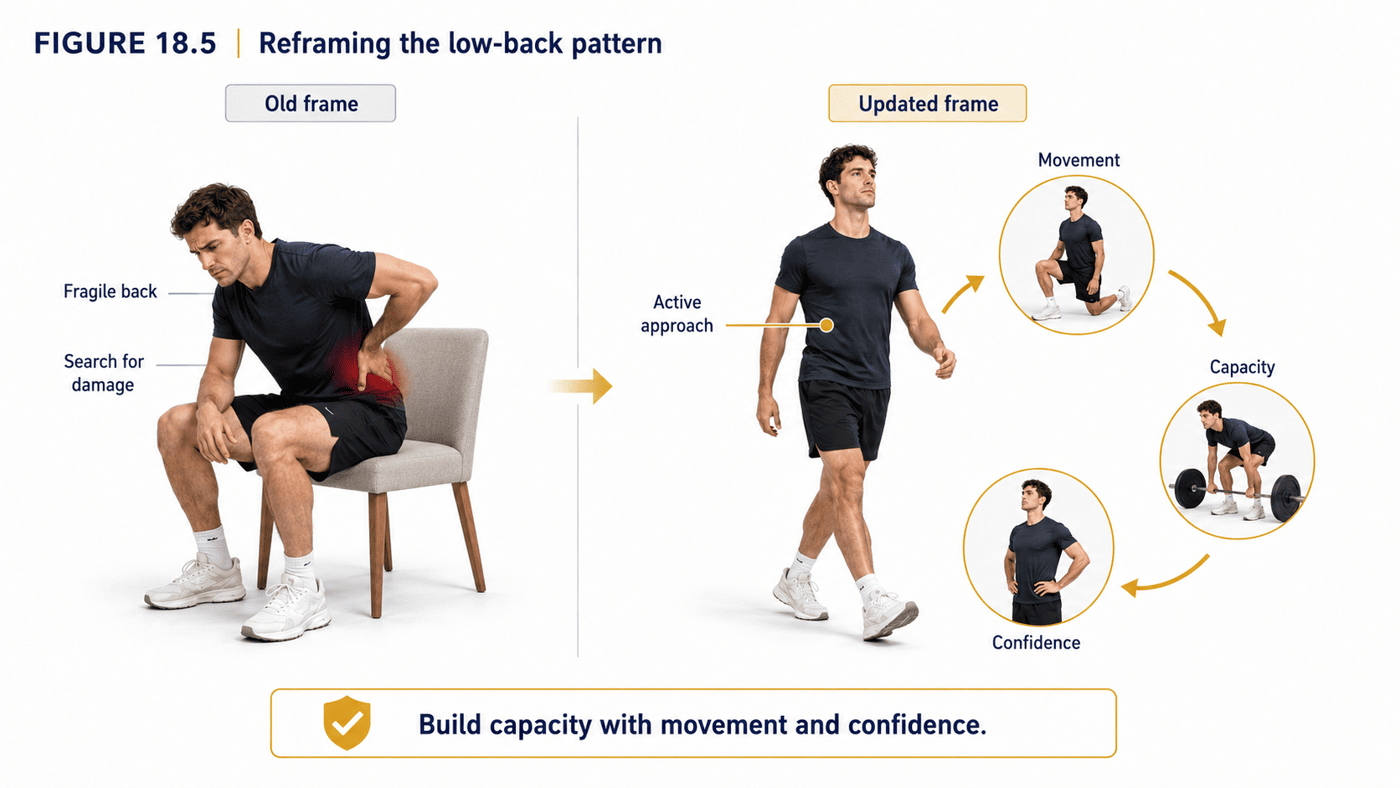
Management follows directly from the pattern’s nature as a multifactorial, non-specific, fear-amplified problem in a robust spine. Figure 18.5 captures the essential shift: from a fragile back to be protected and a search for damage, to a strong, capable back rebuilt through active, confident living. The strands draw together the whole book.
The first and most important is to stay active and keep moving. Against the old advice to rest, the modern evidence is unambiguous: prolonged rest worsens back pain, while staying active, continuing ordinary activities as far as pain allows, and returning to movement promptly speed recovery and prevent persistence (Foster et al., 2018). The second is to break the fear-avoidance cycle through accurate, reassuring understanding — to grasp that hurt does not equal harm, that the back is robust, and that movement is safe — since this understanding is itself among the most powerful treatments. The third is to address the mechanical contributors by breaking up sustained sitting (Chapter 15), restoring hip mobility (Chapter 10), reawakening the glutes (Chapter 11) and rebuilding the back’s capacity through graded loading and exercise, which the evidence supports for both treatment and prevention (Steffens et al., 2016). The fourth is to address the non-mechanical contributors — stress, sleep and mood — which loom especially large in the back. As ever, no single strand is the whole answer; together, and applied with confidence rather than fear, they are highly effective.
When back pain persists
Most episodes of low-back pain improve, but a minority become persistent, and persistent back pain is where the biopsychosocial understanding matters most. Long-standing pain is rarely a sign of ongoing damage; far more often it reflects a sensitised nervous system and an entrenched fear-avoidance cycle, in which the psychological and social factors — fear, low mood, poor sleep, stress, the meaning the pain has acquired — have come to dominate. This does not mean the pain is imagined; it is entirely real. It means that the path out lies less in searching the tissues for a fault than in graded movement, rebuilding confidence and capacity, and addressing those wider factors, ideally with the guidance of a qualified professional skilled in modern, active approaches (O’Sullivan et al., 2018). Persistence calls for tailored, confident help — not greater fear, more scans, or more rest.
The pattern in a working life
A common example shows how the pieces fit, and how the wrong response can make a benign problem worse. A data analyst in her forties had episodes of low-back ache every few months, usually settling within a week or two. After one episode she was sent for a scan, which reported ‘degeneration’ and a ‘disc bulge’. Alarmed by the words, she concluded her back was damaged and fragile, stopped the exercise she had previously enjoyed, began to move cautiously and to avoid bending, and braced herself against further harm. Over the following months her pain became more frequent and more limiting, not less.
Her decline was a textbook fear-avoidance spiral, driven not by her back but by her beliefs about it. The scan findings were almost certainly incidental — the same degeneration and bulges seen in countless pain-free people her age — and her back was robust, not fragile. Helped to understand this, she reversed course: she resumed activity and exercise, learned that hurt did not equal harm, restored her hip mobility and reawakened her glutes, and rebuilt her back’s capacity through graded loading. As her confidence returned and her conditioning improved, her back pain receded to the occasional, manageable episode it had been before — a powerful illustration that, for the common pattern, understanding and activity are the treatment, and fear and rest the trap.
Strength, not just stretch
A common misconception about the desk back is that the answer lies chiefly in stretching — in loosening tight muscles until the pain releases. Stretching and mobility have their place, particularly for the stiff hips that funnel load onto the back; but the more powerful and more neglected half of the answer is strength. A back and trunk conditioned by appropriate loading — strong glutes, a capable trunk, a posterior chain accustomed to work — raises the capacity of the whole system to meet the demands of sitting, lifting and living, so that those demands fall comfortably within its reserve rather than exceeding it.
This reframes the goal from a loose back to a capable one. The evidence that exercise helps prevent and manage back pain rests substantially on this capacity-building effect, and the most strongly supported preventive measure is exercise rather than any passive treatment (Steffens et al., 2016). Crucially, this means the back is not a fragile thing to be protected from load, but a robust system that load makes stronger — the precise opposite of the rest-and-protect instinct that fear instils. Building strength, gradually and confidently, is among the most effective things a person can do for the desk back.
Confidence as treatment
A final point underlies everything in this chapter, and it is perhaps the most important of all: confidence itself is part of the treatment. The modern, evidence-based approaches to low-back pain place the restoration of confidence — the patient understanding that the back is robust, that movement is safe, and that hurt does not equal harm — at the centre of management, not at its margins (Foster et al., 2018; O’Sullivan et al., 2018). This is not because the pain is imaginary or a matter of mere positive thinking; it is because fear and avoidance are themselves powerful drivers of pain and disability, so that reducing them has real, measurable effects on how a person recovers and lives.
This is genuinely good news, because confidence is something that can be rebuilt. Each time a person moves, bends or lifts without the feared catastrophe, the conviction that the back is fragile is gently disproved, and the fear-avoidance cycle loosens its grip. Understanding, in this sense, is not a preliminary to treatment but a part of it — which is why a chapter that replaces fear with accurate, reassuring knowledge is doing something therapeutic, and why the calm confidence to live actively is, for the common pattern, among the most effective medicines there is.
| Common belief | What the evidence shows |
|---|---|
| ‘My back is fragile and damaged’ | Most back pain is non-specific; the spine is robust and built to load (Hartvigsen et al., 2018). |
| ‘The scan explains my pain’ | Degeneration and bulges are common in pain-free people and rise with age (Brinjikji et al., 2015). |
| ‘I should rest until it settles’ | Rest worsens it; staying active speeds recovery and prevents persistence (Foster et al., 2018). |
| ‘Bending and lifting are dangerous’ | They are normal movements a capable back is built for; hurt does not equal harm. |
| ‘It is purely a mechanical fault’ | Beliefs, stress, mood and sleep are central, especially in persistence (Vlaeyen & Linton, 2000). |
Table 18.1. Common beliefs about low-back pain set against the evidence. Educational only — not a substitute for individual assessment.
In summary
- Low-back pain is the world’s leading cause of disability and deeply misunderstood; this chapter describes the common pattern to inform and reassure, not to diagnose.
- The great majority is non-specific — not attributable to serious disease or structural damage — with a generally favourable outlook (Maher et al., 2017).
- Mechanical contributors (sustained flexion, hip stiffness, idle glutes, deconditioning) funnel load onto the back together; there is rarely one fault (Hartvigsen et al., 2018).
- Non-mechanical factors are central — especially the fear that pain means damage, which drives the self-perpetuating fear-avoidance cycle (Vlaeyen & Linton, 2000).
- It is usually not damage: scan ‘abnormalities’ are common in pain-free people and rise with age, and hurt does not equal harm (Brinjikji et al., 2015).
- Red flags — bladder/bowel or saddle/both-leg symptoms (emergency), trauma, progressive weakness, systemic features, severe unremitting night pain — mark the minority needing care (Appendix C).
- Management keeps people active, breaks the fear cycle with reassurance, addresses the mechanics and capacity, and tends to stress and sleep — an active, confident answer (Foster et al., 2018).
References
Brinjikji, W., Luetmer, P. H., Comstock, B., Bresnahan, B. W., Chen, L. E., Deyo, R. A., … Jarvik, J. G. (2015). Systematic literature review of imaging features of spinal degeneration in asymptomatic populations. American Journal of Neuroradiology, 36(4), 811–816.
Foster, N. E., Anema, J. R., Cherkin, D., Chou, R., Cohen, S. P., Gross, D. P., … Buchbinder, R. (2018). Prevention and treatment of low back pain: Evidence, challenges, and promising directions. The Lancet, 391(10137), 2368–2383.
Hartvigsen, J., Hancock, M. J., Kongsted, A., Louw, Q., Ferreira, M. L., Genevay, S., … Woolf, A. (2018). What low back pain is and why we need to pay attention. The Lancet, 391(10137), 2356–2367.
Maher, C., Underwood, M., & Buchbinder, R. (2017). Non-specific low back pain. The Lancet, 389(10070), 736–747.
Moseley, G. L., & Butler, D. S. (2015). Fifteen years of explaining pain: The past, present, and future. The Journal of Pain, 16(9), 807–813.
O’Sullivan, P. B., Caneiro, J. P., O’Keeffe, M., Smith, A., Dankaerts, W., Fersum, K., & O’Sullivan, K. (2018). Cognitive functional therapy: An integrated behavioral approach for the targeted management of disabling low back pain. Physical Therapy, 98(5), 408–423.
Steffens, D., Maher, C. G., Pereira, L. S. M., Stevens, M. L., Oliveira, V. C., Chapple, M., … Hancock, M. J. (2016). Prevention of low back pain: A systematic review and meta-analysis. JAMA Internal Medicine, 176(2), 199–208.
Vlaeyen, J. W. S., & Linton, S. J. (2000). Fear-avoidance and its consequences in chronic musculoskeletal pain: A state of the art. Pain, 85(3), 317–332.