Part VI · DESK BODY PAIN PATTERNS
Shoulder and Upper-Back Pain Pattern
The tight, tired upper back and aching shoulders are a close companion of the desk neck. This chapter assembles the pattern from the rounded-shoulder and stiff-thorax mechanics of earlier chapters, separates what it usually is from what it is feared to be, sets out the warning signs, and points toward restoring a robust upper quarter. It describes a common pattern — it does not diagnose the reader.
17.1 The Pattern
Close behind the aching neck, and often accompanying it, comes the second great discomfort of the desk body: a tired, tight, aching sensation across the shoulders and upper back. It is the feeling of shoulders that have been held forward and a thorax that has been held still for too long — a heaviness between the shoulder blades, a burning tightness across the tops of the shoulders, a longing to roll the shoulders back and open the chest. For the desk worker it is among the most familiar of all bodily complaints.
This chapter assembles the pattern from the mechanics of Chapter 5, on shoulder rounding, and Chapter 9, on the rib cage and thoracic spine, into a coherent picture. As in the previous chapter, two framing points govern what follows. First, this is an educational account of a common pattern and not a diagnosis of any individual; the shoulder in particular is a complex region in which many specific conditions are possible, and only proper assessment can establish what is happening in a given person. Second, the ordinary desk-related upper-back pattern is usually a benign matter of sustained posture and under-used muscles rather than a damaged structure, and it responds well to the active approach this chapter describes — with the important exception of the warning signs set out later.
17.2 The Typical Presentation
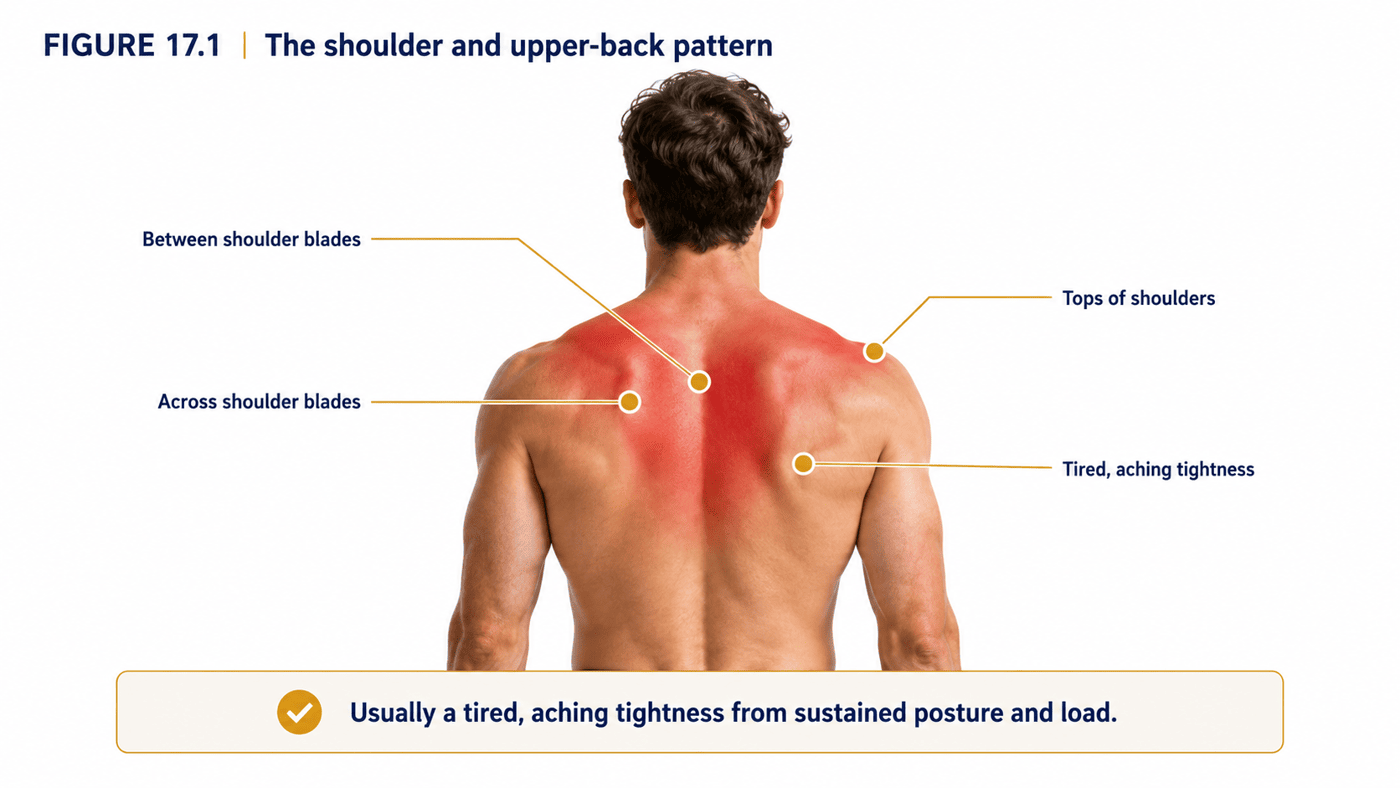
The pattern has a recognisable distribution, shown in Figure 17.1. It is felt most often between and across the shoulder blades — a deep, aching tiredness in the muscles of the upper back — and across the tops of the shoulders in the upper trapezius, frequently overlapping with the neck pattern of the previous chapter. Some people also feel it toward the front of the shoulder. The quality is typically an ache, a tightness or a sense of fatigue rather than a sharp pain, and it characteristically builds through a long period at the desk and eases with movement, a change of posture, or the simple act of rolling the shoulders and opening the chest.
As with the neck, this temporal signature is informative. A discomfort that accumulates with sustained desk posture and dissolves with movement is behaving as a fatigued, loaded, under-varied system behaves, not as an injury would. The upper back is reporting that it has been held in one position, with certain muscles working statically and others idle, for too long — a description of sustained load, not of damage.
17.3 The Mechanical Contributors
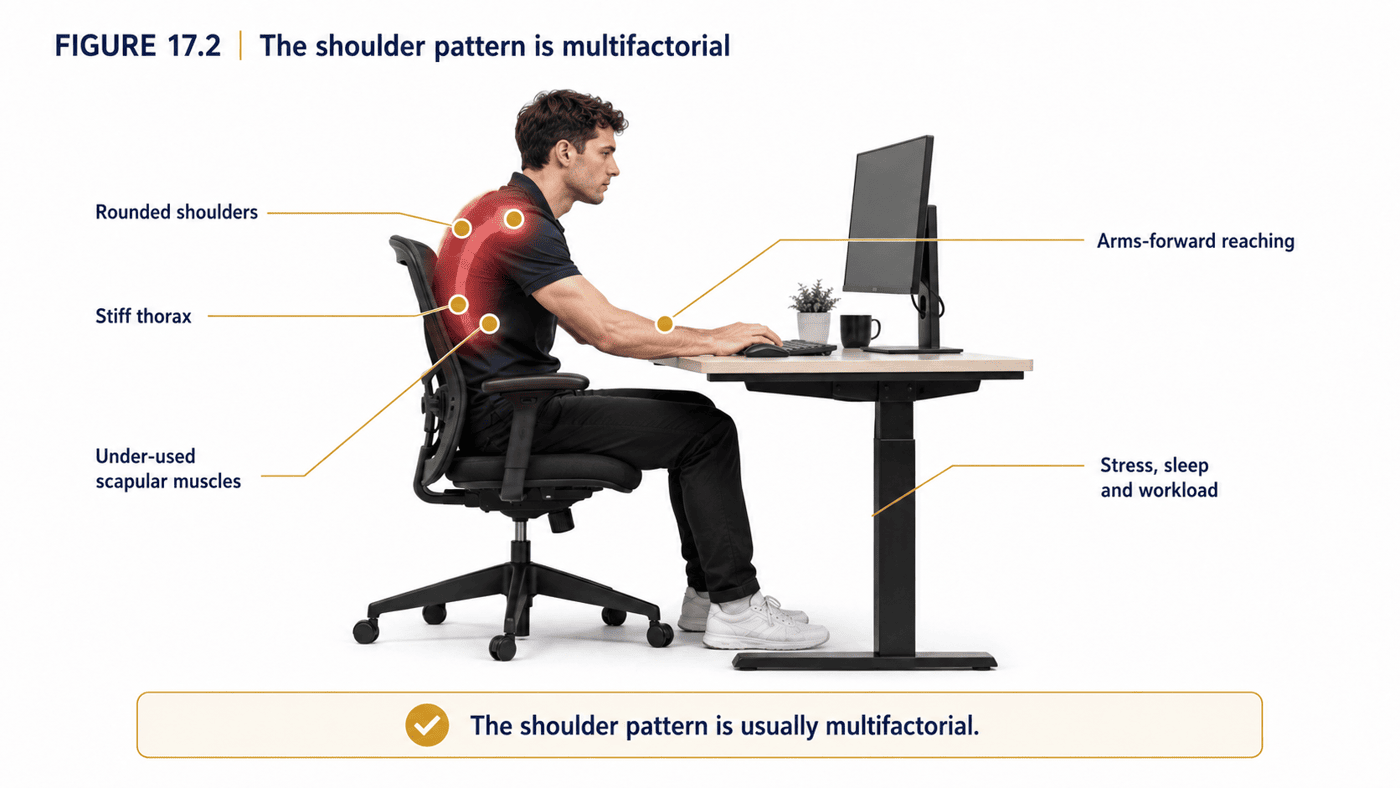
The mechanical contributors to this pattern were developed in earlier chapters, and Figure 17.2 sets them beside the non-mechanical factors. The central one is the rounded-shoulder posture of Chapter 5: the arms-forward position of desk work draws the shoulders forward and the shoulder blades into a tilted, protracted position, in which the muscles that should anchor them — the lower trapezius and the muscles between the shoulder blades — are held lengthened and under-used, while others work statically to hold the arms forward. Over a long day this imbalance of sustained work and under-use produces the characteristic ache.
Compounding this is the stiff, flexed thorax of Chapter 9. The shoulder blade does not float free; it sits on the back of the rib cage and depends on a mobile thoracic spine to position it well. When the thorax is held rounded and stiff, the shoulder blade is tipped forward and its mechanics are compromised, adding to the load on the upper-back muscles. The sustained, static nature of the whole posture — the arms held forward, the thorax held still — matters as much as its shape, in keeping with the book’s recurring theme that duration, not just position, is the difficulty.
17.4 The Non-Mechanical Contributors
As with the neck, the upper back is strongly influenced by non-mechanical factors, and they must not be overlooked. The shoulders are, with the neck, the body’s principal site for the physical expression of psychological stress: tension, anxiety and pressure are felt as a bracing and tightening across the shoulders and upper back, independent of any posture. The very language of ‘shouldering a burden’ and ‘carrying weight on the shoulders’ reflects a genuine physiological tendency for stress to settle here.
Sustained workplace stress and a heavy workload therefore feed this pattern directly, as does the static bracing that accompanies concentration and time pressure. Poor sleep lowers the threshold at which the tissues complain and slows recovery, and beliefs again matter: worry that the shoulder is damaged promotes guarding and avoidance that tend to worsen the discomfort. A purely mechanical approach that corrects posture while ignoring stress, sleep and belief addresses only part of the pattern, and often not the largest part.
17.5 The Mechanism in Focus
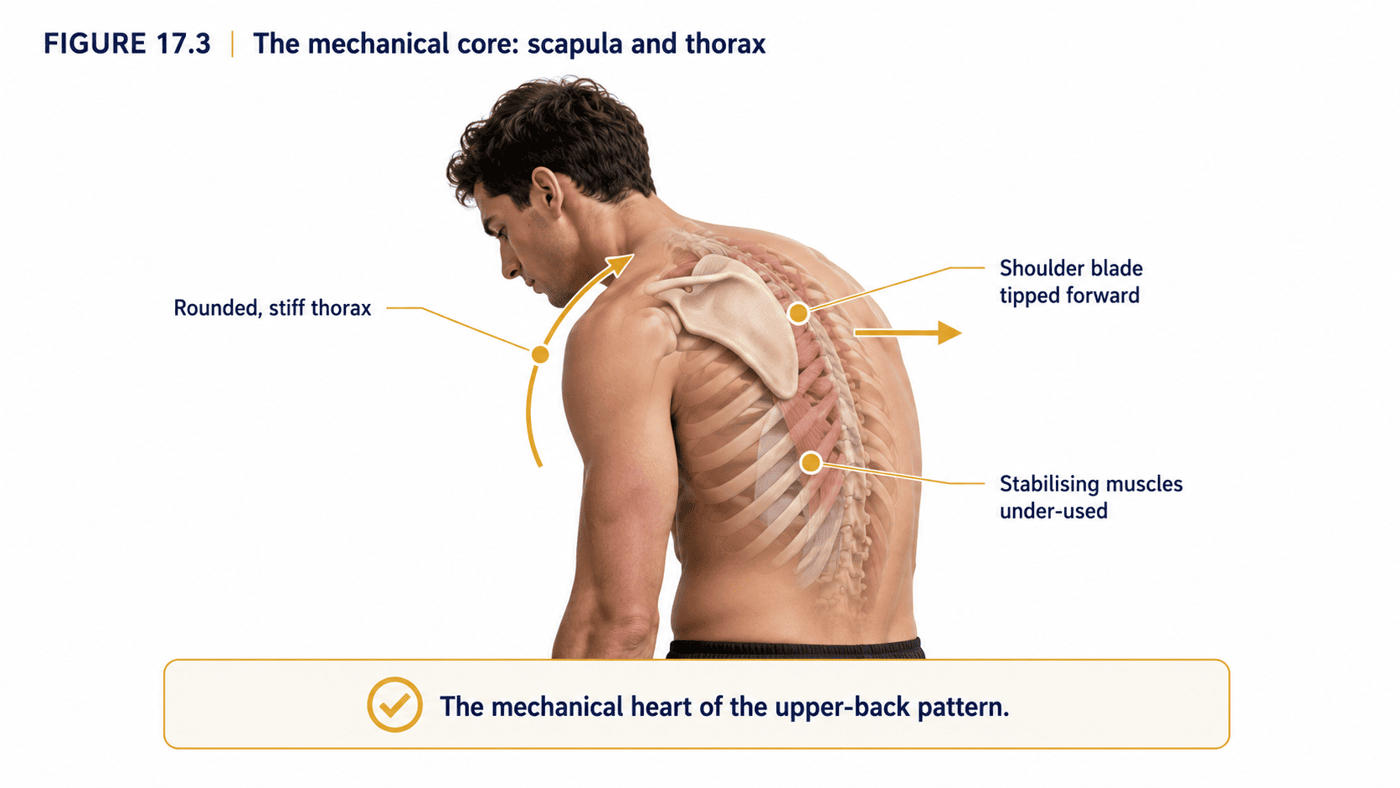
At the mechanical heart of the pattern lies the position of the shoulder blade on the rib cage, and Figure 17.3 contrasts the balanced and the rounded arrangement. On an open, mobile thorax the shoulder blade sits back and flat, well positioned for its muscles to work efficiently and for the shoulder to move freely. On a rounded, stiff thorax — the sustained posture of desk work — the blade is tipped and drawn forward, its stabilising muscles lengthened and under-used, the whole arrangement held statically for hours. This altered position and the muscular imbalance it entails are the mechanical core of the pattern (Ludewig & Cook, 2000; Cools et al., 2007).
Understanding this mechanism clarifies the management. The remedy is not to protect a supposedly damaged shoulder but to restore the position and function of the shoulder blade and the mobility of the thorax: to mobilise the stiff thoracic spine, to reawaken and strengthen the under-used muscles between and below the shoulder blades, and to break up the sustained arms-forward holding. The pattern is one of altered posture, under-use and sustained load — and each of those is reversible.
17.6 What It Is Usually Not
The desk-related upper-back pattern is usually not the damaged structure people fear. Aching between the shoulder blades is very rarely a sign of serious disease, and the tightness across the shoulders is a matter of muscular fatigue and posture, not injury. As with the neck, scans are a particular source of unnecessary alarm: imaging of the shoulder reveals features such as rotator-cuff changes and degeneration in large numbers of people who have no shoulder pain at all, with the prevalence rising steadily with age (Sher et al., 1995). Such findings frequently do not explain a person’s symptoms and should not be assumed to be their cause (Lewis, 2016).
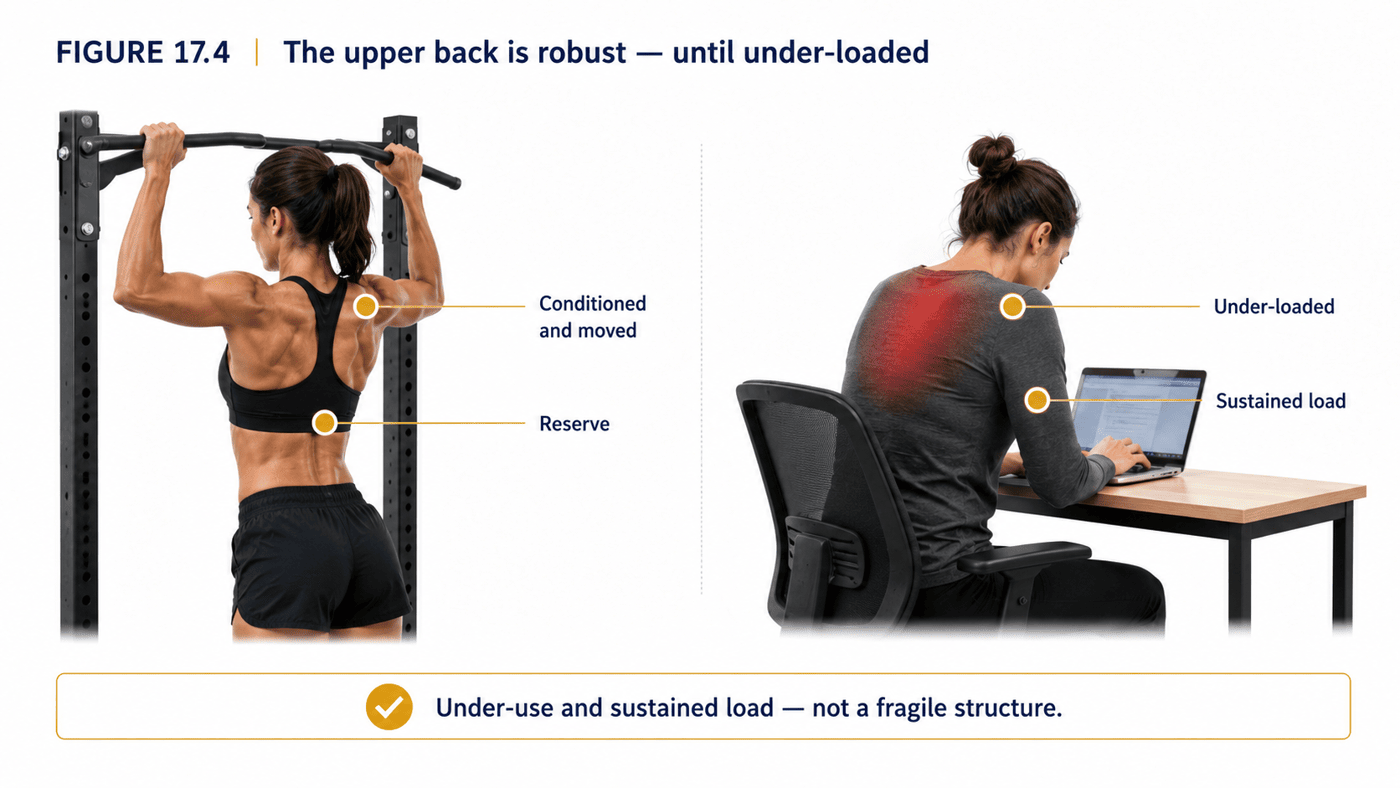
The constructive truth, set against the fear, is that the shoulder and upper back are robust and adaptable. The tendons and muscles respond to load by getting stronger, not weaker, when loaded appropriately (Cook & Purdam, 2009), and the common pattern reflects under-use and sustained posture rather than fragility. Indeed, much of what is felt as a ‘weak’ or ‘damaged’ shoulder is in truth a deconditioned one — an upper quarter that has lost capacity through disuse, as Figure 17.4 illustrates, and that regains it through movement and loading. Lederman (2011) influentially questioned the assumption that postural and muscular imbalances are a structural cause of pain, and the modern view treats this pattern as a modifiable, capacity-related problem rather than a fixed fault. Hurt does not equal harm here any more than at the neck.
The overhead test of a healthy shoulder
A simple, reassuring observation often helps people with this pattern: the ability to raise the arms freely overhead. A shoulder that can reach comfortably overhead, with the arms rising easily beside the head, is demonstrating a great deal of healthy function — mobility, coordination and the cooperation of the shoulder blade and the arm. The aching tightness of the desk pattern rarely takes this away, and discovering that the movement is still there, and still comfortable, is itself reassuring evidence that the shoulder is working, not failing.
This movement also reveals the thorax’s contribution, the theme of Chapter 9. Reaching fully overhead requires the upper back to extend; a stiff, rounded thorax quietly limits the reach and throws more demand onto the shoulder itself. Restoring thoracic mobility, accordingly, often frees the overhead movement and eases the shoulder at once — a reminder that the upper back and the shoulder are one system, and that confident use of the arm overhead is to be encouraged rather than feared.
Why it travels with the neck
The shoulder and upper-back pattern rarely arrives alone; far more often it travels in company with the neck pattern of the previous chapter, and the reason is mechanical. The two regions share muscles — the upper trapezius spans both neck and shoulder — share the same forward-head, rounded-shoulder posture, and share the same tendency to hold the tension of stress. A sustained desk posture loads neck and upper back together, and the stress that tightens one tightens the other.
The practical lesson is that the two are best addressed together rather than separately. The measures that help the neck — raising the screen, breaking up sustained posture, easing the rounded shoulders, managing stress — help the upper back as well, and the thoracic mobility and upper-back strengthening that help the shoulder also support the neck. Treating the upper quarter as a single connected region, rather than chasing the neck and the shoulder as separate problems, is both more accurate and more effective.
17.7 Red Flags: When to Seek Professional Help
The reassurance above applies to the ordinary desk pattern, not to the warning signs below. Because the shoulder region can occasionally signal something needing prompt attention — including problems referred from elsewhere — it is important to recognise the features that fall outside the common pattern. Anyone with these should seek assessment from a qualified healthcare professional, and certain ones warrant urgent care. The list is a guide, not a replacement for professional judgement; see Appendix C.
Seek prompt professional assessment if shoulder or upper-back symptoms include any of the following: pain following significant trauma, especially with visible deformity, or a sudden inability to lift or use the arm (which may indicate a fracture, dislocation or major tendon tear); signs of infection such as a red, hot, swollen joint with fever or feeling unwell; a new, unexplained lump or swelling; spreading numbness, pins and needles or weakness down the arm; or systemic features such as unexplained weight loss or a history of cancer. Crucially, because pain over the shoulder and upper back can be referred from internal organs, any chest pain, pressure or tightness, breathlessness, sweating or nausea — especially if brought on by exertion — should be treated as a potential medical emergency and prompt immediate help, as it may arise from the heart rather than the shoulder. These features need proper evaluation rather than self-management.
17.8 The Management Approach
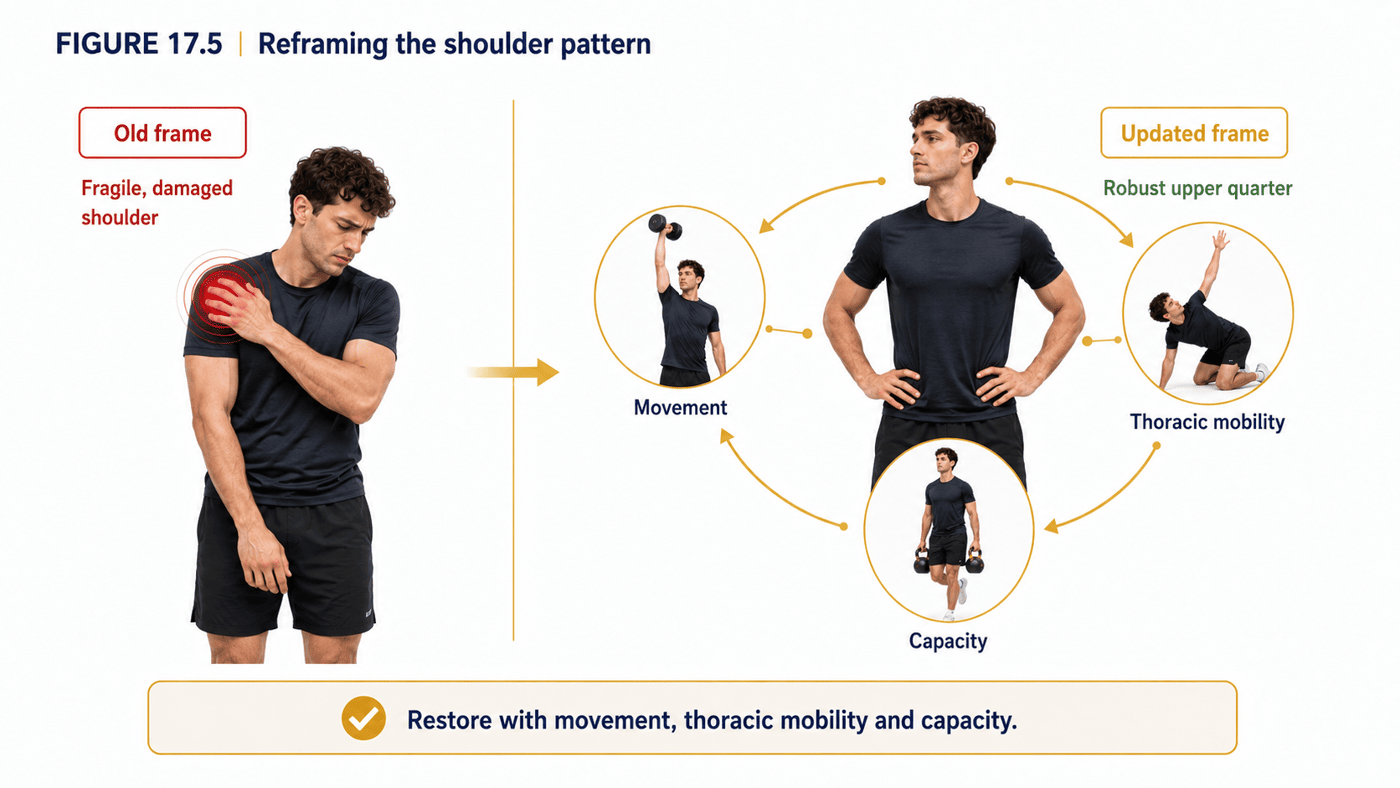
Management follows from the pattern’s nature as one of altered posture, under-use and sustained load in a robust region. Figure 17.5 captures the shift in approach: from a fragile, damaged shoulder to be protected, to a robust upper quarter to be mobilised and trained. The strands of management draw on the principles built across the book.
The first is to restore thoracic mobility: the stiff, flexed thorax of Chapter 9 underlies much of the pattern, and gentle thoracic extension and rotation free the base on which the shoulder blade sits. The second is to reawaken and strengthen the under-used muscles between and below the shoulder blades, building the capacity of the upper back to hold good position and meet demand with reserve. The third is to break up the sustained posture with frequent movement and position changes — the microbreaks of Chapter 15 — and to ease the arms-forward, rounded posture through the workstation adjustments of Chapter 13. The fourth, again, is to address the non-mechanical contributors: to manage stress and the bracing it produces, protect sleep, and replace fearful beliefs with the accurate understanding that the shoulder is robust. As with the neck, the management is multifactorial because the pattern is, and the strands reinforce one another.
On ‘posture’ and the limits of correction
A word of balance is needed on posture, because this pattern is so often blamed entirely on ‘bad posture’ and treated as though a single correct alignment would cure it. The position of the shoulders does matter, and easing a sustained rounded posture genuinely helps — but, as Chapter 3 argued and Lederman (2011) influentially set out, the link between any particular posture and pain is far weaker and more variable than popular belief assumes. There is no single perfect shoulder posture to be achieved and held; people with markedly rounded shoulders are often pain-free, and rigidly holding a ‘correct’ posture merely substitutes one sustained position for another. The more accurate target is not a fixed ideal alignment but a mobile, strong, frequently-varied upper quarter — one that can move into and out of many positions with ease, rather than one frozen into the posture of the month.
The pattern in a working life
A common example illustrates the pattern and its management. A graphic designer in his thirties developed a burning, aching tightness between his shoulder blades that built through the afternoon, worst when he was absorbed in detailed work hunched over a laptop. He felt an urge to roll his shoulders and crack his upper back for relief, and had started to fear that something between his shoulder blades was ‘out of place’ or being damaged.
Nothing was out of place. His upper back was held rounded and still for hours, the muscles between his shoulder blades lengthened and under-used while he held his arms forward over the laptop — a textbook instance of this chapter’s pattern. The response addressed the system rather than hunting for a damaged part: he raised his screen and added a separate keyboard to open out the rounded posture, introduced gentle thoracic extension and rotation to free the stiff upper back, began simple strengthening for the under-used muscles between the shoulder blades, and broke up his long absorbed stretches with brief movement. The burning tightness eased over several weeks into an occasional, manageable sensation — a pattern of posture, under-use and sustained load, reversed by mobility, strength and movement.
The cost of the static hold
It is worth dwelling on why sustained, static holding tires the upper back so much more than movement does, because it explains the pattern’s character and points to its remedy. When a muscle contracts and relaxes rhythmically, as in movement, blood flows through it freely, delivering oxygen and clearing the by-products of effort. But when a muscle is held in a sustained, low-level contraction — as the upper-back and shoulder muscles are when the arms are held forward and still for hours — the constant tension impedes that blood flow, so that the same low-level effort, prolonged, becomes far more fatiguing and irritating than its modest size suggests.
This is the deep reason that duration, not just posture, is the problem, and that movement is the antidote. It is not the magnitude of the load that wears the upper back — the forces are small — but its unrelenting, static, uninterrupted nature. Breaking up the static hold with movement, even briefly and often, restores the blood flow and relieves the muscles in a way that no amount of ‘better posture’ held equally still ever could. The remedy for a static problem is movement, which is why the microbreaks of Chapter 15 matter as much here as anywhere.
| Common worry | What the evidence suggests |
|---|---|
| ‘Something in my shoulder is torn’ | The common pattern is muscular fatigue and posture, not a tear; cuff changes are common painlessly (Sher et al., 1995). |
| ‘My posture has damaged my back’ | The posture-pain link is weaker than assumed; this pattern is modifiable (Lederman, 2011). |
| ‘I should rest the shoulder’ | Appropriate movement and loading build capacity; guarding tends to worsen it. |
| ‘I must hold perfect posture’ | A mobile, varied, strong upper quarter matters more than one fixed alignment. |
| ‘It is purely mechanical’ | Stress and the bracing it brings are powerful contributors (Moseley & Butler, 2015). |
Table 17.1. Common worries about the desk shoulder set against the evidence. Educational only — not a substitute for assessment.
In summary
- The tired, tight upper back and aching shoulders are a close companion of the desk neck; this chapter describes the pattern to inform and reassure, not to diagnose.
- It is typically felt between and across the shoulder blades and the tops of the shoulders, building with sustained desk posture and easing with movement.
- Its mechanical core is the rounded shoulder and tipped scapula on a stiff, flexed thorax, with under-used stabilising muscles (Ludewig & Cook, 2000; Cools et al., 2007).
- Stress and the bracing it produces, poor sleep and fearful beliefs are powerful non-mechanical contributors that often dominate.
- It is usually not damage: cuff and degenerative changes are common in pain-free shoulders and rise with age, and much of the pattern is deconditioning, not fragility (Sher et al., 1995; Lederman, 2011).
- Red flags — trauma with deformity or sudden weakness, infection, a new lump, spreading arm symptoms, and especially chest pain or breathlessness suggesting the heart — warrant prompt or emergency care (Appendix C).
- Management restores thoracic mobility, strengthens the upper back, breaks up sustained posture and addresses stress — a multifactorial answer to a multifactorial pattern.
References
Cook, J. L., & Purdam, C. R. (2009). Is tendon pathology a continuum? A pathology model to explain the clinical presentation of load-induced tendinopathy. British Journal of Sports Medicine, 43(6), 409–416.
Cools, A. M., Witvrouw, E. E., Declercq, G. A., Vanderstraeten, G. G., & Cambier, D. C. (2007). Scapular muscle recruitment patterns: Trapezius muscle latency in overhead athletes with and without impingement symptoms. The American Journal of Sports Medicine, 31(4), 542–549.
Kibler, W. B., & Sciascia, A. (2010). Current concepts: Scapular dyskinesis. British Journal of Sports Medicine, 44(5), 300–305.
Lederman, E. (2011). The fall of the postural–structural–biomechanical model in manual and physical therapies: Exemplified by lower back pain. Journal of Bodywork and Movement Therapies, 15(2), 131–138.
Lewis, J. (2016). Rotator cuff related shoulder pain: Assessment, management and uncertainties. Manual Therapy, 23, 57–68.
Ludewig, P. M., & Cook, T. M. (2000). Alterations in shoulder kinematics and associated muscle activity in people with symptoms of shoulder impingement. Physical Therapy, 80(3), 276–291.
Moseley, G. L., & Butler, D. S. (2015). Fifteen years of explaining pain: The past, present, and future. The Journal of Pain, 16(9), 807–813.
Sher, J. S., Uribe, J. W., Posada, A., Murphy, B. J., & Zlatkin, M. B. (1995). Abnormal findings on magnetic resonance images of asymptomatic shoulders. The Journal of Bone and Joint Surgery, 77(1), 10–15.