Part VI · DESK BODY PAIN PATTERNS
Neck Pain Pattern
The aching, stiff neck is the desk body’s most familiar complaint. This chapter assembles its mechanics into a recognisable pattern, explains the mechanical and non-mechanical factors that feed it, reassures where reassurance is due, sets out the warning signs that warrant professional help, and points toward confident management. It describes a common pattern — it does not diagnose the reader.
16.1 The Pattern
Of all the discomforts of desk work, neck pain is the most common and the most characteristic (Hartvigsen et al., 2018). Neck pain is among the leading causes of disability worldwide, and it is especially prevalent among office and computer workers (Hogg-Johnson et al., 2008). For many desk workers it is a familiar companion: a dull ache and stiffness across the back of the neck and the tops of the shoulders that builds through the working day, eases at the weekend, and returns each Monday — a pattern so common as to seem almost a normal feature of the working life.
This chapter brings together the mechanics developed earlier in the book — particularly the screen-neck relationship of Chapter 4 and the shoulder posture of Chapter 5 — into a coherent picture of why this pattern arises, what it usually is and is not, and how to manage it. Before going further, two framing points must be stated plainly, because they govern everything that follows. First, this is an educational account of a common pattern, not a diagnosis: the same symptom can have many causes, and only an individual assessment by a qualified professional can establish what is happening in a particular person. Second, and reassuringly, the great majority of desk-related neck pain is what clinicians call non-specific — it is not a sign of serious disease or structural damage, and it tends to settle. The warning signs that call for professional attention are set out clearly later in the chapter; within those bounds, the aim here is to replace anxiety with understanding.
16.2 The Typical Presentation
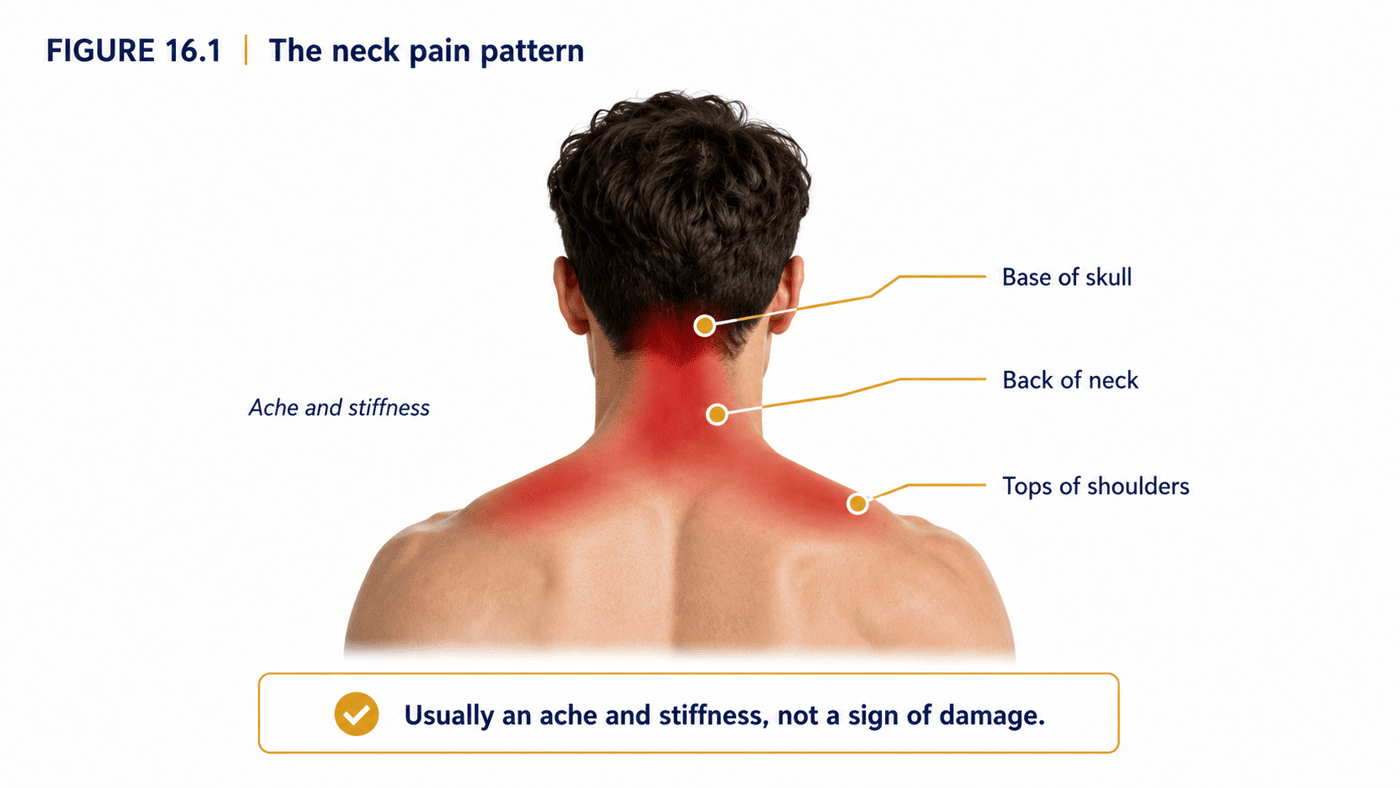
The desk-related neck pattern has a recognisable shape. It is usually felt across the back of the neck, often spreading to the base of the skull and outward to the tops of the shoulders and the upper trapezius muscles, as Figure 16.1 shows. The quality is typically a dull ache, a tightness or a stiffness rather than a sharp or shooting pain, and it is commonly accompanied by a sense of tension in the muscles and a reluctance to turn the head fully. Movement may feel stiff, particularly after a long period held still, and the neck often feels worse at the end of a long day at the screen and better after rest, sleep or a change of activity.
This temporal pattern — worse with sustained desk posture, better with movement and rest — is itself informative, because it points away from a fixed structural fault and toward the sustained-load mechanism this book has described throughout. A neck that aches after hours of stillness and eases when one moves is behaving exactly as a loaded, fatigued system behaves, not as a damaged structure would. The pattern is the body reporting sustained load, not announcing injury.
16.3 The Mechanical Contributors
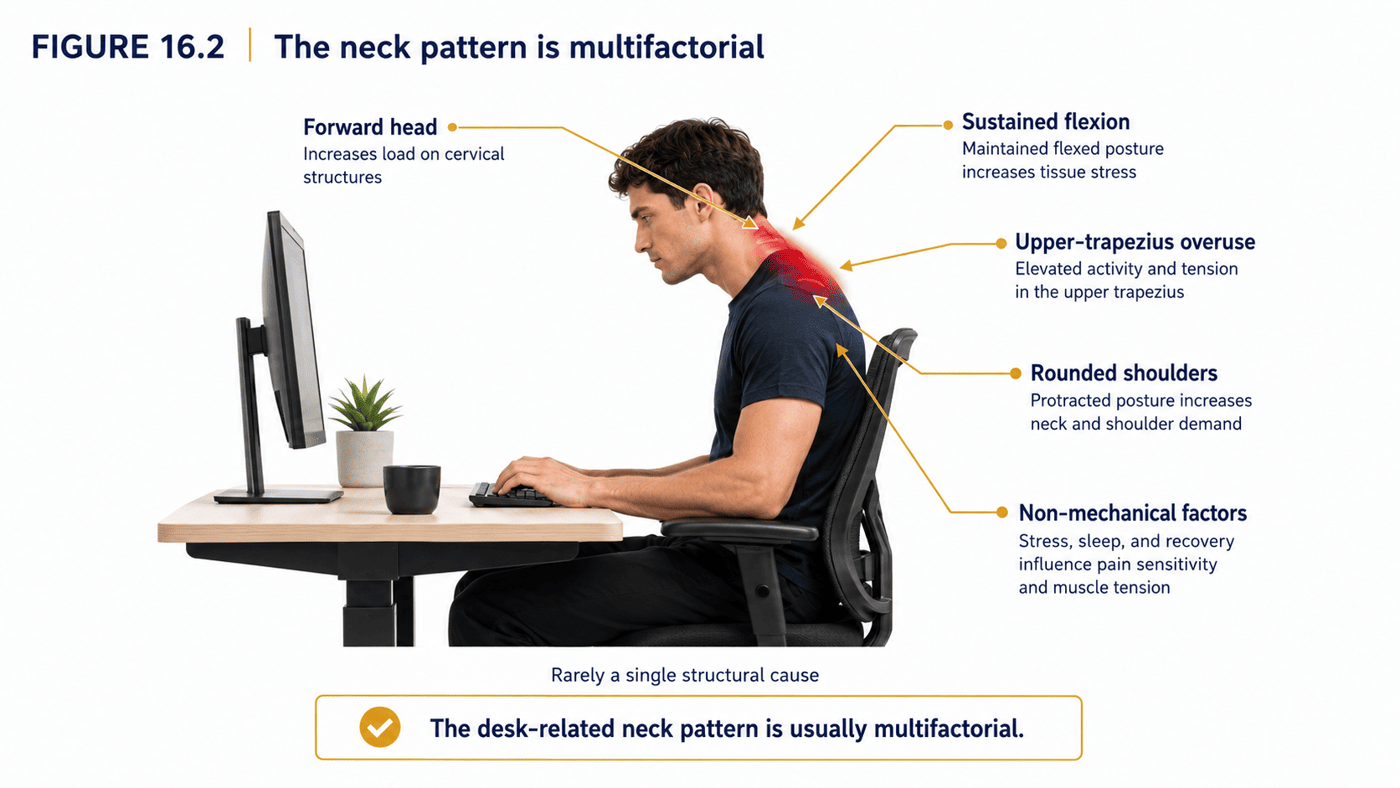
Several of the mechanical factors examined earlier in this book converge on the neck, and Figure 16.2 sets them alongside the non-mechanical factors considered next. The central mechanical contributor is the sustained forward-head posture that a low screen or a hand-held device encourages, examined in detail in Chapter 4. When the head tilts forward of the spine, the muscles at the back of the neck must contract continuously to hold it, and the load they bear rises steeply with the angle of forward tilt. Held for hours, this sustained muscular effort produces exactly the fatigue and ache the pattern describes.
Other mechanical factors compound this. The rounded-shoulder posture of Chapter 5 alters the base from which the neck rises and adds to the load on the upper trapezius. The sustained nature of the posture — the simple fact of holding any position for hours — matters as much as its shape, in keeping with the book’s central theme. And the upper trapezius, the large muscle spanning neck and shoulder, is often kept in a state of low-level, sustained activation through the working day, whether by posture, by the static holding of the arms at a keyboard, or by stress — the first hint that mechanical and non-mechanical factors are intertwined.
16.4 The Non-Mechanical Contributors
It would be a serious error to treat the desk neck as a purely mechanical problem, because some of its most powerful contributors are not mechanical at all. Modern understanding recognises pain as a biopsychosocial phenomenon — shaped by biological, psychological and social factors together — and the neck is particularly responsive to this wider picture (Moseley & Butler, 2015; O’Sullivan et al., 2018). Several non-mechanical factors feed the desk neck pattern directly.
Psychological stress is foremost among them. Stress and anxiety raise muscle tension, and the neck and shoulders are among the commonest places that tension settles — the ‘carrying the weight of the world on one’s shoulders’ of common speech is a real physiological phenomenon. Sustained workplace stress, deadlines and a heavy workload thus contribute to neck tension directly, independent of posture. Poor sleep both lowers the threshold at which tissues complain and impairs recovery. And beliefs matter: a person who fears that their neck pain signals damage tends to tense, guard and restrict movement, which paradoxically worsens the very pain they fear. These factors are not secondary; they often dominate, and any approach that addresses only the mechanics while ignoring stress, sleep and belief will be working with one hand tied.
16.5 The Mechanism in Focus
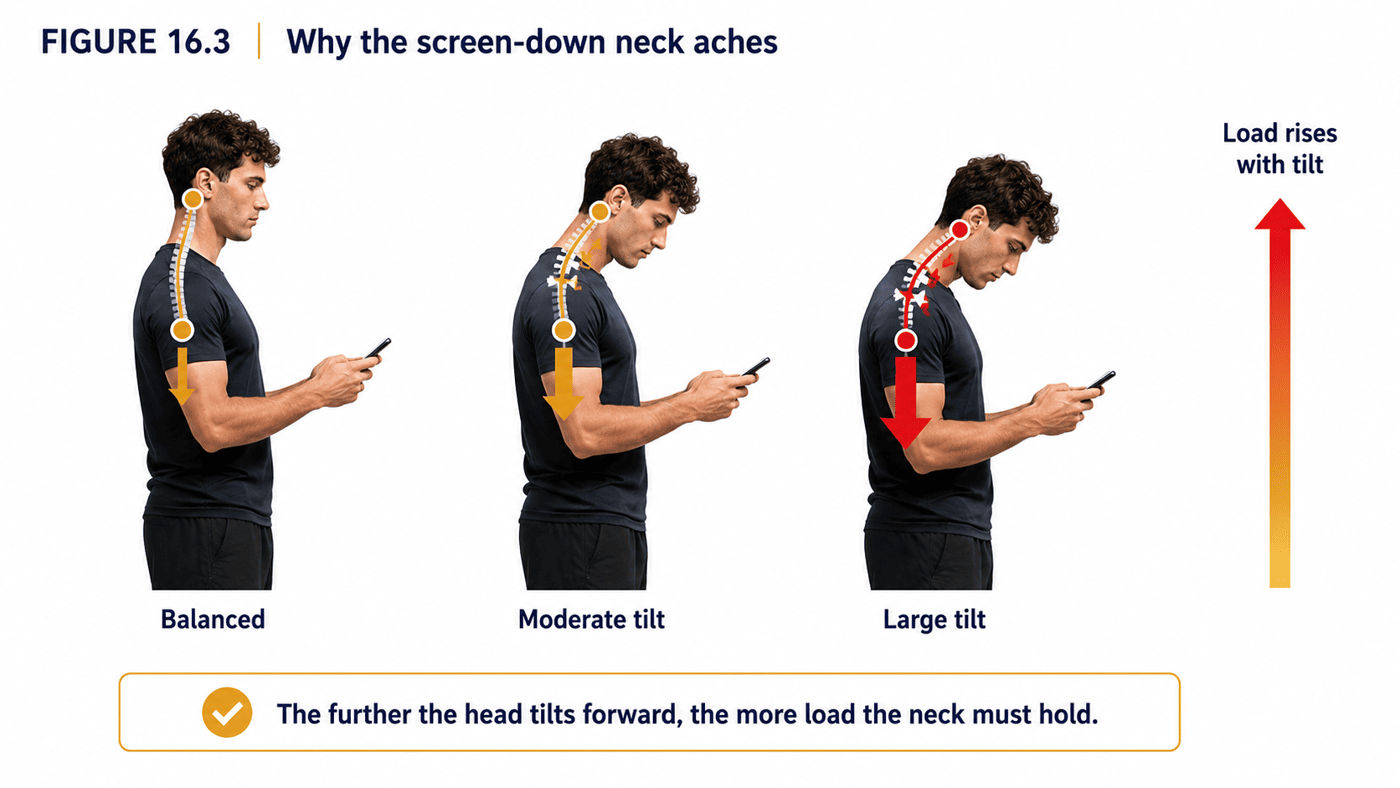
At the mechanical heart of the pattern lies the relationship between head position and neck load, and it is worth seeing it clearly because it explains so much of the pattern’s behaviour. Figure 16.3 shows how the effective load on the neck rises as the head tilts forward: a head held in balance over the spine is carried with little effort, but each degree of forward tilt lengthens the lever through which its weight acts and increases the sustained load the neck must hold (Hansraj, 2014). The person bent over a low screen or a phone is asking the back of the neck to hold a multiplied load, continuously, for hours.
This mechanism explains why the pattern responds as it does to the interventions discussed later. Raising the screen reduces the forward tilt and so the load; moving and changing position interrupts the sustained holding; and building the capacity of the neck muscles raises the load they can comfortably sustain. It also explains why the pattern is a pattern of load and fatigue rather than of damage: the tissue is being worked hard, not injured, and the remedy is to reduce the sustained load and raise the capacity, not to protect a supposedly fragile structure.
16.6 What It Is Usually Not
Reassurance is a genuine part of management, and the desk neck pattern is usually not several of the frightening things people fear. It is usually not a sign of serious disease, not evidence that the neck is damaged or degenerating dangerously, and not a reason to fear movement. A particular source of unnecessary alarm deserves direct attention: the findings of neck scans. Imaging studies show that features such as disc degeneration and bulges are extremely common in people with no neck pain at all, and grow steadily more common with age as a normal part of ageing (Nakashima et al., 2015; cf. Brinjikji et al., 2015). Such findings on a scan, therefore, frequently do not explain a person’s pain and are better understood as the equivalent of grey hair — a sign of age, not of damage.
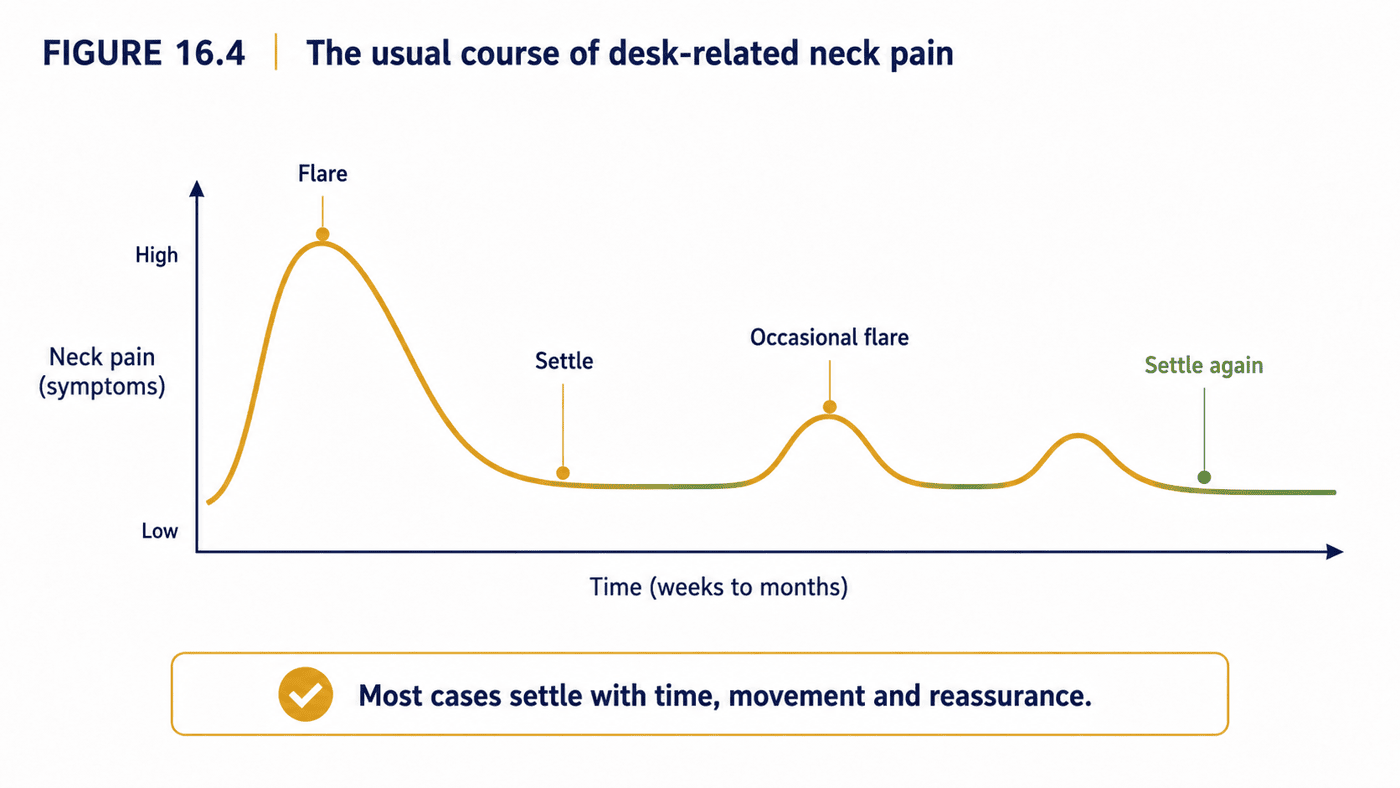
This matters because frightening interpretations of normal findings can themselves worsen pain, through the fear, guarding and avoidance they provoke. The constructive truth is that the neck is a robust structure, that aching and stiffness reflect a sensitised, fatigued, loaded system far more often than a damaged one, and that hurt does not equal harm — the neck can ache without being injured, just as a muscle aches after unaccustomed work. Figure 16.4 shows the usual course: most desk-related neck pain settles with time, movement and reassurance, and even when flares recur, they are part of a normal fluctuating course rather than evidence of accumulating damage.
The role of the deep neck muscles
Beneath the large, visible muscles of the neck lie smaller, deeper ones — the deep cervical flexors at the front and the deep extensors at the back — whose job is the patient, low-level work of supporting and controlling the neck through the day. In many people with the neck pattern, these deep supporting muscles fatigue easily and their endurance is reduced, so that the larger, more superficial muscles (such as the upper trapezius) are left to take up the slack, working harder and tiring sooner (Falla & Farina, 2008). This helps explain the end-of-day quality of the ache: the supporting system fatigues as the hours accumulate.
The encouraging implication is that this endurance can be rebuilt. Gentle, low-load training of the deep neck muscles — the kind of slow, controlled, undramatic movement that builds endurance rather than brute strength — can restore their supporting role and reduce the burden on the overworked superficial muscles. This is not about forceful exercise or strain; it is about patiently reconditioning a support system that sustained desk posture has allowed to fade, so that the neck tires less readily through the day.
Sleep, pillows and the morning-stiff neck
Not all of the desk neck’s troubles happen at the desk. A neck that is stiff and sore first thing in the morning often owes something to the night, for the position in which the neck is held during many hours of sleep matters as much as any daytime posture. A pillow that leaves the neck cricked to one side, dropped too low or propped too high holds it at the end of its range for hours, and the morning stiffness is the result — a night-time version of the same sustained-posture problem this book describes.
The remedy is unfussy. A supportive pillow that keeps the neck in a comfortable, roughly neutral alignment — filling the gap between the head and the mattress so the neck is neither bent up nor sagging down, whether one sleeps on the back or the side — allows the tissues to rest rather than to hold. There is no single ‘correct’ pillow for everyone, and the test is simply comfort and a neck that wakes easier; but for the person whose neck is worst in the morning, attention to the sleeping position is often as valuable as anything done during the working day.
16.7 Red Flags: When to Seek Professional Help
Although the common desk neck pattern is benign, neck symptoms can occasionally signal something that needs prompt medical attention, and it is essential to know the difference. The reassurance in this chapter applies to the ordinary, non-specific pattern — not to the warning signs below. Anyone who experiences these features should seek assessment from a qualified healthcare professional, and the more urgent ones warrant urgent medical care. This list is a guide, not a substitute for professional judgement; see Appendix C for the book’s consolidated referral guidance.
Seek prompt professional assessment if neck pain is accompanied by any of the following: pain following significant trauma, such as a fall or road accident; spreading numbness, pins and needles, or weakness in an arm or hand; symptoms in the legs, problems with balance or walking, clumsiness of the hands, or any disturbance of bladder or bowel control (which can indicate pressure on the spinal cord and require urgent attention); fever, unexplained weight loss, or a history of cancer; severe pain that is unremitting, steadily worsening, or markedly worse at night and not eased by rest or position; or pain associated with significant dizziness, visual disturbance or difficulty swallowing or speaking. These features do not mean something serious is certainly present, but they fall outside the ordinary pattern and need proper evaluation rather than self-management.
16.8 The Management Approach
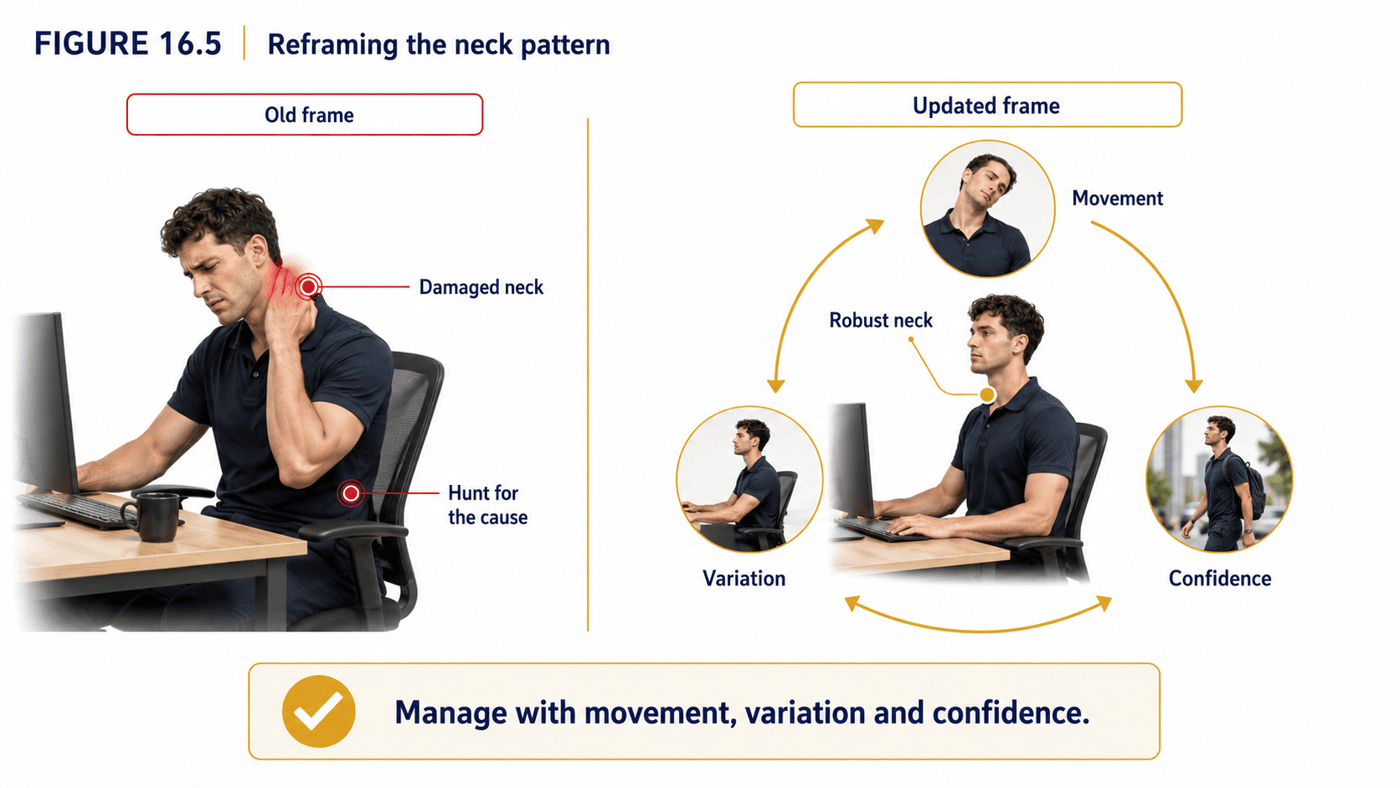
The management of the desk neck pattern follows directly from its nature as a loaded, multifactorial pattern, and it is best understood as a shift in the whole way the neck is approached, captured in Figure 16.5: from a damaged structure to be protected to a robust system to be moved, varied and strengthened. The approach has several strands, drawn from the principles developed across this book.
The first strand is to reduce the sustained mechanical load: raise the screen to eye level, as Chapter 13 set out, so the head need not tilt forward; address the rounded-shoulder posture; and, above all, break up the sustained holding with frequent movement, the microbreaks of Chapter 15. The second is to keep the neck moving with confidence: gentle movement through the neck’s full range, rather than fearful guarding, eases stiffness and reassures the nervous system that movement is safe. The third is to build capacity: a neck and upper back conditioned by regular movement and appropriate strengthening tolerate the demands of desk work with greater reserve. The fourth, and easily the most neglected, is to address the non-mechanical contributors — to manage stress, protect sleep, and replace fearful beliefs about the neck with the accurate, reassuring understanding this chapter has set out. Because the pattern is multifactorial, the management is multifactorial too; no single lever is the whole answer, but together they are powerful.
A note on persistence
Most desk-related neck pain settles, but some becomes persistent, and persistence does not change the fundamental approach so much as deepen it. Long-standing neck pain is still usually a problem of a sensitised system and accumulated contributors rather than ongoing damage, and it still responds best to graded movement, capacity building, and attention to the non-mechanical factors — stress, sleep, mood and belief — which tend to loom larger the longer pain persists. What persistent neck pain warrants is not greater fear or more passive protection, but individualised guidance from a qualified professional who can assess the particular person and tailor the same active principles to them. Persistence is a reason to seek tailored help, not a reason to abandon the confident, active approach this chapter describes.
The pattern in a working life
A familiar example draws the threads together. An account manager in her forties noticed a dull ache across the back of her neck and the tops of her shoulders that arrived most afternoons and was worst on her busiest days, often with a tight band at the base of her skull by evening. She worked long hours on a laptop placed flat on her desk, looking down at it, and through stressful periods she was aware of her shoulders creeping up toward her ears. She had begun to worry that years at the desk had ‘worn out’ her neck.
The reassuring reality fitted the pattern exactly. Her neck was not worn out; it was loaded and fatigued — the forward-head posture of the low screen multiplying the work of the neck muscles, the stress adding its own tension, the long unbroken hours letting both accumulate. The response followed this chapter’s strands: she raised the laptop on a stand with a separate keyboard so her head no longer dropped, set an hourly prompt to move and roll her shoulders, took her neck gently through its range each day, and paid attention to the stress and to her sleep. The ache did not vanish overnight, but over a few weeks it faded from a daily companion to an occasional visitor — a pattern of load and fatigue, eased by lowering the load and restoring movement, exactly as the mechanics predict.
Why the weekend brings relief
One of the most telling features of the desk neck pattern is also one of the most reassuring: the way it so often eases at the weekend and on holiday, only to return with the working week. This rhythm is itself informative. A neck that recovers as soon as the sustained desk posture and the workplace stress are removed is reporting load and tension, not disease; serious structural problems do not politely subside every Saturday and reappear each Monday. The weekly pattern is, in effect, a natural experiment confirming that the workday — its postures, its sustained stillness, its pressures — is the driver.
This is encouraging because it locates the levers precisely where they can be pulled. If the workday creates the pattern, then changes to the workday — the screen height, the movement breaks, the management of stress — are exactly what will ease it, and the relief felt at weekends is a preview of what those changes can extend into the week. The neck is not failing; it is responding to a removable load, and the task is simply to remove more of that load, more of the time.
| Common worry | What the evidence suggests |
|---|---|
| ‘My neck is damaged’ | Most desk neck pain is non-specific load and fatigue, not damage (Hogg-Johnson et al., 2008). |
| ‘The scan shows degeneration’ | Such findings are common in pain-free people and rise with age (Nakashima et al., 2015). |
| ‘I must find the perfect posture’ | Varied movement matters more than one ideal position; sustained stillness is the issue. |
| ‘I should rest and protect it’ | Gentle, confident movement eases stiffness; guarding tends to worsen it. |
| ‘It is purely mechanical’ | Stress, sleep and beliefs are powerful contributors (Moseley & Butler, 2015). |
Table 16.1. Common worries about the desk neck set against the evidence. Educational only — not a substitute for individual assessment.
In summary
- Neck pain is the desk body’s most common complaint; this chapter describes a familiar pattern to inform and reassure, not to diagnose any individual.
- The pattern is typically felt across the back of the neck, base of skull and tops of the shoulders, worse with sustained desk posture and better with movement and rest.
- Its mechanical core is the rising neck load of sustained forward-head posture (Hansraj, 2014), compounded by rounded shoulders and the sheer duration of holding.
- Powerful non-mechanical contributors — stress, poor sleep and fearful beliefs — feed the pattern directly and often dominate (Moseley & Butler, 2015).
- It is usually not damage: degenerative scan findings are common in pain-free people and rise with age, and hurt does not equal harm (Nakashima et al., 2015).
- Red flags — trauma, spreading neurological symptoms, leg/balance/bladder changes, systemic features, or severe unremitting pain — warrant prompt professional assessment (Appendix C).
- Management lowers the load, keeps the neck moving with confidence, builds capacity and addresses stress and sleep — a multifactorial answer to a multifactorial pattern.
References
Brinjikji, W., Luetmer, P. H., Comstock, B., Bresnahan, B. W., Chen, L. E., Deyo, R. A., … Jarvik, J. G. (2015). Systematic literature review of imaging features of spinal degeneration in asymptomatic populations. American Journal of Neuroradiology, 36(4), 811–816.
Falla, D., & Farina, D. (2008). Neuromuscular adaptation in experimental and clinical neck pain. Journal of Electromyography and Kinesiology, 18(2), 255–261.
Hansraj, K. K. (2014). Assessment of stresses in the cervical spine caused by posture and position of the head. Surgical Technology International, 25, 277–279.
Hartvigsen, J., Hancock, M. J., Kongsted, A., Louw, Q., Ferreira, M. L., Genevay, S., … Woolf, A. (2018). What low back pain is and why we need to pay attention. The Lancet, 391(10137), 2356–2367.
Hogg-Johnson, S., van der Velde, G., Carroll, L. J., Holm, L. W., Cassidy, J. D., Guzman, J., … Peloso, P. (2008). The burden and determinants of neck pain in the general population. Spine, 33(4S), S39–S51.
Moseley, G. L., & Butler, D. S. (2015). Fifteen years of explaining pain: The past, present, and future. The Journal of Pain, 16(9), 807–813.
Nakashima, H., Yukawa, Y., Suda, K., Yamagata, M., Ueta, T., & Kato, F. (2015). Abnormal findings on magnetic resonance images of the cervical spines in 1211 asymptomatic subjects. Spine, 40(6), 392–398.
O’Sullivan, P. B., Caneiro, J. P., O’Keeffe, M., Smith, A., Dankaerts, W., Fersum, K., & O’Sullivan, K. (2018). Cognitive functional therapy: An integrated behavioral approach for the targeted management of disabling low back pain. Physical Therapy, 98(5), 408–423.