Part V · WORKSTATION AND WORKDAY MECHANICS
Microbreaks: Small Movements With Big Mechanical Value
After chairs and standing desks, the most powerful tool for the desk body turns out to be the smallest and the cheapest: the movement break. A minute or two of movement, taken often, resets the loading clock, blunts the metabolic cost of sitting and sharpens the mind — a return out of all proportion to its size.
15.1 The Most Powerful Lever
This book has examined the chair and the workstation, the standing desk and the treadmill desk, and found each to be, at best, a modest tool. It now arrives at the intervention that is none of these things — that costs nothing, requires no equipment, and yet does more for the desk body than any piece of furniture ever could. It is the movement break: the simple act of interrupting sustained sitting with brief, frequent movement. If this book has a single most important practical message, it is this one, and the present chapter is in many ways its heart.
The reason the movement break matters so much follows directly from everything that has come before. Again and again, across every region of the body and every system, the deepest problem of desk work has turned out to be not bad posture but sustained posture — the unbroken duration of stillness, not the particular shape held. The spine creeps, the discs go unnourished, the muscles quieten, the glucose lingers, the hips stiffen, all because a position is held without interruption for too long. And the direct antidote to sustained anything is, simply, to interrupt it. The movement break attacks the desk body’s problem at its root, which is why so small an act yields so large a return.
The term ‘microbreak’ captures the scale: these are not exercise sessions or lengthy pauses, but brief interruptions — a minute or two, sometimes only seconds — taken frequently through the day. Their power lies not in their duration but in their frequency, and in what each one does to reset the mechanical and metabolic clock that sustained sitting sets running. This chapter sets out that power: the mechanics of what a break changes, the striking metabolic evidence, the question of how often and how long, what actually counts as a break, and how to build the habit into a real working day.
15.2 The Mechanics of a Break: What Changes When You Move
To understand why a brief break is so valuable, recall what sustained sitting does to the tissues, set out in Chapter 7, and consider what happens the moment a person stands and moves (Mueller & Maluf, 2002). The accumulated creep in the spinal tissues, which built up silently over a long seated bout, begins at once to reverse as the load is removed and redistributed (Callaghan & McGill, 2001). The protective muscle reflexes that sustained loading had quietened, in the manner Solomonow (2004) documented, reawaken. The intervertebral discs, starved of the cyclic loading they depend on for nourishment, receive a pulse of the fluid exchange that movement drives. The muscles that had fallen electrically silent fire again. In the space of a minute, a great deal of what sustained sitting had set in motion is undone.
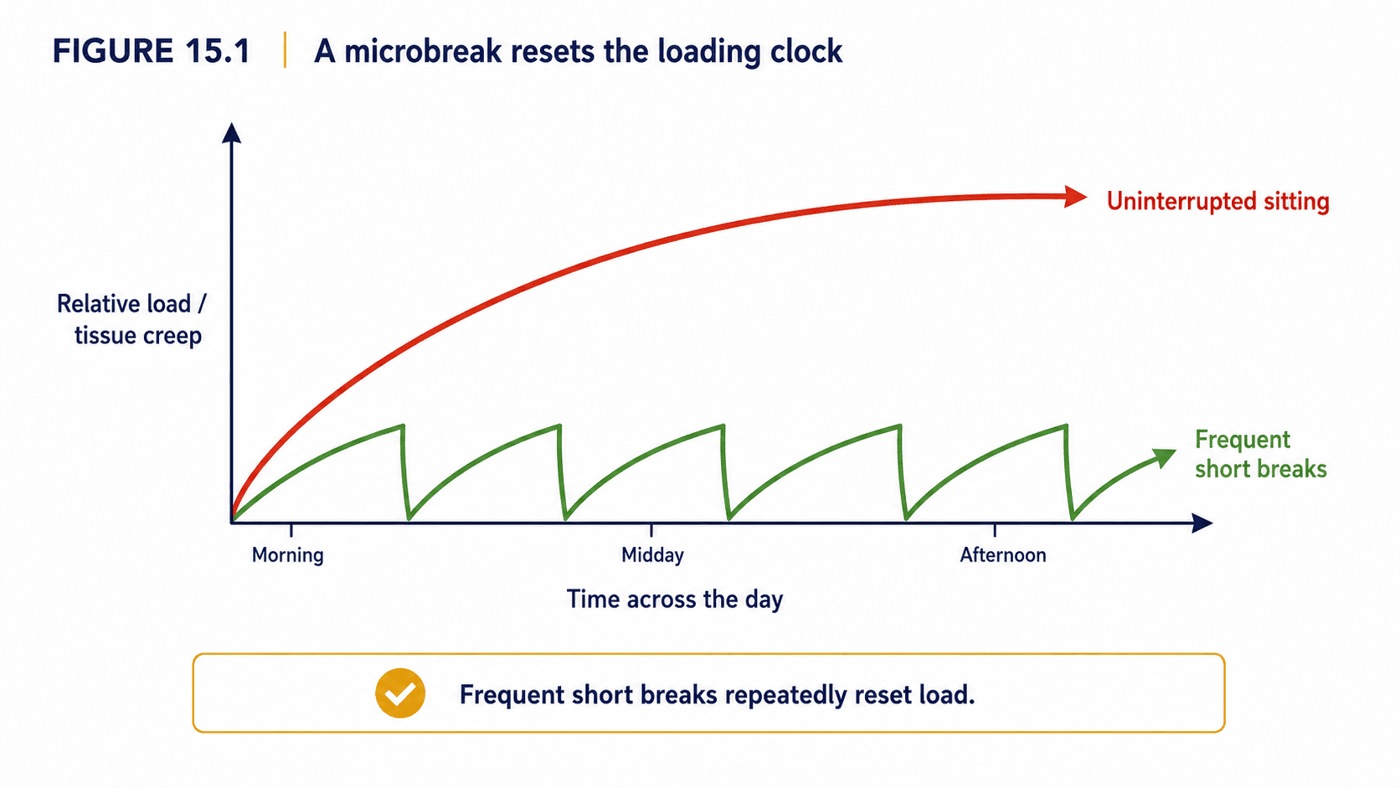
Figure 15.1 captures this in the terms of the loading clock. Uninterrupted sitting lets tissue creep and load climb and then remain high for the whole bout; a microbreak resets that accumulation, dropping it back toward baseline, so that frequent breaks keep the load low all day rather than letting it build and build. The break does not merely pause the accumulation of load — it reverses it, returning the tissues toward their rested state before the next bout begins. This is why many short breaks are so much more effective than one long one: each reset prevents the load from ever reaching the high, sustained levels that do the damage.
The same logic extends beyond the spine to every region this book has examined. A break lets the held-flexed hip extend, the idle glutes fire, the rounded shoulders draw back, the forward head rebalance, the compressed rib cage expand, the unloaded legs bear weight. A single movement break is, in effect, a brief, whole-body correction of the entire desk-body pattern — a momentary undoing of the sustained posture in every structure at once. Its mechanical value is genuinely systemic.
15.3 The Metabolic Case: Breaking Up Sitting
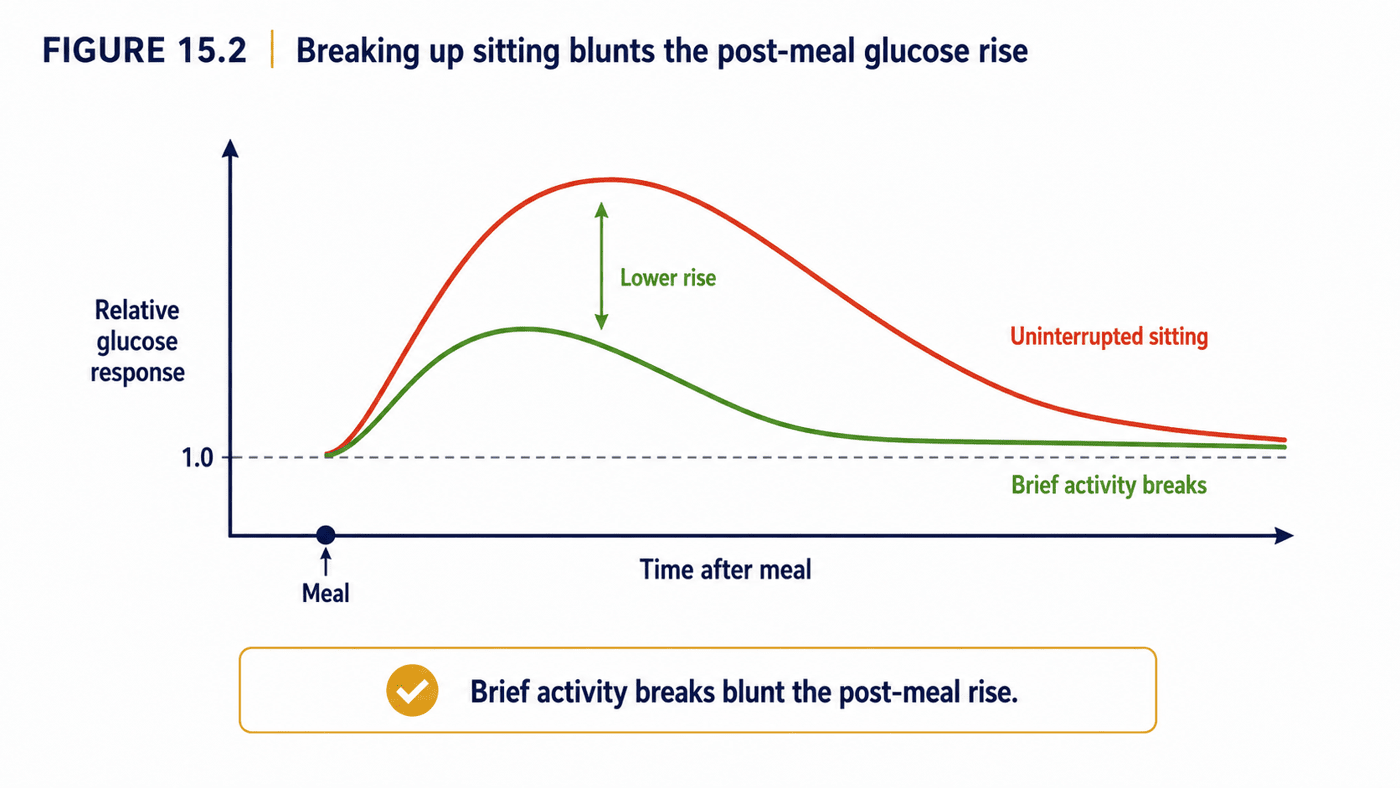
The mechanical case for movement breaks is compelling on its own, but it is the metabolic evidence that has made the strongest scientific impression, and it deserves to be set out clearly. A series of carefully controlled studies has shown that simply interrupting prolonged sitting with brief bouts of light activity meaningfully improves the body’s handling of a meal. Dunstan and colleagues (2012) found that breaking up sitting with short, regular bouts of light walking substantially reduced the rise in blood glucose and insulin after eating, compared with sitting uninterrupted. Peddie and colleagues (2013) found that such regular activity breaks were actually more effective for blood-glucose control than a single equivalent bout of continuous exercise. Figure 15.2 illustrates the effect: the post-meal glucose spike, sharp and prolonged after uninterrupted sitting, is visibly blunted when the sitting is broken by movement.
This finding is profound for two reasons. First, it shows that the harm of sitting is not only musculoskeletal but metabolic, and that the metabolic harm, too, responds directly to interruption. Healy and colleagues (2008) had earlier found, in a large population study, that more frequent breaks in sedentary time were associated with a healthier metabolic profile — a smaller waist, better glucose handling — independent of the total amount of sitting or of moderate exercise. The experimental and population evidence point the same way.
Second, and most importantly, these benefits appear to be partly independent of whether a person also does formal exercise. The breaks help over and above a workout; the person who exercises in the morning and then sits unbroken all day does not capture the benefit that frequent interruption provides. This is the origin of the now-established public-health refrain to ‘sit less, move more’ in addition to, not instead of, structured activity — because the body needs both the dose of exercise and the frequent interruption of sitting, and one does not substitute for the other.
15.4 How Often, How Long?
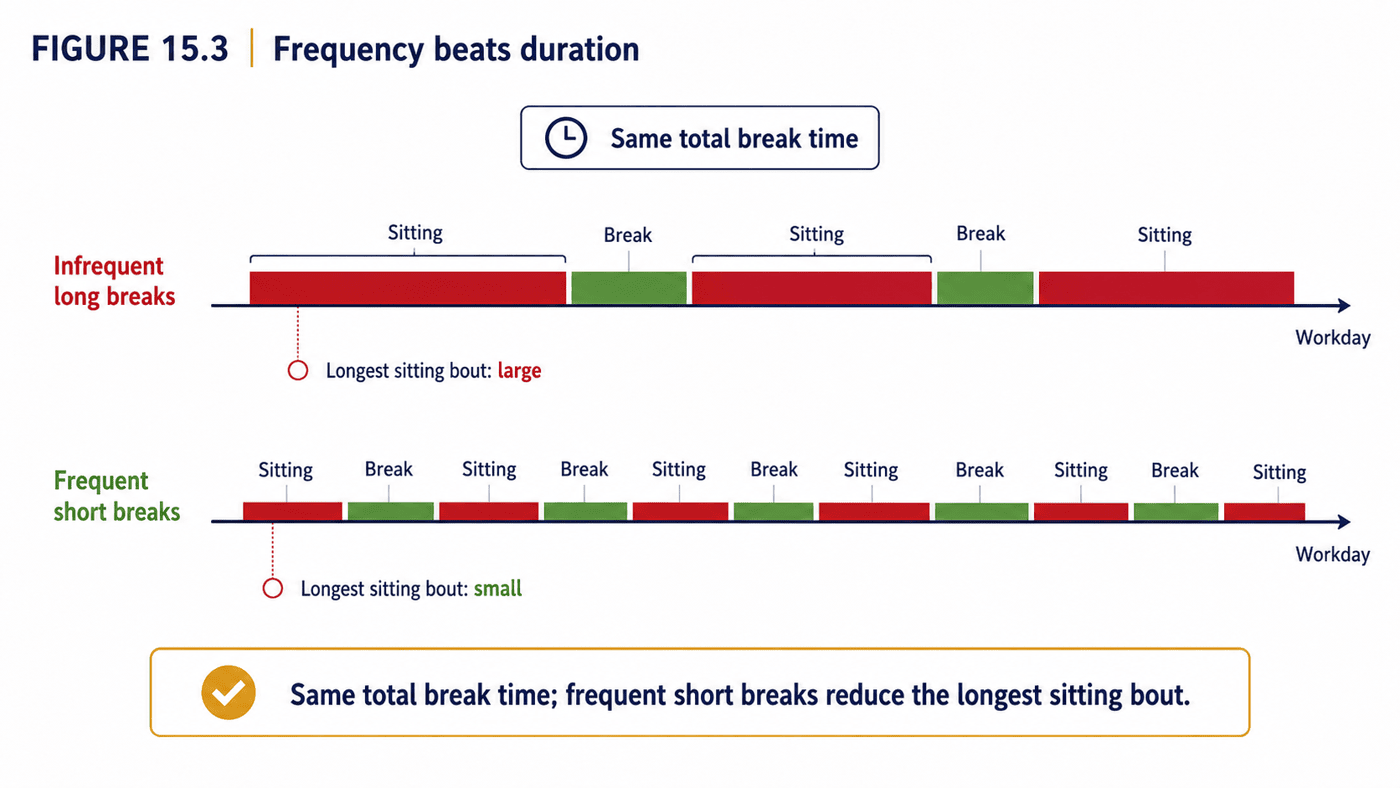
If breaks are so valuable, the practical question is how often to take them and how long they need to be — and the answer, consistent with everything above, is that frequency matters far more than duration. Because the harm comes from the long unbroken bout, what matters most is to prevent any bout from running too long, which is achieved by breaking frequently rather than by taking occasional long rests. Figure 15.3 makes the point with the same total break time arranged two ways: a single long break after hours of sitting leaves one enormous unbroken bout, while the same minutes spread as frequent short breaks keep the longest bout small — and it is the longest bout that does the damage.
As a practical rule, interrupting sitting roughly every twenty to thirty minutes captures most of the benefit, and the interruption need not be long: even one to two minutes of movement, sometimes less, is enough to reset the loading clock and to contribute to the metabolic benefit the studies describe. The studies that demonstrated the glucose effects used brief breaks of only a couple of minutes; the spinal creep that builds over a long bout reverses within a similar span. This is liberating, because it means the break need not disrupt work in any serious way — a minute on one’s feet between tasks, a short walk to refill a glass of water, a few movements beside the desk. The bar is low, and deliberately so: the aim is frequent interruption, not lengthy exercise.
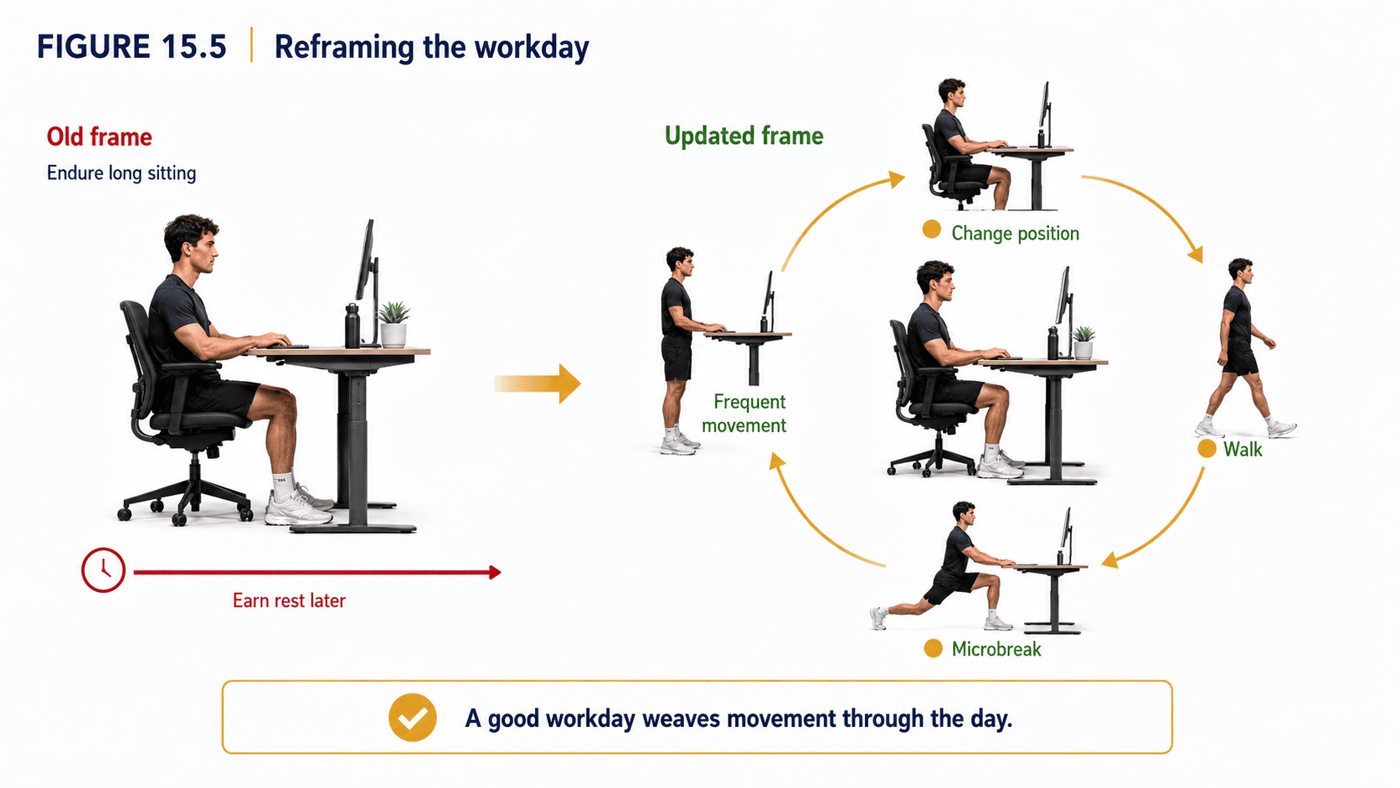
It is worth stating the corollary plainly, because it overturns a common habit. The instinct to ‘power through’ a long stretch of work and earn a proper rest afterwards is exactly backwards for the body: it maximises the unbroken bout that does the harm. Far better to break little and often, before strain and stiffness accumulate, than to endure a long sustained bout and then rest. The best break is the one taken before you feel you need it.
Between the breaks: keep fidgeting
A small but genuine point bridges the gap between one movement break and the next: the low-level, spontaneous movement that fills the time in between. Fidgeting, shifting in the chair, tapping a foot, crossing and uncrossing the legs, changing position — these restless micro-movements, long frowned upon as signs of inattention, are in fact mild but real contributors to keeping the body active and the circulation moving. They are a trickle of the movement that sitting otherwise removes, and they should be welcomed rather than suppressed.
This reframes the squirming, restless impulse of a long sit as useful physiology rather than poor discipline — the body, once again, seeking the movement that stillness denies it. While such fidgeting is no substitute for proper movement breaks or for an active day, it adds a baseline of low-level activity between the breaks, and the person who shifts, fidgets and changes position frequently is a little better off than the one who sits rigidly still. Between your breaks, in short, do not sit perfectly still: let the body move as it wants to.
15.5 What Counts as a Microbreak
A common misconception is that a movement break must be exercise — a set of vigorous repetitions, a brisk lap of the building — and this misconception puts people off, because such things feel disruptive and effortful. In fact the bar is far lower. What counts is simply interrupting the sustained posture with movement, and almost any movement will do. Standing up and sitting down again; a short walk to the window, the printer or the kettle; a few shoulder rolls, a gentle backbend, a reach overhead; shifting from sitting to standing at a sit-stand desk; taking a phone call on one’s feet or while walking — all of these are microbreaks, and all deliver the essential benefit of interruption (Buckley et al., 2015).
This breadth is part of what makes the movement break so practical. Because the requirement is interruption rather than exertion, a break can be woven into the smallest gaps of a working day without changing clothes, breaking a sweat or losing one’s thread. The point is not to exercise but to move — to break the stillness, change the load, and let the tissues reset — and that can be achieved in the course of ordinary activity as much as in any deliberate routine. Chapter 21, the three-minute desk reset, offers a structured sequence for those who want one; but the humblest unstructured movement, taken often, captures most of the value.
Resting the eyes and the mind
Although this book is chiefly concerned with the body, the movement break delivers two further benefits that matter to anyone at a screen: it rests the eyes and it refreshes the mind. Sustained screen work holds the eyes at a fixed close focus and reduces the rate of blinking, contributing to the dry, fatigued eyes of a long day. A movement break almost always takes the gaze off the screen and into the distance, relaxing the eye’s focusing muscles and prompting a few restorative blinks — the same relief the ‘20–20–20’ habit of Chapter 13 provides, here delivered automatically by the act of getting up and moving.
The mind benefits no less. Attention, as the previous section argued, is refreshed by brief changes of activity, and there is a long tradition — familiar to anyone who has solved a problem in the shower or on a walk — of insight arriving when the mind steps away from a task rather than grinding at it. A short movement break provides exactly this kind of stepping-away, allowing a stuck problem to settle and often returning the worker not only rested but unstuck. The break, in other words, is good for the eyes, the body and the thinking at once — three returns on a single minute of movement.
From microbreaks to movement variety
A subtle refinement makes the movement break still more valuable, and it follows from the very first principle of this book. Chapter 1 framed the desk body’s problem as movement that is not merely insufficient but under-varied — the same few positions repeated endlessly. The same logic applies to breaks: a microbreak that consists of the identical stretch every time, while far better than no break at all, still offers the body only one kind of movement. A more powerful practice is to vary the breaks — to reach overhead in one, to rotate the trunk in another, to walk in a third, to squat or hinge in a fourth — so that across the day the body visits many of the ranges and loads that sitting neglects.
Thought of this way, the day’s microbreaks become a kind of distributed movement diet, feeding the body a varied menu of positions in small, frequent portions. The hips get their extension, the spine its rotation and extension, the shoulders their overhead reach, the legs their loading — not in a single session but sprinkled through the working hours. This variety addresses not just the duration problem that any break solves, but the deeper poverty of movement that defines the desk body, and it costs nothing more than a little imagination in choosing what to do with each two-minute pause.
15.6 Building Microbreaks Into a Workday
Knowing that frequent movement breaks are valuable is one thing; actually taking them amid the absorption and pressure of a working day is another, and this is where good intentions most often fail. The difficulty is real: deep work and meetings draw the attention away, and an hour passes unbroken before one notices. The solution is to remove the reliance on memory and willpower, and instead to build breaks into the structure of the day through cues, habits and prompts.
Several strategies work. Habit-stacking attaches a break to an existing regularity — standing for every phone call, walking to a colleague rather than messaging, taking a brief lap after each meeting or completed task. Prompts outsource the remembering: a timer, a calendar reminder, or one of the many applications designed to nudge movement at set intervals. Environmental design, as Chapter 13 noted, helps by placing the printer, the kettle or the bin a little further away, so that ordinary needs require rising. And social normalisation — a team that treats walking meetings and movement breaks as ordinary rather than odd — removes the awkwardness that can inhibit them. The aim of all of these is the same: to make the break automatic, so it happens without depending on a busy person remembering, in the moment, to interrupt absorbing work.
The most common objection — ‘I am too busy; breaks will cost me productivity’ — deserves a direct answer, because it is both the main barrier and largely mistaken. Brief movement breaks do not harm productivity, and there is good reason to think they support it, as the next section describes. The few minutes spent moving are repaid in sustained attention, comfort and energy across the day. The busy worker who never breaks is not being more productive; they are accumulating the stiffness, fatigue and metabolic cost that erode performance, and trading long-term wellbeing for a false economy of uninterrupted hours.
Microbreaks, focus and productivity
The fear that breaks cost productivity is worth addressing with evidence as well as reassurance. Far from impairing performance, frequent short movement breaks appear to support the very faculties that desk work depends upon. Bergouignan and colleagues (2016) found that interrupting prolonged sitting with brief, regular walking breaks improved participants’ self-reported energy and mood and reduced fatigue, compared with uninterrupted sitting. More broadly, attention is not an inexhaustible resource that uninterrupted effort preserves; it flags over long unbroken stretches and is refreshed by brief changes of activity, so that a short movement break often returns a person to their work sharper than before.
This reframes the break not as a theft from productive time but as an investment in it. A mind kept fresh by periodic movement, in a body kept comfortable and free of accumulating stiffness, sustains better focus across a full day than one ground down by unbroken sitting. The standing instruction to ‘power through’ mistakes the nature of both the body and the attention; both do better with rhythm and variation than with relentless stillness. Properly understood, the movement break is among the most productive minutes in the working day.
Overcoming the real barriers
It is worth naming honestly the specific barriers that stop people taking breaks, because each has a practical answer. The first is self-consciousness, especially in open-plan offices, where rising to stretch or pace can feel conspicuous. The remedy is partly discretion — many effective microbreaks are unobtrusive, a stand, a walk to fetch water, a few quiet movements — and partly normalisation: when colleagues, and above all leaders, treat movement as ordinary, the awkwardness dissolves. A workplace where walking meetings and movement breaks are routine removes the social cost that inhibits them.
The second barrier is the absorbing flow of deep work, in which an hour vanishes unbroken. Here the answer is to attach breaks to the natural seams of the work — the end of a task, the sending of a document, the close of a meeting — rather than to fight the flow at arbitrary moments, and to accept that a brief interruption at a sensible boundary costs little and returns much. The third barrier is the meeting-heavy day, which can be turned from an obstacle into an opportunity: calls and one-to-one meetings taken standing or walking convert otherwise sedentary hours into movement. None of these barriers is insurmountable; each simply requires a small, deliberate strategy in place of reliance on willpower.
A typical case shows the strategies working together. A software developer worked in long blocks of intense concentration, two or three hours at a stretch, and prided himself on never breaking his flow. By mid-afternoon, however, he was stiff, headachy and noticeably slower, and his neck and lower back ached by evening. He had assumed this was the unavoidable price of focused work; in fact it was the avoidable price of unbroken sitting, the long bouts maximising exactly the sustained load this chapter has described.
His solution required no change to his work, only to its rhythm. He set an unobtrusive timer to prompt a brief movement break roughly every half hour, took his daily stand-up meeting and his phone calls on his feet or walking, and learned to break at the natural pauses between tasks rather than grinding through them. He worried at first that this would fracture his concentration; instead he found the opposite — the brief breaks left him sharper, his afternoon slump lifted, and the stiffness and headaches faded. He had not sacrificed his focus to movement; he had protected it.
15.7 The Movement Snack and the Cumulative Day
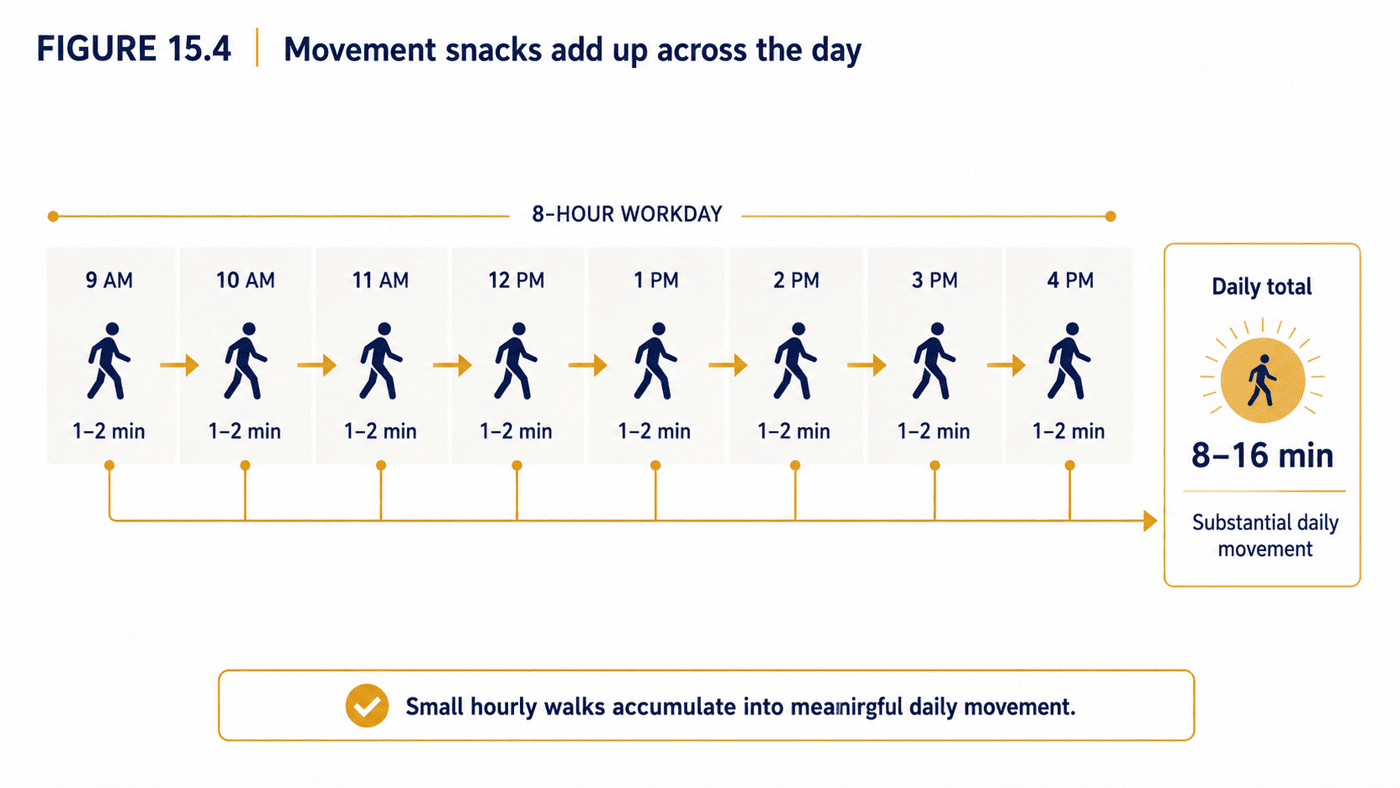
There is a final, encouraging way to see the movement break: not only as damage prevention but as a quiet accumulation of genuine activity — the ‘movement snack’. Each brief interruption is a small portion of movement, and across a long day these portions add up to a substantial total that the uninterrupted day never gathers. Figure 15.4 illustrates the arithmetic: a minute or two of walking each hour accumulates, by the day’s end, into a meaningful quantity of movement and a considerable number of steps — movement that would otherwise simply not have happened.
This cumulative view matters because it shows that the small breaks are not merely mitigating a harm but building a positive total. The steps, the standing, the brief walks — individually trivial, collectively significant — contribute to the daily movement and energy expenditure that, as Part I established and the next part develops, underpin health far beyond the desk. The person who weaves movement snacks through the day is not only resetting their loading clock and blunting their glucose spikes, but quietly assembling, in two-minute pieces, a genuinely more active life. It is a reminder that the small and the frequent, in movement as in much else, compound into the large.
Microbreaks across the whole day, not just the workday
A final extension widens the principle beyond the desk. The logic of the movement break — that frequent interruption of sustained sitting protects the body and the metabolism — does not stop when the working day ends. It applies to every hour of sedentary time, and many people who diligently break up their sitting at work then undo much of the benefit by sitting unbroken all evening: a long commute, a sofa, several hours of television or screens before bed. The body does not distinguish between sitting for work and sitting for leisure; sustained stillness is sustained stillness, whatever its purpose.
The same small habits therefore belong in the evening as much as at the desk. Standing and moving during the breaks in a television programme; taking a personal phone call on one’s feet or while walking; moving about between episodes or chapters; breaking up the commute where possible — each applies the workday lesson to the rest of the day. Seen across the full twenty-four hours, health is shaped by the whole pattern of sitting, moving and sleeping, and the desk is only the part of it that this book has examined most closely.
This whole-life view is, in the end, the most hopeful framing of all. The habit of frequent movement, once built at the desk, extends naturally into the rest of life, until a day punctuated by movement — at work and at home, in two-minute pieces — becomes simply how one lives. The goal was never merely a more comfortable working day, but a more active life, of which the workday is one well-managed part. The smallest movements, taken often and everywhere, compound across not just a day but a lifetime.
15.8 Putting It Into Practice
The practical conclusion of this chapter, and in many ways of the whole book, is simple to state and worth taking seriously: interrupt sitting frequently, with brief movement, all day long. Figure 15.5 sets the old mindset against the new — from earning rest by enduring long sitting, to weaving movement through the day as a matter of course. The table that follows offers a menu of microbreaks, and the box below distils the habit into practice. None of it requires equipment, fitness or much time; it requires only the recognition that the smallest movements, taken often, are the most powerful tool the desk body has.
| Microbreak | What to do | Mechanical / metabolic benefit |
|---|---|---|
| Postural reset | Stand, draw shoulders back, gentle backbend | Reverses creep; rebalances head and spine |
| Stand and sit | Rise and sit a few times; shift to standing | Interrupts the bout; loads hips and legs |
| Short walk | To the window, kettle, printer or a colleague | Blunts glucose; adds steps; wakes the glutes |
| Reach and mobilise | Reach overhead; rotate the trunk; circle the ankles | Restores neglected ranges; eases stiffness |
| Walking call | Take a phone call standing or on the move | Turns dead time into movement time |
Table 15.1. A menu of microbreaks. Almost any movement qualifies; the essential ingredient is frequent interruption, not exertion.
In summary
- The movement break is the most powerful and most neglected tool for the desk body: free, equipment-free, and aimed directly at the root problem of sustained stillness.
- A brief break reverses, not merely pauses, the costs of sitting — tissue creep subsides, muscles reawaken, discs are nourished, and the whole desk-body pattern is momentarily corrected (Callaghan & McGill, 2001; Solomonow, 2004).
- Interrupting sitting with brief light activity blunts the post-meal glucose and insulin rise, over and above formal exercise (Dunstan et al., 2012; Peddie et al., 2013; Healy et al., 2008).
- Frequency beats duration: what matters is preventing any unbroken bout from running too long, so break every 20–30 minutes for even a minute or two.
- Almost any movement counts — standing, a short walk, a few reaches — so the bar is low; the essential ingredient is frequent interruption, not exertion.
- Breaks are best built in through cues, habit-stacking, prompts and environmental design rather than willpower, and they support rather than harm focus and productivity (Bergouignan et al., 2016).
- Movement snacks accumulate into a meaningfully more active day; the small and frequent compound into the large.
References
Bergouignan, A., Legget, K. T., De Jong, N., Kealey, E., Nikolovski, J., Groppel, J. L., … Bessesen, D. H. (2016). Effect of frequent interruptions of prolonged sitting on self-perceived levels of energy, mood, food cravings and cognitive function. International Journal of Behavioral Nutrition and Physical Activity, 13, 113.
Buckley, J. P., Hedge, A., Yates, T., Copeland, R. J., Loosemore, M., Hamer, M., … Dunstan, D. W. (2015). The sedentary office: An expert statement on the growing case for change towards better health and productivity. British Journal of Sports Medicine, 49(21), 1357–1362.
Callaghan, J. P., & McGill, S. M. (2001). Low back joint loading and kinematics during standing and unsupported sitting. Ergonomics, 44(3), 280–294.
Dunstan, D. W., Kingwell, B. A., Larsen, R., Healy, G. N., Cerin, E., Hamilton, M. T., … Owen, N. (2012). Breaking up prolonged sitting reduces postprandial glucose and insulin responses. Diabetes Care, 35(5), 976–983.
Healy, G. N., Dunstan, D. W., Salmon, J., Cerin, E., Shaw, J. E., Zimmet, P. Z., & Owen, N. (2008). Breaks in sedentary time: Beneficial associations with metabolic risk. Diabetes Care, 31(4), 661–666.
Mueller, M. J., & Maluf, K. S. (2002). Tissue adaptation to physical stress: A proposed “physical stress theory” to guide physical therapist practice, education, and research. Physical Therapy, 82(4), 383–403.
Peddie, M. C., Bone, J. L., Rehrer, N. J., Skeaff, C. M., Gray, A. R., & Perry, T. L. (2013). Breaking prolonged sitting reduces postprandial glycemia in healthy, normal-weight adults: A randomized crossover trial. The American Journal of Clinical Nutrition, 98(2), 358–366.
Solomonow, M. (2004). Ligaments: A source of work-related musculoskeletal disorders. Journal of Electromyography and Kinesiology, 14(1), 49–60.