Part V · WORKSTATION AND WORKDAY MECHANICS
The Standing Desk Myth
The standing desk arrived as the cure for sitting — and the claims around it grew taller than the evidence. This chapter examines it even-handedly: standing is not the antidote to sitting, it burns barely more energy, and prolonged standing has its own costs. The real remedy is not standing instead of sitting, but alternating and moving.
14.1 The Rise of the Standing Desk
Few pieces of office equipment have risen as fast, or been freighted with as much hope, as the standing desk. Propelled by a wave of alarming headlines about the dangers of sitting — captured in the much-repeated slogan that ‘sitting is the new smoking’ — the sit-stand desk has gone from novelty to fixture in a decade, sold as the simple solution to the harms of desk work. The promise is appealing in its directness: if sitting is the problem, then standing must be the answer, and a desk that lets you stand must be the cure.
This chapter examines that promise with an even hand, because the truth is more interesting and more useful than either the marketing or the backlash suggests. The standing desk is neither the panacea its champions claim nor the gimmick its critics dismiss. Approached through the biomechanics and the evidence, it turns out to be a genuinely useful tool whose real value lies somewhere quite different from where the hype places it — not in standing as such, but in the movement and variation it can enable. To see why, we need to examine four things in turn: what the evidence actually shows, the myth that standing burns meaningful calories, the real and often-ignored costs of prolonged standing, and the deeper point that standing is not, mechanically, the opposite of sitting at all.
How the myth took hold
It is worth understanding how the standing desk came to be sold as a cure, because the story is a case study in how a real but limited finding becomes an oversold product. The starting point was genuine: epidemiological research, of the kind reviewed in Part I, established that high volumes of sedentary time are associated with poorer health (Biswas et al., 2015). That measured finding was then compressed, by headline and marketing, into something far simpler and more alarming — ‘sitting disease’, ‘sitting is the new smoking’ — and from there it was a short step to a device that promised to solve it.
The appeal is easy to understand. A simple, purchasable object that appears to fix a complex behavioural and physiological problem is far more attractive than the harder, unglamorous truth that the remedy is to change how one moves throughout the day. The standing desk offered the comfort of a solution that could be bought once and then forgotten, and it sold accordingly. None of this means the desk is worthless — as the evidence above shows, it has real if modest value — but it does mean that the claims surrounding it should be read with the knowledge that they grew from marketing as much as from mechanism. The task of this chapter is to recover the modest, useful truth from the oversized promise.
14.2 What the Evidence Actually Shows
Begin with the evidence, set out fairly. The strongest synthesis comes from a Cochrane review of workplace interventions to reduce sitting (Shrestha et al., 2018), and its findings are measured rather than triumphant. Sit-stand desks do reduce the amount of time people spend sitting at work, at least in the short term — a real and worthwhile effect. But the review judged the quality of the evidence to be low, found the reductions in sitting time variable and often modest, and concluded that there was not yet good evidence that sit-stand desks deliver the broader health benefits frequently claimed for them. They change behaviour somewhat; they have not been shown to transform health.
This is neither an endorsement nor a dismissal, and it should not be read as either. A tool that reduces sitting time is doing something useful, given the genuine concerns about sedentary behaviour set out in Part I. But the gap between ‘reduces sitting time’ and ‘cures the harms of desk work’ is wide, and much of the marketing leaps across it without warrant. The honest position is that the standing desk is a reasonable tool with modest, real benefits and uncertain larger ones — a useful addition to the workday, not a solution to it. The sections that follow explain why its benefits are more limited, and more specific, than the simple ‘standing undoes sitting’ story implies.
Is sitting really ‘the new smoking’?
The slogan that launched a thousand standing desks deserves direct scrutiny, because it is misleading in a way that distorts the whole conversation. Sedentary behaviour is a real health concern, as Part I documented: high volumes of sitting are associated with increased cardiometabolic risk and mortality. But the comparison with smoking is not supported by the magnitude of the evidence — the risks of sitting are real but considerably smaller than those of smoking, and, crucially, much of the risk associated with sitting can be offset by being physically active. A large pooled analysis by Ekelund and colleagues (2016) found that high levels of physical activity attenuated much of the mortality risk associated with prolonged sitting — something that cannot be said of smoking, where no amount of exercise makes it safe. Sitting is worth reducing; it is not the new smoking, and the slogan’s main effect has been to sell a panic, and a product, rather than to inform.
14.3 The Calorie Myth
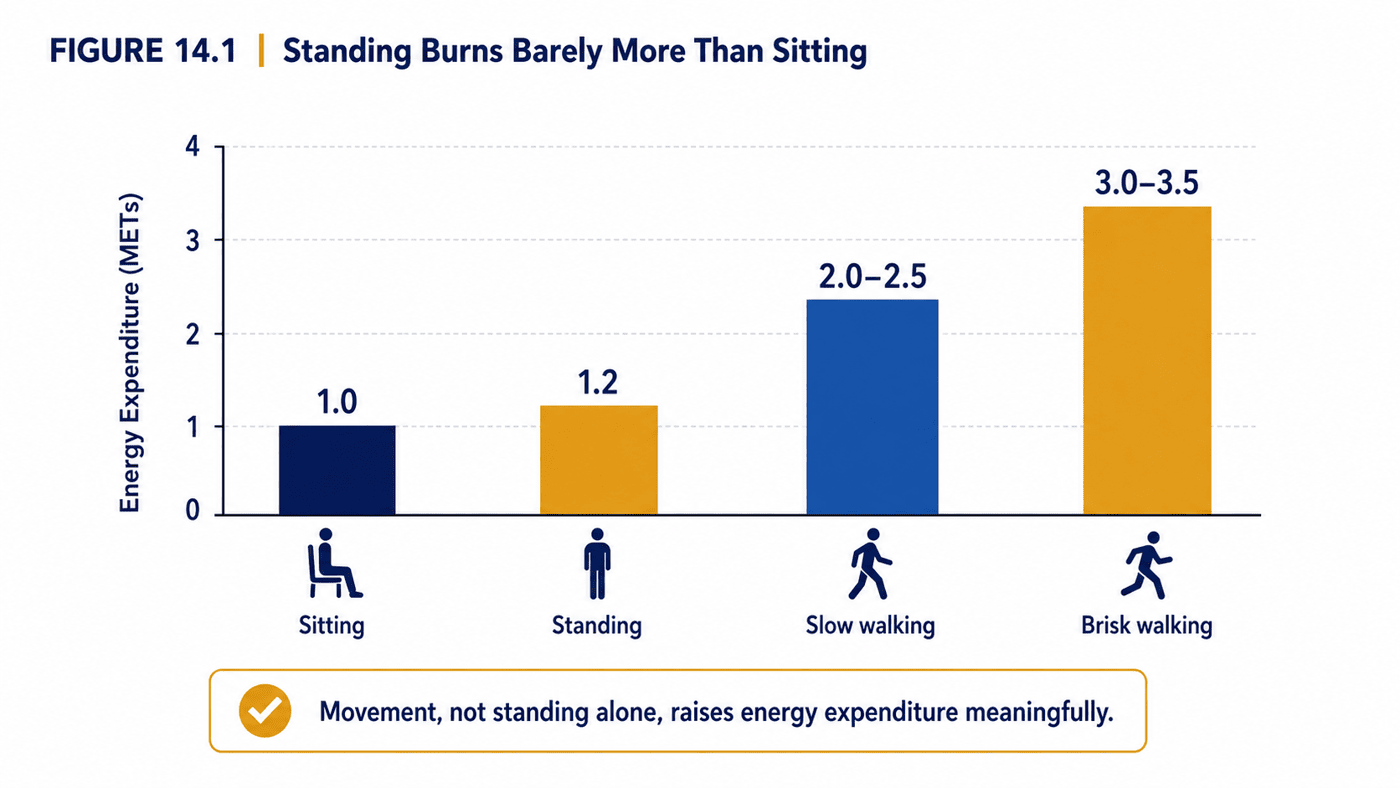
Among the most persistent claims for the standing desk is that it burns a meaningful number of extra calories — that simply standing rather than sitting will, over time, contribute to weight loss. The evidence does not support this. A meta-analysis by Saeidifard and colleagues (2018) found that standing increases energy expenditure over sitting only marginally — on the order of a fraction of a calorie per minute — a difference far too small to function as a weight-loss strategy. Figure 14.1 places standing in context: it exceeds sitting only slightly, while it is movement, and walking in particular, that raises energy expenditure to any meaningful degree.
The mechanical reason is simple. Standing still, like sitting, involves very little muscular work; the body is held in a static position, with the postural muscles ticking over quietly to maintain balance. It is not the change from sitting to standing that burns energy but the change from stillness to movement — and a standing desk, used as a place to stand still, supplies little of the latter. The person hoping to offset a sedentary job by standing at their desk is pursuing a rounding error; the person who walks for a few minutes each hour is doing something that actually moves the needle. This is the first hint of the chapter’s central theme: that the benefit, when it comes, comes from movement, not from the posture itself.
14.4 The Hazards of Prolonged Standing
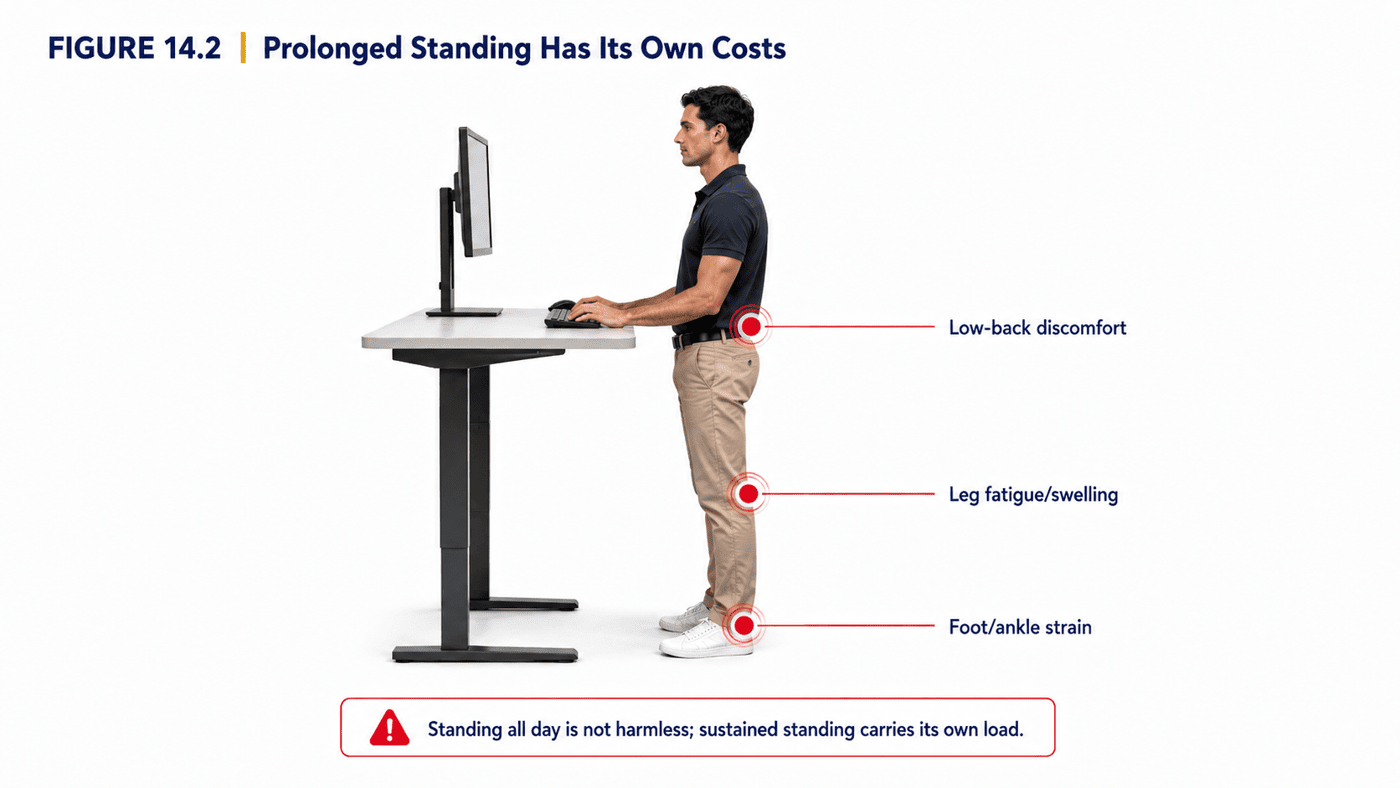
If the benefits of standing have been oversold, its costs have been almost entirely ignored — and they are real. Prolonged standing is not the harmless opposite of sitting; it is its own sustained, static load, with its own well-documented consequences. Waters and Dick (2015), reviewing the evidence on prolonged standing at work, identified a range of associated problems, and Coenen and colleagues (2018) found occupational standing associated with musculoskeletal symptoms, particularly in the low back and lower limbs. Figure 14.2 summarises the principal costs.
These costs follow from the mechanics of holding any position too long. Standing for extended periods is associated with low-back discomfort, as the spine bears a sustained load; with aching, fatigued feet and legs; and, over the longer term, with venous problems such as varicose veins, as blood pools in the legs against gravity without the muscular pumping that walking provides. General fatigue and reduced comfort accompany all of this. The point is not that standing is dangerous — it is not, in moderation — but that prolonged, static standing is simply another sustained posture, with its own bill to pay. Swapping eight hours of sitting for eight hours of standing does not escape the problem of sustained posture; it merely changes which tissues are asked to bear it.
Anti-fatigue mats, footwear and standing comfort
For the periods when a person does choose to stand, a few measures genuinely ease the lower-limb load that prolonged standing imposes, and they are worth knowing precisely because standing has the costs just described. A cushioned anti-fatigue mat underfoot reduces the discomfort of standing on a hard floor, encouraging the small, near-constant shifts of weight that keep the leg muscles active and the circulation moving. Supportive, well-cushioned footwear does similar work, as Chapter 12 discussed; high heels and hard, flat soles make standing harder.
Beyond equipment, how one stands matters. Standing rigidly stock-still is the most fatiguing option; shifting weight from foot to foot, using a low footrail or box to rest one foot and then the other, and generally fidgeting all keep the lower-limb muscles working as a pump and stave off the pooling and aching of static standing. These measures soften the costs of standing but do not abolish them, and they are no substitute for the real remedy of alternating with sitting and, above all, moving. They make standing more comfortable; they do not make prolonged static standing advisable.
Who might benefit most — and who should be cautious
Because bodies and circumstances differ, the standing desk suits some people more than others, and an even-handed account must say so. Some individuals — particularly those whose back discomfort happens to ease in standing rather than sitting — may find that the option to alternate into standing brings real relief, and for them a sit-stand desk, used for alternation, is especially valuable. Others find standing helps their alertness or simply their comfort, and that is reason enough to value the choice.
Equally, some should be cautious about prolonged standing. People with venous problems such as varicose veins, those with certain lower-limb conditions, and women in some stages of pregnancy may find prolonged standing uncomfortable or inadvisable, and anyone whose work already demands long hours on their feet has the opposite problem from the office sitter and needs, if anything, more opportunity to sit. The sensible principle is individual: a sit-stand desk offers a useful additional posture to alternate into, to be used in the proportion that suits the person, and those with relevant medical conditions should be guided by their own healthcare professionals rather than by a general enthusiasm for standing.
14.5 Why Standing Is Not the Opposite of Sitting
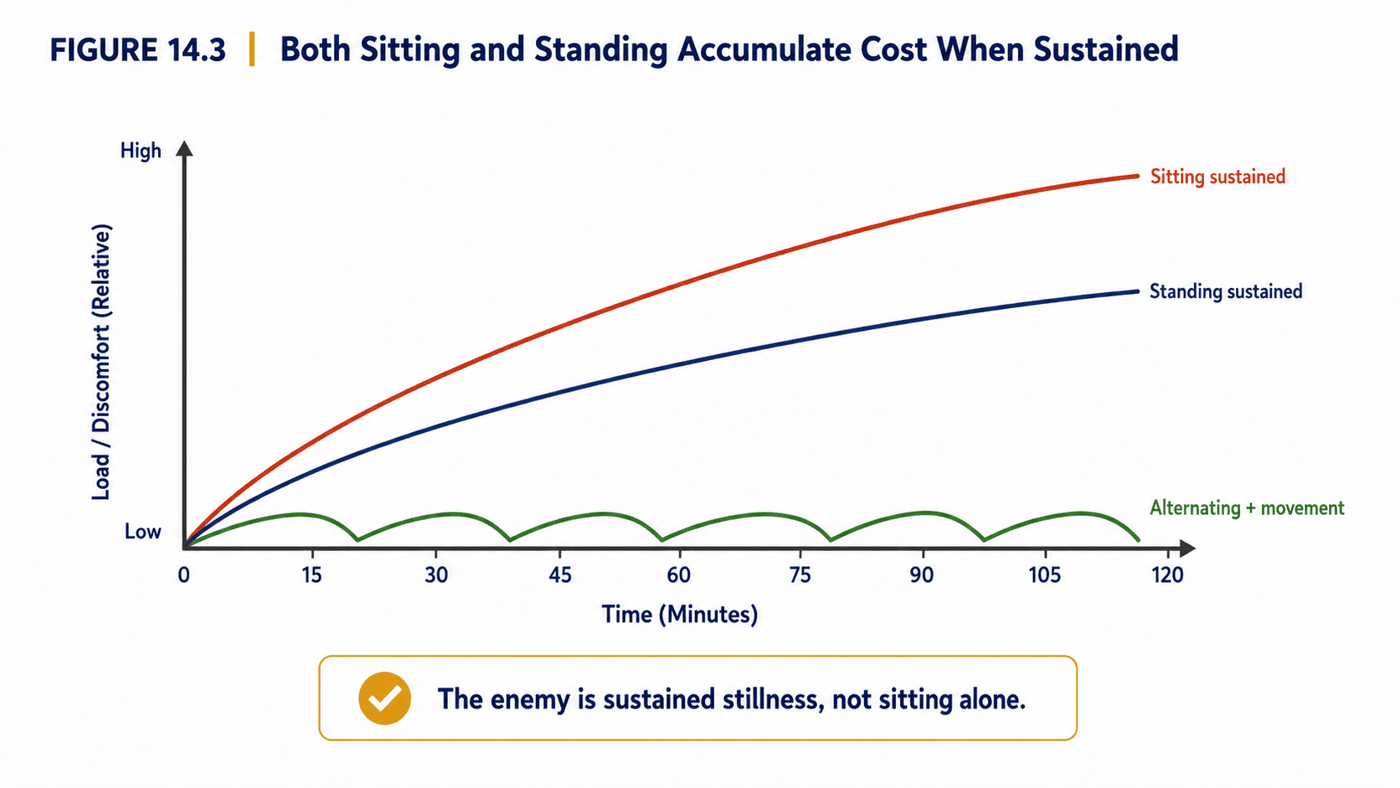
These threads converge on the chapter’s central insight, which quietly dismantles the whole premise of the standing desk as a cure. The intuitive model treats sitting and standing as opposites — sitting bad, standing good, so replace one with the other. But mechanically and metabolically, sitting and standing are not opposites at all; they are siblings. Both are sustained, static postures in which the body is held still and the large muscles do little. The true opposite of both is not the other but movement. Figure 14.3 makes the point: held long enough, both sitting and standing accumulate discomfort and load, and it is alternation and movement — not the choice between the two static options — that keeps the cost low.
This reframing dissolves the standing-desk debate as usually framed. The question was never really ‘sit or stand?’, because both, sustained, are problematic. As Chapter 1 argued, the body’s difficulty with desk work is fundamentally a difficulty with stillness and lack of variation, and a static stander is only marginally better off than a static sitter — indeed, on some measures, such as lower-limb and venous load, worse. The person who buys a standing desk, sets it to standing, and then stands rigidly all day has not solved their problem; they have exchanged one form of stillness for another. The genuine solution lies in a different direction entirely.
14.6 The Real Value: Movement and Alternation
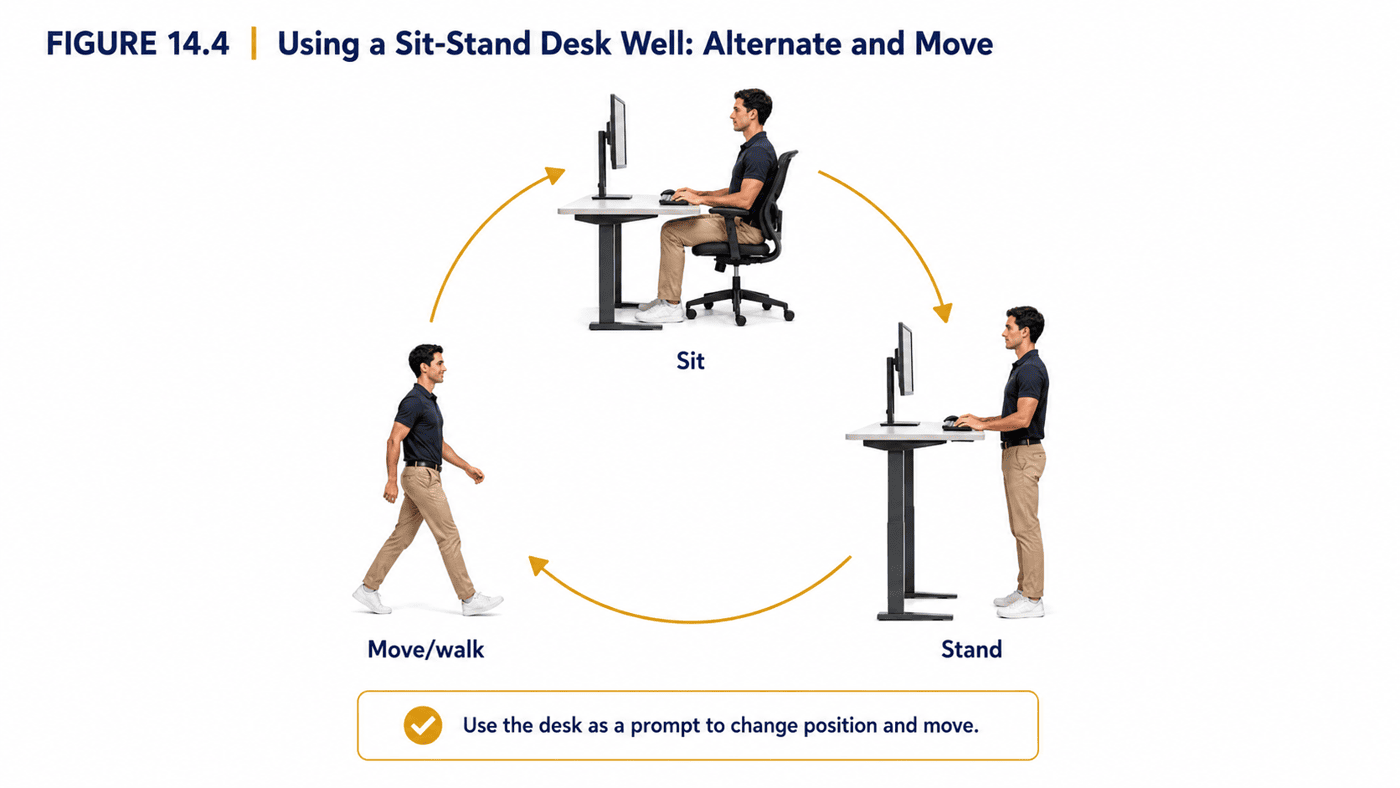
If sitting and standing are both static postures, then the real value of a sit-stand desk is not that it lets you stand, but that it lets you change — and, used well, prompts you to move. Its worth lies in alternation: shifting between sitting and standing through the day so that no single posture is sustained for too long, breaking the long unbroken bouts that do the damage. Figure 14.4 illustrates the contrast between the static extremes — all-day sitting, all-day standing — and the alternating, movement-punctuated pattern that actually serves the body.
Understood this way, the standing desk earns its place not as a cure but as a prompt. Each transition from sitting to standing is itself a small movement and a change of load; the act of standing up periodically interrupts the creep and the metabolic stagnation of sustained sitting; and a desk at standing height invites the small shifts, weight changes and steps that a seated posture discourages. This is a real benefit, and it aligns the standing desk with the deeper logic of this book — but it is a benefit of movement and variation, enabled by the desk, not a benefit of the upright posture in itself. The desk is valuable to the precise extent that it gets you moving and changing; a sit-stand desk left in one position is just a desk.
14.7 Using a Standing Desk Well
It follows that there is a right and a wrong way to use a standing desk, and the difference is decisive. The wrong way is to treat standing as the goal — to set the desk high and stand rigidly for hours, swapping a sitting problem for a standing one. The right way is to treat the desk as a tool for alternation and movement: to shift between sitting and standing through the day, neither sustained for long; to use each posture change as a cue to move, stretch or take a few steps; and to remember that the aim is variation, not the accumulation of standing hours.
A few practical points make this work. There is no magic ratio of sitting to standing; the principle is simply to alternate before either posture becomes sustained, changing every twenty to thirty minutes or whenever discomfort prompts it. Expert guidance on the sedentary workplace has suggested accumulating a couple of hours of standing and light activity across the working day, building gradually toward more (Buckley et al., 2015) — a reasonable target, provided it is reached through alternation and movement rather than static standing. When standing, a supportive shoe or an anti-fatigue mat eases the lower-limb load, and shifting weight, fidgeting and stepping are to be encouraged rather than suppressed. And those new to standing should build up gradually, as prolonged standing on unaccustomed legs has its own costs. Used in this spirit, the standing desk is a genuinely useful instrument — not because standing is good, but because the desk, used well, keeps you changing and moving.
Standing desks and productivity
A further claim often made for standing desks is that they boost productivity, and here too the evidence counsels modesty. Studies of standing and sit-stand desks in the workplace have generally found no clear harm to productivity and, in some cases, small favourable signals for engagement, alertness or wellbeing — but no consistent, large productivity benefit of the kind sometimes advertised. The honest summary is that a sit-stand desk is unlikely to hurt one’s output and may modestly help how one feels at work, but that it should not be justified, or expected, as a performance-enhancing device.
This matters because it keeps the rationale for the desk where it belongs. The case for a sit-stand desk rests on its value as a prompt to alternate posture and move, with whatever modest comfort and wellbeing benefits follow — not on inflated promises of calorie burning, cured backs or transformed productivity. Bought and used in that spirit, it tends to satisfy; bought as a cure-all, it tends to disappoint, and is often quietly abandoned in its lowered, seated position within a few months — a fate that befalls a great many standing desks precisely because they were sold as something they are not.
A familiar case illustrates the right and wrong way to use one. An office worker, alarmed by headlines about the dangers of sitting, bought a standing desk and resolved to stand all day. For the first week he felt virtuous; by the third, his feet ached, his lower back was sore by mid-afternoon, and he was privately wondering whether the desk had made things worse. It had not made things worse so much as revealed the chapter’s central lesson: he had simply swapped one sustained static posture for another, and his body objected to prolonged standing exactly as it had objected to prolonged sitting.
The remedy was not to abandon the desk but to use it correctly. He began alternating — sitting for a stretch, standing for a stretch, neither sustained — and, crucially, used each change of posture as a cue to take a few steps or a brief walk. He added an anti-fatigue mat for his standing spells and stopped treating standing hours as a target to accumulate. Within a fortnight the foot and back discomfort had resolved, and the desk had become what it should always have been: not a cure for sitting, but a convenient prompt to keep changing posture and moving through the day.
A simple way to begin
For anyone setting up a sit-stand desk for the first time, a modest, gradual start prevents the common mistake of standing too much too soon. A reasonable beginning is to stand for a short spell — perhaps fifteen or twenty minutes — in each hour, sitting comfortably for the rest, and to build the standing time gradually as the legs adapt over the following weeks. There is no need to reach any particular total; the aim is to alternate before either posture is sustained, not to accumulate standing hours for their own sake.
Two simple habits make this work. The first is to attach each change of posture to a natural cue — standing for phone calls, sitting to write, rising at the start of each hour — so the alternation happens without constant decision. The second is to treat every transition between sitting and standing as a moment to add a little movement: a few steps, a stretch, a roll of the shoulders. Begun this way, the desk settles quickly into a comfortable rhythm of changing and moving, which is the whole of its value.
| Claim about standing desks | What the evidence shows |
|---|---|
| Standing undoes the harm of sitting | Both are sustained static postures; movement, not standing, is the antidote. |
| Standing burns lots of calories | Only a fraction of a calorie per minute more than sitting (Saeidifard et al., 2018). |
| A standing desk cures back pain | Sit-stand desks reduce sitting time but lack proven health benefits (Shrestha et al., 2018). |
| Standing all day is healthy | Prolonged standing risks back, leg, foot and venous problems (Waters & Dick, 2015; Coenen et al., 2018). |
| Sitting is ‘the new smoking’ | Overstated; activity offsets much of sitting’s risk (Ekelund et al., 2016). |
Table 14.1. Standing-desk claims set against the evidence — an even-handed reckoning.
14.8 Beyond the Desk: The Bigger Picture
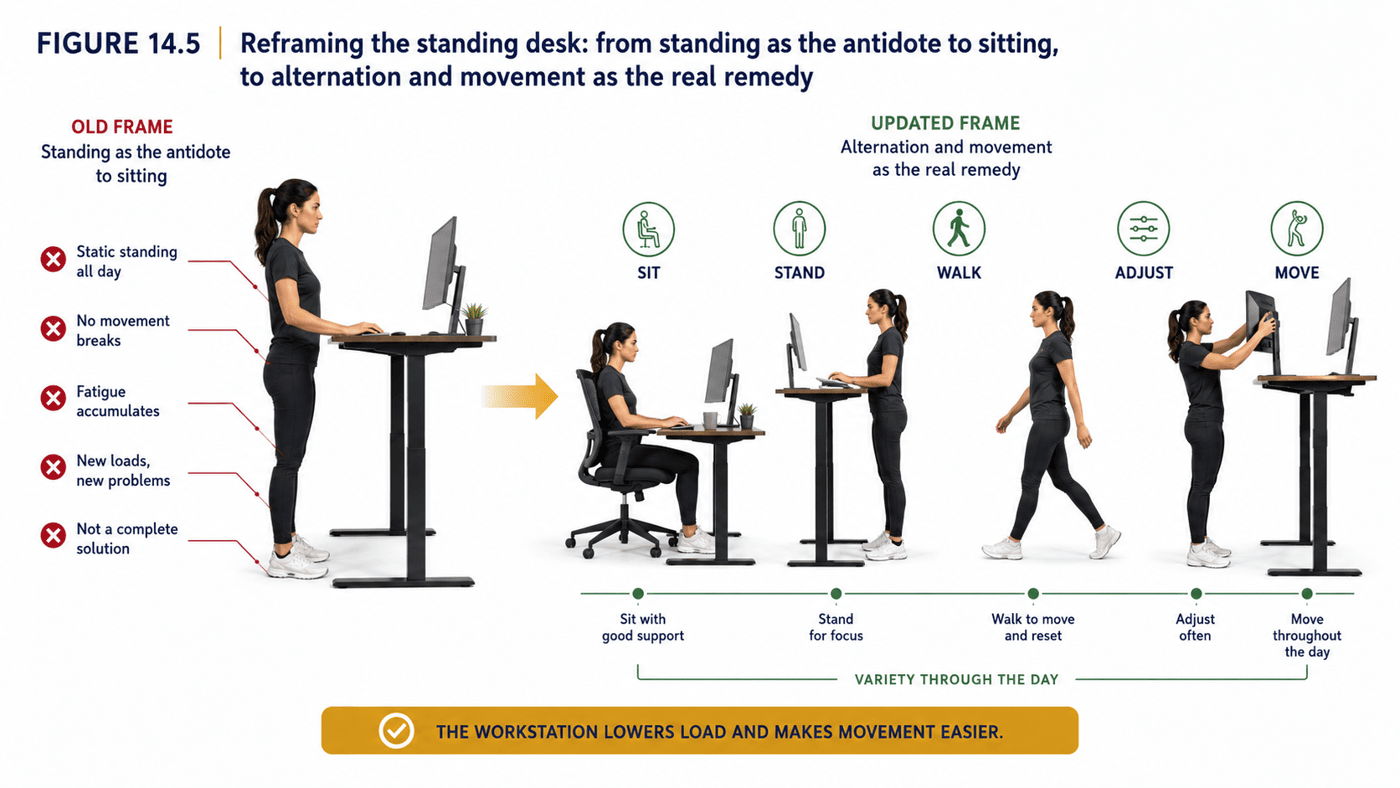
Stepping back, the standing-desk debate is a small part of a larger truth about the desk body, and Figure 14.5 frames the shift in thinking the chapter argues for: from standing as the antidote to sitting, to movement and alternation as the real remedy. The fixation on whether to sit or stand has distracted from the variable that actually matters — how much, and how often, a person moves through the day. The incidental movement of daily life, sometimes called non-exercise activity, and the walking examined throughout this book, do far more for the desk body than any stationary posture, upright or seated.
This places the standing desk in its proper, modest perspective. It is one tool among many, useful insofar as it nudges a person toward more movement and less sustained sitting, and worth having on those terms. But it is no substitute for the larger pattern of an active day — the walking, the breaks, the general movement — that the final parts of this book develop. The person who has a standing desk but rarely moves has missed the point; the person who moves often needs no standing desk to be well, though they may still find one a helpful prompt. The desk is a detail; movement is the principle, and it is to movement, in its smallest and most powerful form, that the next chapter turns.
What about treadmill and cycle desks?
A reasonable question follows from all this: if movement is the goal, do treadmill desks and under-desk cycles — which add actual movement to desk work — deliver what the standing desk cannot? In principle, yes: by introducing genuine movement, they raise energy expenditure meaningfully and break the stillness that is the real problem, and for some people they are a useful tool. But they carry their own trade-offs. Typing and fine mouse work are measurably harder while walking or pedalling; the equipment is bulkier and costlier; and the movement is necessarily slow and low-intensity. They are best seen as one more option for building movement into the day rather than as a universal answer, and — like the standing desk — they are valuable for the movement they add, not for any magic in the device. For most people, the simpler and more powerful tool is the one the next chapter describes: the deliberate movement break, which requires no equipment at all.
An honest balance sheet
It is worth drawing the chapter’s even-handed verdict together explicitly, because the standing desk has been so thoroughly oversold and, in reaction, so unfairly dismissed. On the credit side, the benefits are real if modest: a sit-stand desk reliably reduces the time spent sitting at work, it offers an additional posture to alternate into, and it can prompt the movement and posture changes that genuinely serve the body. For some people it eases discomfort and lifts alertness. These are worthwhile, and they make the desk a legitimate tool.
On the debit side stand the claims that do not survive scrutiny: that standing meaningfully burns calories, that it cures back pain, that it transforms productivity, or that it undoes the harm of sitting. None of these holds, and prolonged static standing brings its own costs. And in the column marked unknown sits an honest admission a research institute should make plainly: the long-term health effects of sit-stand desks remain uncertain, because most of the evidence is short-term and of modest quality (Shrestha et al., 2018). We can say that these desks change behaviour somewhat; we cannot yet say that they change health outcomes.
The balanced conclusion follows. A sit-stand desk is a reasonable, modestly useful tool for anyone who will use it to alternate posture and move — worth having on those terms, and worth nothing on the inflated ones. But it is no substitute for the movement habit that the next chapter describes, and the person without a standing desk loses little, while the person with one gains little unless they actually move. The honest bottom line is the one this whole part has built toward: buy the desk if you like, but build the habit regardless — the habit is the thing.
In summary
- The standing desk arrived as the cure for sitting, propelled by the overstated slogan that ‘sitting is the new smoking’; the reality is more modest and more useful.
- The best evidence (a Cochrane review) finds sit-stand desks reduce workplace sitting time but, on low-quality evidence, without proven broader health benefits (Shrestha et al., 2018).
- Standing burns only a fraction of a calorie per minute more than sitting — useless for weight loss; it is movement, not the upright posture, that raises energy expenditure (Saeidifard et al., 2018).
- Prolonged standing has its own costs — low-back, leg and foot discomfort and venous problems — so swapping sitting for standing solves nothing (Waters & Dick, 2015; Coenen et al., 2018).
- Sitting and standing are not opposites but siblings: both sustained static postures. The true opposite of both is movement.
- The real value of a sit-stand desk is as a prompt to alternate and move; used to stand rigidly all day it achieves little, but used to break up sitting and trigger movement it genuinely helps (Buckley et al., 2015).
- The standing desk is a modest tool within the larger principle of an active day; movement, not posture choice, is what matters — the subject of the next chapter.
References
Biswas, A., Oh, P. I., Faulkner, G. E., Bajaj, R. R., Silver, M. A., Mitchell, M. S., & Alter, D. A. (2015). Sedentary time and its association with risk for disease incidence, mortality, and hospitalization in adults. Annals of Internal Medicine, 162(2), 123–132.
Buckley, J. P., Hedge, A., Yates, T., Copeland, R. J., Loosemore, M., Hamer, M., … Dunstan, D. W. (2015). The sedentary office: An expert statement on the growing case for change towards better health and productivity. British Journal of Sports Medicine, 49(21), 1357–1362.
Coenen, P., Parry, S., Willenberg, L., Shi, J. W., Romero, L., Blackwood, D. M., … Straker, L. M. (2018). Associations of prolonged standing with musculoskeletal symptoms: A systematic review of laboratory studies. Gait & Posture, 58, 310–318.
Ekelund, U., Steene-Johannessen, J., Brown, W. J., Fagerland, M. W., Owen, N., Powell, K. E., … Lee, I.-M. (2016). Does physical activity attenuate, or even eliminate, the detrimental association of sitting time with mortality? The Lancet, 388(10051), 1302–1310.
Saeidifard, F., Medina-Inojosa, J. R., Supervia, M., Olson, T. P., Somers, V. K., Erwin, P. J., & Lopez-Jimenez, F. (2018). Differences in energy expenditure between sitting and standing: A systematic review and meta-analysis. European Journal of Preventive Cardiology, 25(5), 522–538.
Shrestha, N., Kukkonen-Harjula, K. T., Verbeek, J. H., Ijaz, S., Hermans, V., & Pedisic, Z. (2018). Workplace interventions for reducing sitting at work. Cochrane Database of Systematic Reviews, (6), CD010912.
Waters, T. R., & Dick, R. B. (2015). Evidence of health risks associated with prolonged standing at work and intervention effectiveness. Rehabilitation Nursing, 40(3), 148–165.