Part IV · HIPS, LEGS AND LOST MOVEMENT CAPACITY
Feet, Ankles and the Lost Ground Connection
At the very bottom of the desk body lies its most neglected structure: the foot. Built to feel, grip and adapt to the ground, it spends the modern day shod, cushioned and still. This chapter follows the lost connection to the ground — and how to rebuild a foot that can sense and work again.
12.1 The Foot: A Sophisticated Foundation
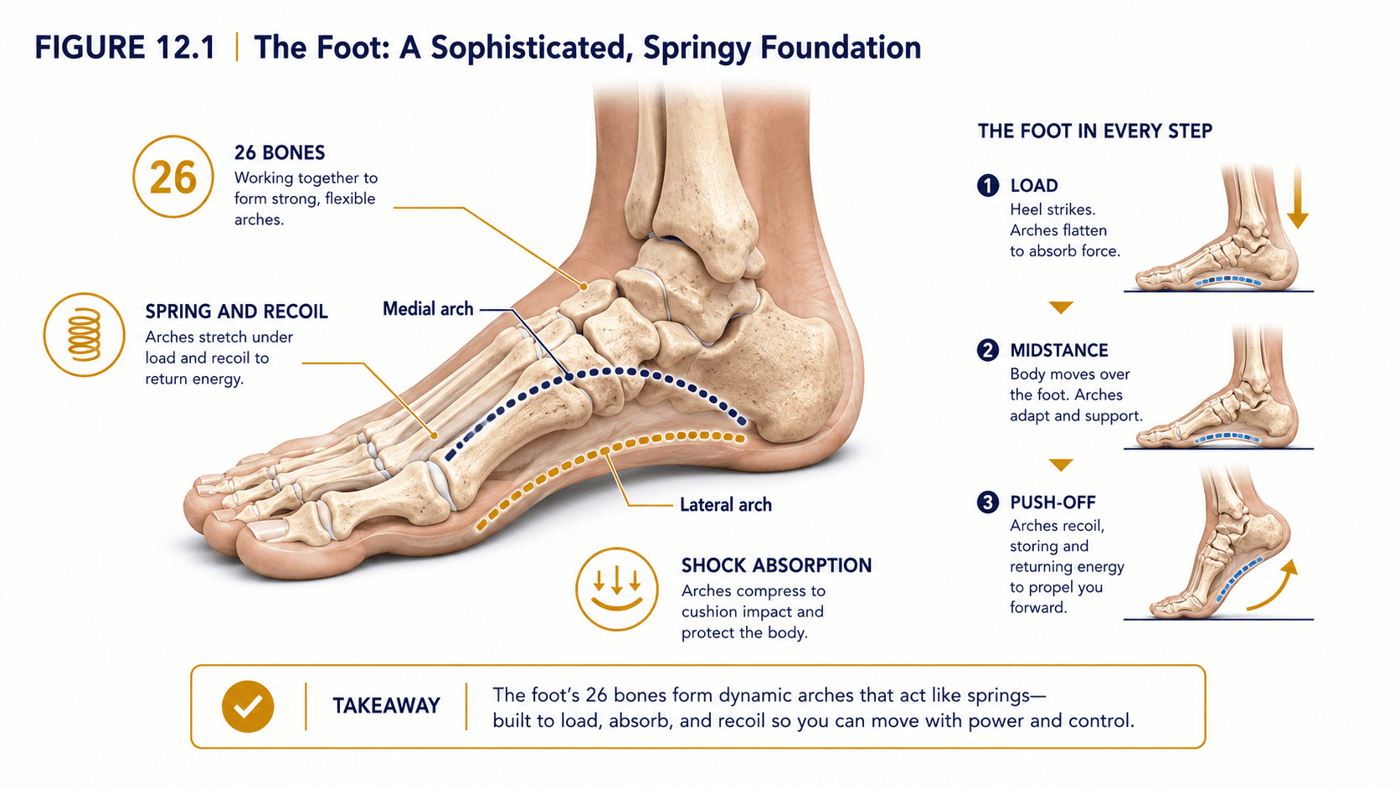
The descent of this book ends where the body meets the ground: at the foot. It is, by any measure, a remarkable structure. Each foot contains twenty-six bones — a quarter of all the bones in the body sit in the two feet — along with more than thirty joints, dozens of muscles, and a dense web of ligaments and tendons. These are arranged into arches, chiefly the medial longitudinal arch on the inner border of the foot, which give it the properties of both a spring and a shock absorber, as Figure 12.1 shows. The foot can stiffen into a rigid lever to push off the ground and soften into a flexible adapter to mould to uneven terrain, switching between the two many times a second as we move (Neumann, 2017).
This sophistication evolved for a purpose. The human foot is the product of millions of years of walking and running across varied, natural ground — sensing its texture, gripping its irregularities, adapting to its slopes. It is, like the hip, a structure built to be used: loaded, flexed, stimulated and challenged by an ever-changing surface. And, like the hip, it meets in modern life almost the opposite of what it was built for. Encased in a cushioned, supportive, often narrow shoe, set upon flat, hard, uniform floors, and — for the desk worker — lifted off the ground entirely for hours of sitting, the foot is under-stimulated and under-used to a degree no other part of the body quite matches.
This chapter follows the consequences. It examines how modern footwear and surfaces under-work the foot; how the arch is actively supported by muscles that weaken when chronically propped up; how lost ankle mobility ripples up the leg; how the foot functions as a sensory organ whose feedback dims with disuse; and, navigating the footwear debate even-handedly, how to rebuild a foot that can once again sense, grip and work. The lost ground connection, like every other deficit in this book, is largely recoverable — but it has been lost more completely than most.
12.2 What Modern Life Does to the Foot
Three features of modern life combine to under-work the foot. The first is footwear: most shoes cushion the foot from the ground, support its arch, constrain its movement and — frequently — crowd its toes into a narrow box with the heel raised above the forefoot. The second is the ground itself: modern surfaces are flat, hard, smooth and uniform, offering none of the varied texture and challenge that natural terrain once provided. The third, for the desk worker, is sitting, which removes the foot from the ground altogether for much of the day, so that it bears no load and does no work at all.
The cumulative effect is a foot that is rarely asked to do the things it is built for. Its muscles do not have to support the arch, because the shoe does it. Its joints do not have to adapt to varied ground, because the ground is flat. Its sensors are not stimulated by texture and pressure, because a cushioned sole intervenes. And for hours of sitting, it does nothing whatever. Predictably, and exactly as the load-response principle of Chapter 1 would forecast, an under-used foot becomes a weaker, stiffer, less sensitive foot — the small intrinsic muscles weaken, the joints lose some mobility, and the sensory feedback dims. The table below summarises the common features of footwear and their mechanical trade-offs.
| Footwear feature | What it does | Trade-off to weigh |
|---|---|---|
| Cushioning | Softens impact with the ground | Blunts sensory feedback; foot works less |
| Arch support | Props the arch passively | Intrinsic arch muscles may under-work |
| Heel-to-toe drop (raised heel) | Tilts weight forward | Can shorten the calf and Achilles over time |
| Narrow toe box | Tapers the front of the shoe | Crowds the toes; limits natural toe splay |
| Stiff sole | Restricts foot bending | Reduces the foot’s own movement and work |
Table 12.1. Common footwear features and their mechanical trade-offs. Each can serve a purpose, but each can also under-work the foot.
12.3 The Arch and the Foot Core
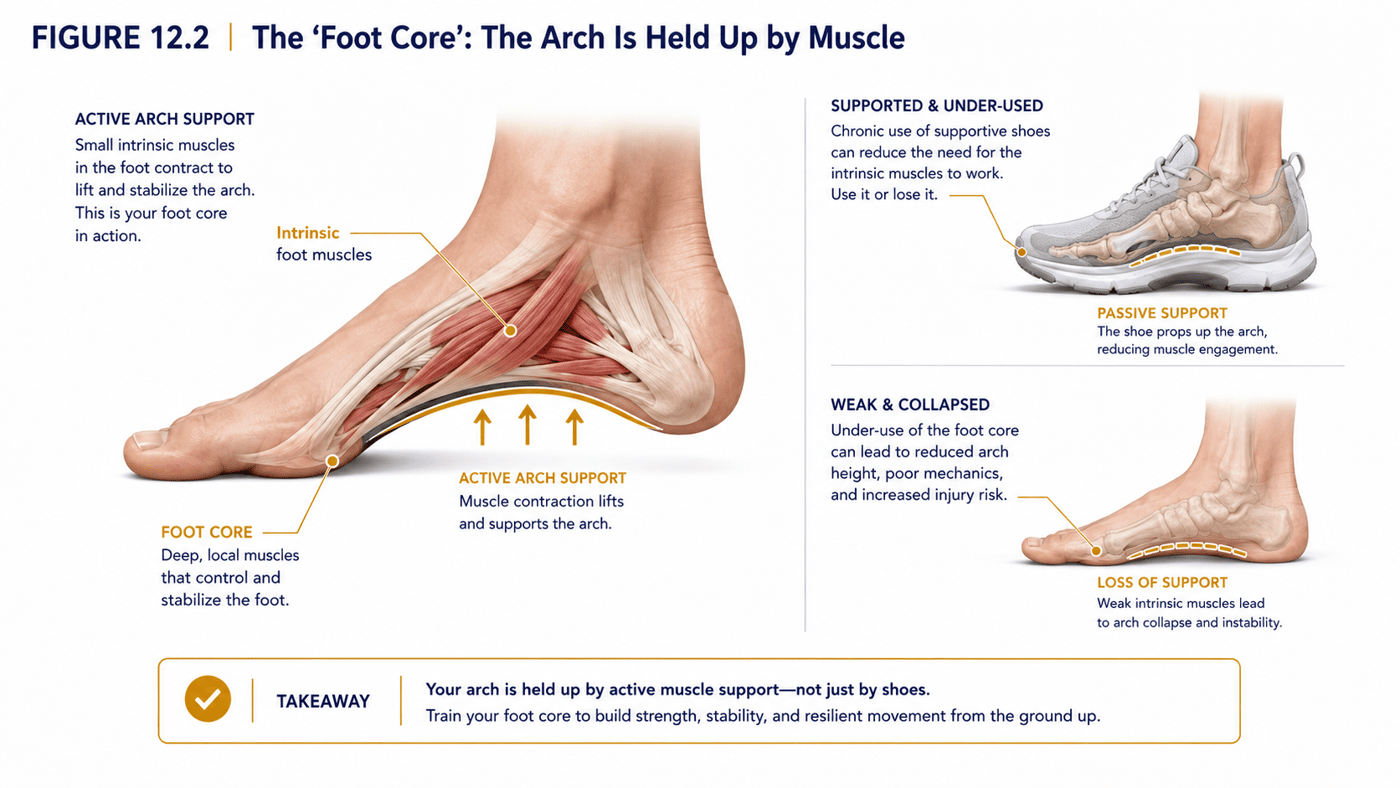
Central to understanding the under-worked foot is a shift in how the arch itself is viewed. The traditional picture treats the arch as a passive structure, held up by the shape of the bones and the tension of the ligaments and the plantar fascia beneath it — a kind of architectural arch that simply needs propping if it sags. But this picture is incomplete. The arch is also held and controlled actively, by the small intrinsic muscles within the foot itself. McKeon and colleagues (2015) formalised this insight in their influential concept of the foot core system, drawing a direct analogy with the lumbopelvic core: just as deep trunk muscles actively stabilise the spine, the intrinsic foot muscles actively stabilise and control the arch. Figure 12.2 contrasts a foot whose intrinsic muscles hold the arch well with one whose weakened muscles let it collapse.
This reframing has a pointed implication for the supportive shoe. If the arch depends in part on active muscular support, then chronically propping it up with external arch support may, over time, allow those intrinsic muscles to under-work and weaken — in the same way that a limb in a cast emerges weaker, or the under-loaded back of Chapter 8 loses capacity. The very support intended to help the foot can, if relied upon constantly, contribute to the weakness it was meant to address. This is the foot’s version of the central paradox of this book: that protecting a structure from work is not the same as caring for it, and can quietly diminish it.
The toes and the push-off
The toes, and the big toe above all, play a larger role than their size suggests, and they are among the structures most compromised by modern footwear. At the end of each step, as the heel lifts and the body rolls forward over the foot, the toes extend and the big toe presses into the ground to drive the push-off. This toe extension also tightens the plantar fascia beneath the arch — the so-called windlass mechanism — stiffening the foot into a rigid, efficient lever just when propulsion demands it. A strong, mobile, well-splayed set of toes is therefore central to powerful, efficient walking.
Narrow, tapering toe boxes work against all of this. By crowding the toes together and preventing them from splaying, they reduce the toes’ contribution to push-off and balance, and over years can contribute to deformities such as hallux valgus, the drift of the big toe that underlies a bunion. A foot whose toes are habitually constrained and under-used loses some of its propulsive power and some of its broad, stable base. Allowing the toes room to spread — through wider footwear and barefoot time — and using them actively is a small but genuine part of rebuilding the foot.
12.4 Ankle Mobility and the Chain
Just above the foot, the ankle contributes its own commonly lost movement: dorsiflexion, the upward movement of the foot toward the shin, or equivalently the forward travel of the shin over a planted foot. Adequate dorsiflexion is essential for walking, for descending stairs, for squatting and for rising from a chair, and it is readily lost — to a tight calf and Achilles (encouraged, as Section 12.2 noted, by raised heels and under-use), to joint stiffness, and to the general immobility of a sedentary life. Figure 12.3 shows why its loss matters.
When the ankle cannot dorsiflex adequately, the shin cannot travel forward over the foot, and — just as with the stiff hip of Chapter 10 — the body finds the movement elsewhere. The compensations cascade through the lower limb: the heel may lift early, the foot may roll inward and the arch collapse to find more range, the knee may fall inward, and the hips and low back may compensate further up. Dill and colleagues (2014) demonstrated exactly this kind of effect, showing that people with limited weight-bearing ankle dorsiflexion altered their knee and ankle mechanics during squatting. The ankle, like every joint in this book, does not suffer its stiffness alone — it passes the cost up the chain.
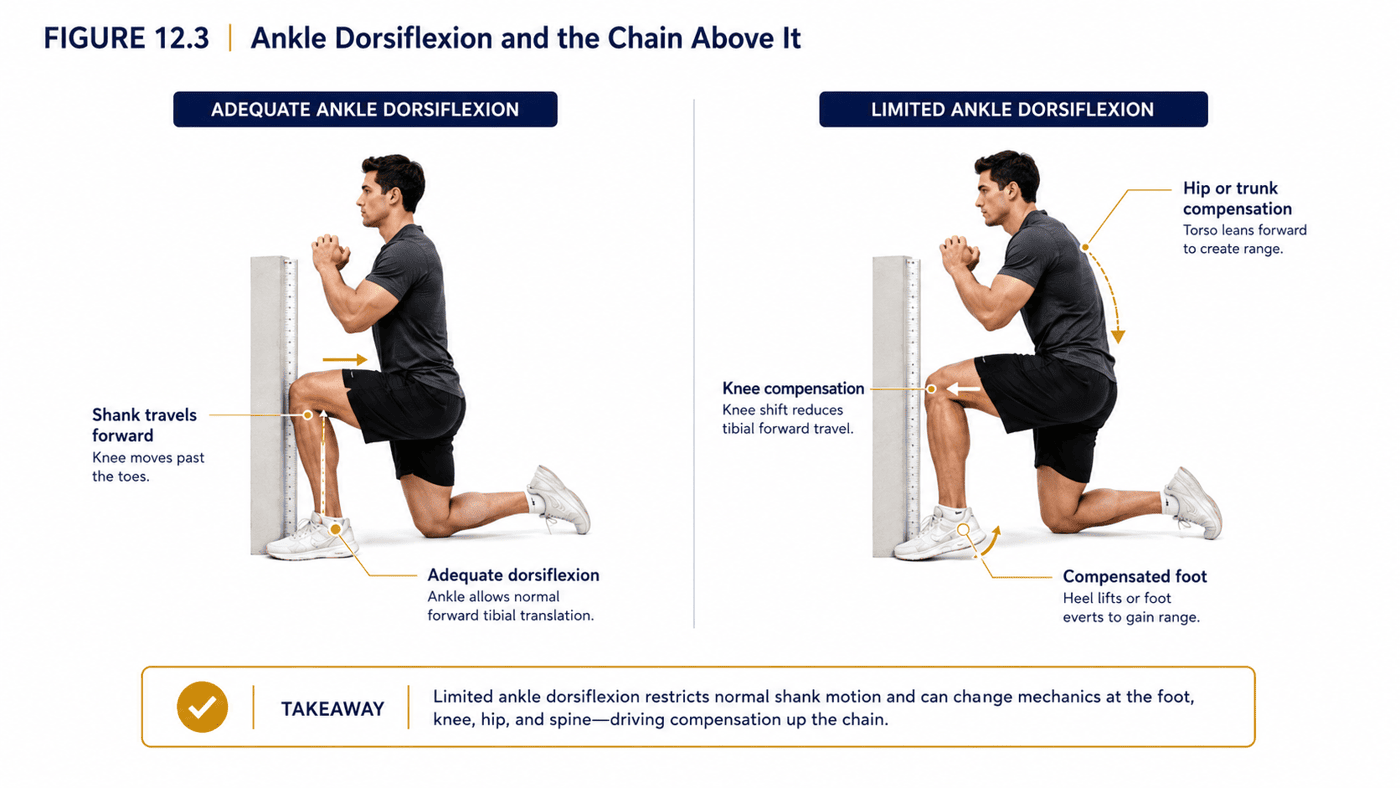
This makes ankle mobility, and calf flexibility in particular, a worthwhile and often-overlooked target. A simple test of weight-bearing dorsiflexion — how far the knee can travel forward over the toes with the heel down — reveals restrictions that may be quietly driving compensation at the knee or hip. Restoring dorsiflexion, through calf mobility and loaded ankle movement, can relieve problems some distance away, in the same spirit as restoring hip extension relieves the back.
The calf, the Achilles and the spring
Behind the ankle sits a structure central to efficient movement: the calf complex — the gastrocnemius and soleus — and the Achilles tendon that joins them to the heel. Beyond simply pushing the body off the ground at each step, this complex acts as a powerful elastic spring: the Achilles stretches and stores energy as the body passes over the foot, then recoils to return it at push-off, making walking and running far more economical than muscle power alone could. A strong calf and a well-conditioned Achilles are quietly fundamental to how efficiently we move.
Sitting and modern footwear under-serve this spring. Hours off the feet leave the calf unloaded, and a raised heel keeps it in a shortened position, so that over time the calf weakens and the Achilles loses some of its conditioning. The result is a less capable push-off and an ankle complex more easily strained when suddenly demanded. Loading the calf — through walking, and through deliberate work such as heel raises — rebuilds both its strength and its spring, complementing the ankle mobility and foot-core work described above.
12.5 The Footwear Question
No chapter on the foot can avoid the contested question of footwear, and here it is important to be even-handed, because the evidence is genuinely mixed and strong claims abound on every side. On one side, advocates of minimalist or barefoot-style footwear argue that the foot functions best when free to move, feel and work as it evolved to. Lieberman et al. (2010) showed that habitually barefoot runners tend to strike the ground differently from shod runners, avoiding a sharp impact transient; Robbins and Hanna (1987) argued that barefoot activity may engage the foot’s own protective and shock-absorbing behaviour. Franklin et al. (2015), reviewing barefoot and shod walking, documented consistent differences in mechanics and muscle activity between the two. The logic of the foot core concept points the same way: a foot that is allowed to work tends to be a stronger foot.
On the other side, caution is warranted, and the evidence does not support sweeping claims that any one type of footwear prevents injury or suits everyone. Feet differ; needs differ; and some people — those with certain structural conditions, diabetes-related nerve loss, or specific diagnosed problems — genuinely benefit from supportive footwear or prescribed orthotics, which should not be abandoned on the strength of a general argument. Moreover, a foot long accustomed to cushioning and support cannot safely be thrown into barefoot activity overnight; doing so too quickly is a well-recognised route to injury, as the under-prepared tissues are suddenly overloaded (Mueller & Maluf, 2002). The sensible reading of the evidence is therefore neither ‘shoes are bad’ nor ‘support is essential’, but something more measured: that footwear is a tool with trade-offs, that chronically over-supporting and over-cushioning a healthy foot can under-work it, and that the remedy is gradual, individual and sensible rather than ideological.
Transitioning to less shoe, safely
For the healthy foot, the practical question raised by all of this is how to move toward footwear that allows more natural movement — and the answer, above all, is slowly. A foot that has spent decades cushioned, supported and raised at the heel has under-prepared tissues: weak intrinsic muscles, a calf and Achilles accustomed to a raised heel, and sensors dulled by insulation. Asking such a foot to go suddenly barefoot or into flat, minimal shoes for long periods is a well-recognised route to injury, from calf and Achilles strain to stress reactions in the bones of the forefoot.
A sensible transition introduces change gradually and watches the response. That means short periods barefoot or in less-supportive shoes at first, building up over weeks and months as the foot adapts; reducing heel-to-toe drop step by step rather than all at once; and treating new soreness as a signal to progress more slowly. The foot, like any other structure being reconditioned, follows the load-response principle of Chapter 1: it strengthens in response to gradually increasing demand, and is injured by demand that outruns its current capacity. Patience is not optional here — it is the whole method. And those with diagnosed conditions should make such changes only with professional guidance.
12.6 The Foot as a Sensory Organ
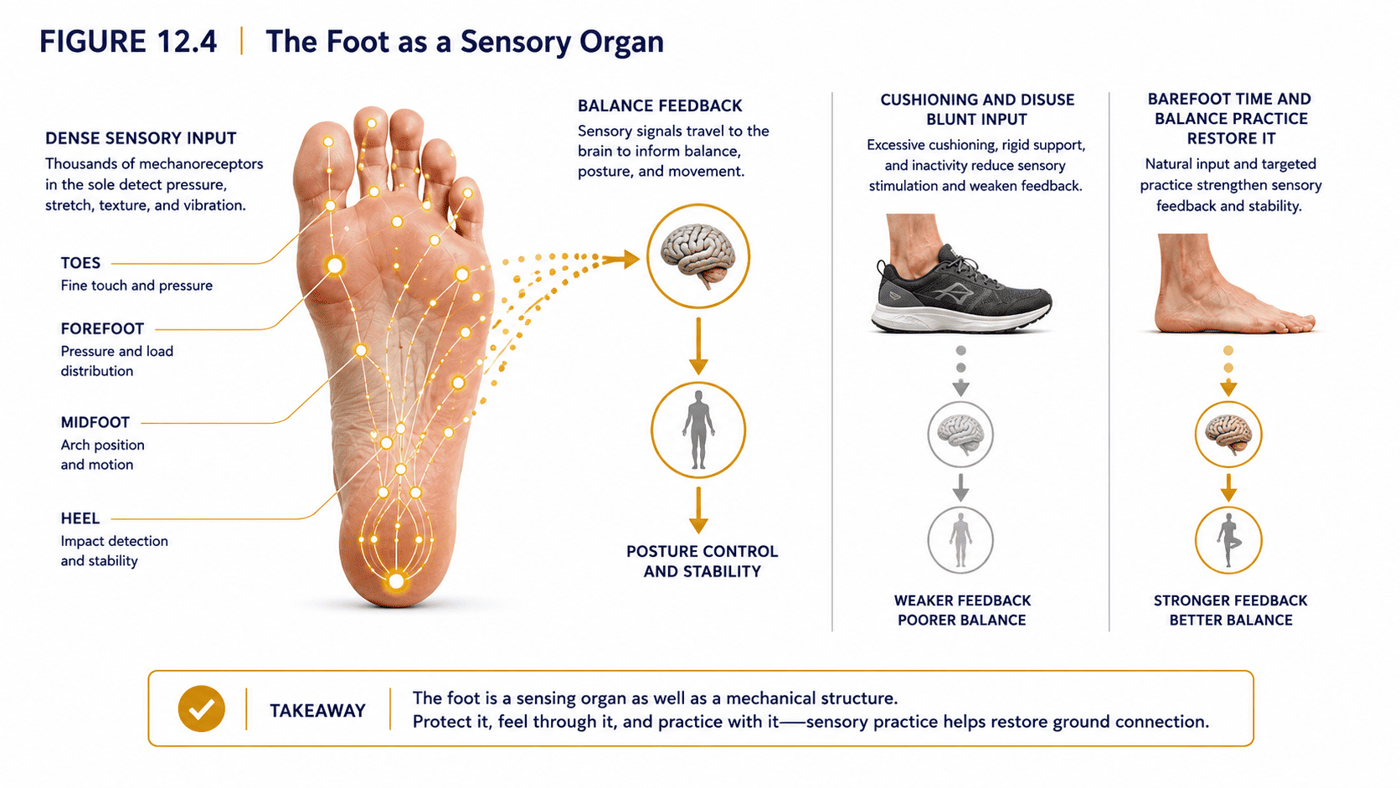
Beyond its mechanical roles, the foot is a sensory organ of remarkable richness. The sole is densely populated with receptors that sense pressure, texture, stretch and the position of the joints, and this stream of information is central to balance. The body knows where it is and how it is moving, in large part, through what the feet report from the ground; the foot is the body’s primary point of contact with the world, and its sensory feedback continuously informs the adjustments that keep us upright, as Figure 12.4 illustrates.
This sensory role, too, is blunted by modern life. A cushioned sole between the foot and the ground dampens the very feedback the balance system depends on, and a foot that is rarely challenged — shod, on flat ground, or off the ground entirely in sitting — receives little of the varied stimulation that keeps the system sharp. The consequence is a gradual dulling of proprioception and balance, which matters at every age and matters enormously with advancing years, when declining balance is a principal cause of falls. The encouraging counterpart, developed below, is that this sensory and balance capacity is highly trainable: the system sharpens with use, responding to barefoot stimulation and to deliberate balance practice much as a muscle responds to load.
Balance is trainable at any age
It is worth dwelling on the trainability of balance, because it is one of the most valuable and under-appreciated returns on attending to the foot. Balance is not a fixed endowment that simply erodes with age; it is a skill, supported by sensory feedback and muscular control, that improves with practice at any stage of life. Standing on one leg, moving on varied surfaces, and challenging stability deliberately all sharpen the system, strengthening both the sensory feedback from the foot and the rapid muscular responses that act on it. For the desk worker, whose balance is quietly under-challenged by a shod, seated, flat-floored life, a little regular balance practice pays dividends now in coordination and control, and pays still larger ones in the decades ahead, when good balance becomes one of the strongest protections against falls and their consequences.
12.7 Building Foot and Ankle Capacity
The strategy for the foot and ankle gathers the threads of this chapter into a programme of gentle, progressive re-use. Its strands are: to let the foot feel and work, through carefully introduced barefoot time on varied surfaces that stimulates the sensors and engages the intrinsic muscles; to strengthen the foot core, through specific work for the small intrinsic muscles that support the arch; to restore ankle mobility, through calf flexibility and loaded dorsiflexion; and to train balance, through single-leg and unstable-surface practice that sharpens the sensory feedback the foot provides. Figure 12.5 sets the old framing against the new: from propping up a foot treated as weak and fragile, to training a foot treated as capable and adaptable.
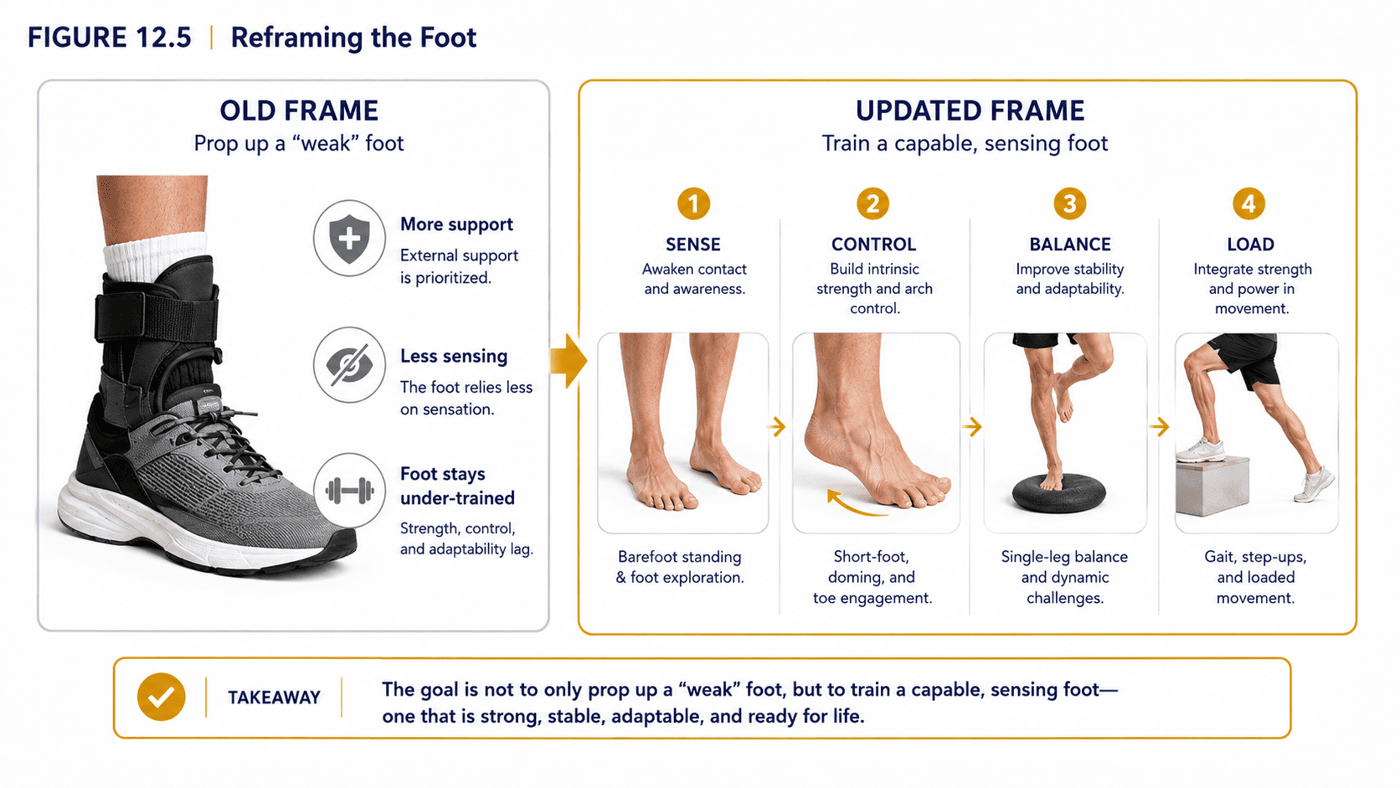
Two cautions keep this programme safe and sensible. The first is that everything must be gradual: a foot long supported and cushioned has under-prepared tissues, and barefoot time, foot strengthening and new loading must be introduced slowly and built up patiently, exactly as one would progress any other reconditioning. The second is that individual needs are real: people with diagnosed foot conditions, nerve loss, diabetes or other medical considerations should be guided by their healthcare professionals, and prescribed support or orthotics should not be abandoned on the basis of a general principle. Within those bounds, the foot — the most neglected structure in the desk body — responds as willingly as any other to being allowed, once more, to do its job.
| Common foot claim | What the evidence and mechanics suggest |
|---|---|
| Flat or weak arches just need support | The arch is actively muscled; constant support can under-work it (McKeon et al., 2015). |
| Cushioning is always better for the foot | Cushioning blunts feedback and reduces the foot’s own work; it is a trade-off, not a pure good. |
| Stiff ankles are a local nuisance | Limited dorsiflexion drives compensation up the knee, hip and back (Dill et al., 2014). |
| Barefoot is best for everyone | Evidence is mixed; benefits are real but transition must be gradual and individual needs respected. |
| Balance just declines with age | Balance is a trainable skill at any age, sharpened by practice and foot stimulation. |
Table 12.2. Common foot and ankle claims set against current evidence and mechanical reasoning.
A final case draws the chapter together. A desk worker in his forties notices that his feet feel weak and his arches ache by evening, that his balance on one leg is poor, and that his calves feel perpetually tight. He has been advised to buy more supportive, cushioned shoes, which bring brief comfort but no lasting change. Seen through this chapter, his feet are simply under-worked: chronically supported arches whose intrinsic muscles have weakened, an ankle that has lost dorsiflexion, and a sensory system dulled by insulation and disuse — a foot, in short, that has lost its connection to the ground.
The path back is gradual re-use. Carefully introduced barefoot time on varied surfaces, specific foot-strengthening work, calf and ankle mobility, and a little daily balance practice rebuild over patient weeks what the shoe had taken over: the arch is held by its own muscle again, the ankle moves, the balance sharpens, and the feet feel strong rather than weak. The supportive shoe had treated the symptom while deepening the cause; the remedy was not more support, but a foot allowed once more to feel, work and carry him.
The whole lower limb: one chain from foot to hip
Stepping back, the three chapters of this part describe not three separate problems but one connected system. The foot, the ankle, the knee and the hip form a single kinetic chain, and a deficit at any level is paid for at the others. A foot whose arch collapses lets the knee fall inward; an ankle that cannot dorsiflex sends its compensation up to the knee, hip and back; a stiff hip exports its workload to the low back; a weak gluteus medius lets the pelvis drop and the knee cave. The lower body is a chain, and the chair acts upon every link of it at once.
The practical consequence is that the lower limb is best addressed as a whole. Restoring ankle dorsiflexion supports the knee and hip above it; strengthening the foot core steadies the entire chain from the ground up; waking the glutes and reclaiming hip extension relieve both the knee below and the back above. The person who rebuilds the foot, frees the ankle, strengthens the posterior chain and mobilises the hip is not treating four regions but one system — and that integrated approach, rather than a single stretch or insole aimed at one link, is what restores a lower body that can carry, propel and balance as it was built to.
In summary
- The foot is a sophisticated foundation — twenty-six bones, arches that spring and absorb shock, and a dense sensory web — built to feel, grip and adapt to varied ground.
- Modern footwear, flat hard surfaces and sitting combine to under-stimulate and under-work the foot, weakening its muscles, stiffening its joints and dimming its sensory feedback.
- The arch is held actively by the intrinsic ‘foot core’ muscles; chronically propping it up with support can let those muscles under-work and weaken (McKeon et al., 2015).
- Lost ankle dorsiflexion drives compensation up the chain — at the foot, knee, hip and low back (Dill et al., 2014).
- Footwear is a tool with trade-offs; the evidence supports neither blanket minimalism nor universal support, and individual needs must be respected (Lieberman et al., 2010; Franklin et al., 2015).
- The foot is a sensory organ central to balance, which dulls with disuse but is highly trainable at any age — with large benefits for falls prevention.
- The remedy is gradual, sensible re-use: barefoot time, foot-core strengthening, ankle mobility and balance practice — rebuilding a foot that can sense, grip and work again.
References
Dill, K. E., Begalle, R. L., Frank, B. S., Zinder, S. M., & Padua, D. A. (2014). Altered knee and ankle kinematics during squatting in those with limited weight-bearing-lunge ankle-dorsiflexion range of motion. Journal of Athletic Training, 49(6), 723–732.
Franklin, S., Grey, M. J., Heneghan, N., Bowen, L., & Li, F. X. (2015). Barefoot vs common footwear: A systematic review of the kinematic, kinetic and muscle activity differences during walking. Gait & Posture, 42(3), 230–239.
Lieberman, D. E., Venkadesan, M., Werbel, W. A., Daoud, A. I., D’Andrea, S., Davis, I. S., … Pitsiladis, Y. (2010). Foot strike patterns and collision forces in habitually barefoot versus shod runners. Nature, 463(7280), 531–535.
McKeon, P. O., Hertel, J., Bramble, D., & Davis, I. (2015). The foot core system: A new paradigm for understanding intrinsic foot muscle function. British Journal of Sports Medicine, 49(5), 290.
Mueller, M. J., & Maluf, K. S. (2002). Tissue adaptation to physical stress: A proposed “physical stress theory” to guide physical therapist practice, education, and research. Physical Therapy, 82(4), 383–403.
Neumann, D. A. (2017). Kinesiology of the musculoskeletal system: Foundations for rehabilitation (3rd ed.). Elsevier.
Robbins, S. E., & Hanna, A. M. (1987). Running-related injury prevention through barefoot adaptations. Medicine & Science in Sports & Exercise, 19(2), 148–156.