Part IV · HIPS, LEGS AND LOST MOVEMENT CAPACITY
Glutes, Hamstrings and the Chair Effect
The glutes and hamstrings are the body’s powerhouse — the engine of every step, jump and lift. They are also the muscles a chair switches off most completely. This chapter separates the real mechanics of an under-used posterior chain from the myths of the ‘dead butt’ and the ‘tight hamstring’.
11.1 The Posterior Chain: The Body’s Powerhouse
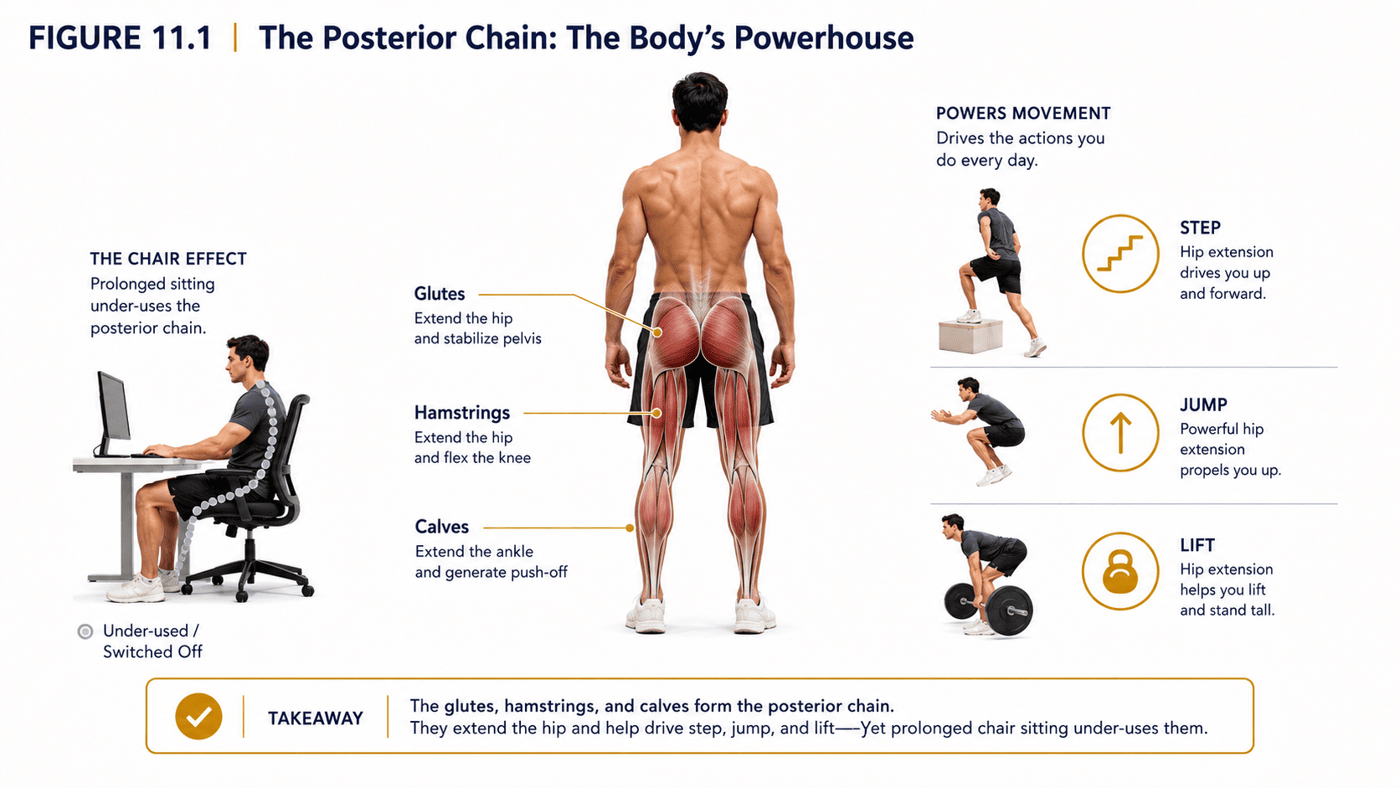
If the front of the hip is what sitting shortens, the back of the body is what sitting silences. The muscles of the posterior chain — the gluteals, the hamstrings and the calves — are, collectively, the most powerful muscle group in the body, and they share a single great purpose: to extend the hip and drive the body forward. Every step taken, every stair climbed, every jump and sprint and heavy lift is powered from behind, by this chain. Figure 11.1 shows its members: the gluteus maximus at the hip, the hamstrings spanning hip and knee, and the calf at the ankle.
It is one of the cruel ironies of desk life that the chair acts most directly on precisely these muscles. To sit is to fold the powerhouse away: the glutes are compressed beneath the body and fall electrically silent, the hamstrings are held in a slackened mid-position, and the whole chain, built to work powerfully and often, does nothing for hours. Where the hip flexors of Chapter 10 suffer from being held short, the posterior chain suffers from being held idle — and idleness, as the load-response window of Chapter 1 established, leads reliably to lost capacity. This chapter follows that loss through the glutes and the hamstrings, correcting the popular myths attached to each, and sets out how to wake and rebuild the body’s engine.
| Muscle | Main job | What sitting does to it |
|---|---|---|
| Gluteus maximus | Powerful hip extension; the body’s largest muscle | Compressed and idle — you sit on it |
| Gluteus medius / minimus | Stabilise the pelvis in single-leg stance | Under-used; weaken with disuse |
| Hamstrings | Hip extension and knee flexion | Held slack; feel ‘tight’, rarely loaded |
| Calf (gastrocnemius / soleus) | Ankle push-off in gait | Under-loaded; less push-off (Ch 12) |
Table 11.1. The posterior chain and what a seated day does to each member — a powerhouse left idle.
11.2 Sitting on the Off Switch
There is a popular term for what sitting does to the glutes — ‘gluteal amnesia’, or the ‘dead butt’ — and, like ‘text neck’, it is a vivid phrase wrapped around a real but more nuanced phenomenon. The glutes do not literally forget how to work, nor do they die. But chronic sitting does reliably produce a state in which they are under-recruited: slow to activate, weak relative to their potential, and often poorly coordinated in the movements that should rely on them. The popular term overstates the mechanism while capturing something true — the desk-bound glute is, functionally, asleep on the job.
Part of the explanation lies in a principle of how muscles are wired. By the rule of reciprocal inhibition, when one muscle contracts, its opposite number is reflexively dampened to allow the movement. A hip flexor that is chronically shortened and overactive from sitting — as Chapter 10 described — can, by this mechanism, contribute to a reflexive damping of the gluteus maximus directly opposite it, as Figure 11.2 illustrates. This is the basis of what Janda termed the lower-crossed syndrome (Page, Frank & Lardner, 2010): a recognisable pattern in which the hip flexors and lower-back extensors become tight and overactive while the glutes and deep abdominals become inhibited and weak — a crossed imbalance that the seated posture actively encourages.
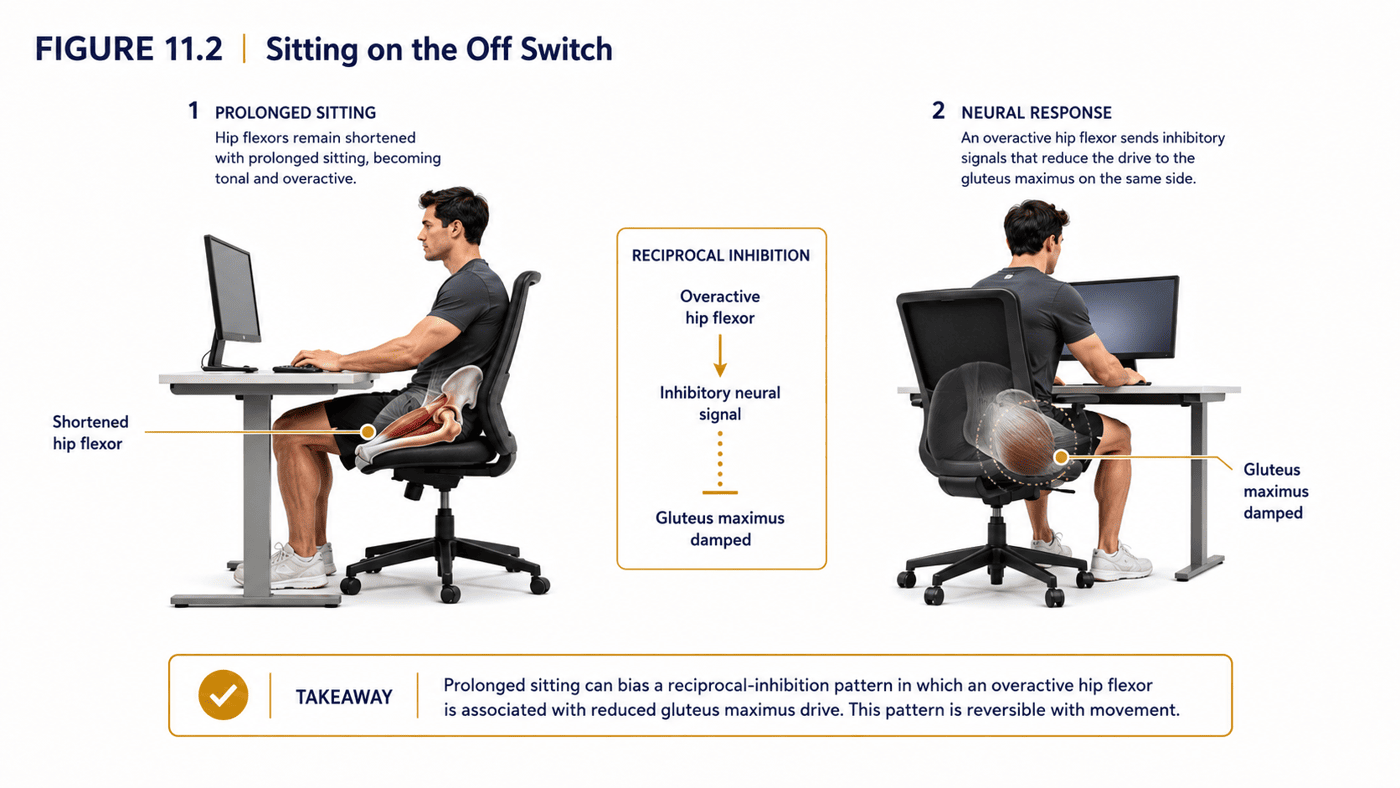
Whatever the precise contribution of reciprocal inhibition — a matter of ongoing discussion — the practical reality is not in doubt: people who sit a great deal tend to have under-active, under-strong glutes that do not contribute their proper share to hip extension. The body, faithful to its habits, has simply stopped asking the glutes to work, and they have quietly powered down. The good news, developed below, is that this is readily reversible — the glutes wake up promptly when they are once again given something to do.
11.3 Gluteus Maximus: The Sleeping Giant
The gluteus maximus deserves singling out, because it is the largest and one of the most powerful muscles in the entire body, and its under-use is among the most consequential effects of a sedentary life. Its primary job is to extend the hip powerfully — to drive the body up from a squat, forward in a sprint, upward in a jump, and to hold the trunk erect over the legs. A well-functioning gluteus maximus is central to almost every athletic and everyday movement that matters.
And yet, for the desk worker, this great engine spends the day as a cushion. Sitting places the body’s weight directly upon the glutes, compressing them, while asking nothing of them — a more complete switching-off than almost any other muscle endures. Over time the predictable happens: the glute weakens, its activation becomes sluggish, and other muscles step in to do its job. In hip extension, the hamstrings and the lower back often take over the work the glute has abdicated — a substitution that overloads those structures and helps explain both the ‘tight hamstrings’ and the aching low back so common among sitters. A weak glute does not fail quietly; it conscripts its neighbours.
The remedy is as direct as the problem. Because the glute is merely under-used rather than damaged, it responds rapidly to being asked to work — to deliberate, progressive loading in hip extension. The sleeping giant is easily woken; it has simply not been called upon. Section 11.7 and the box at the chapter’s end set out how.
11.4 Gluteus Medius and Pelvic Stability
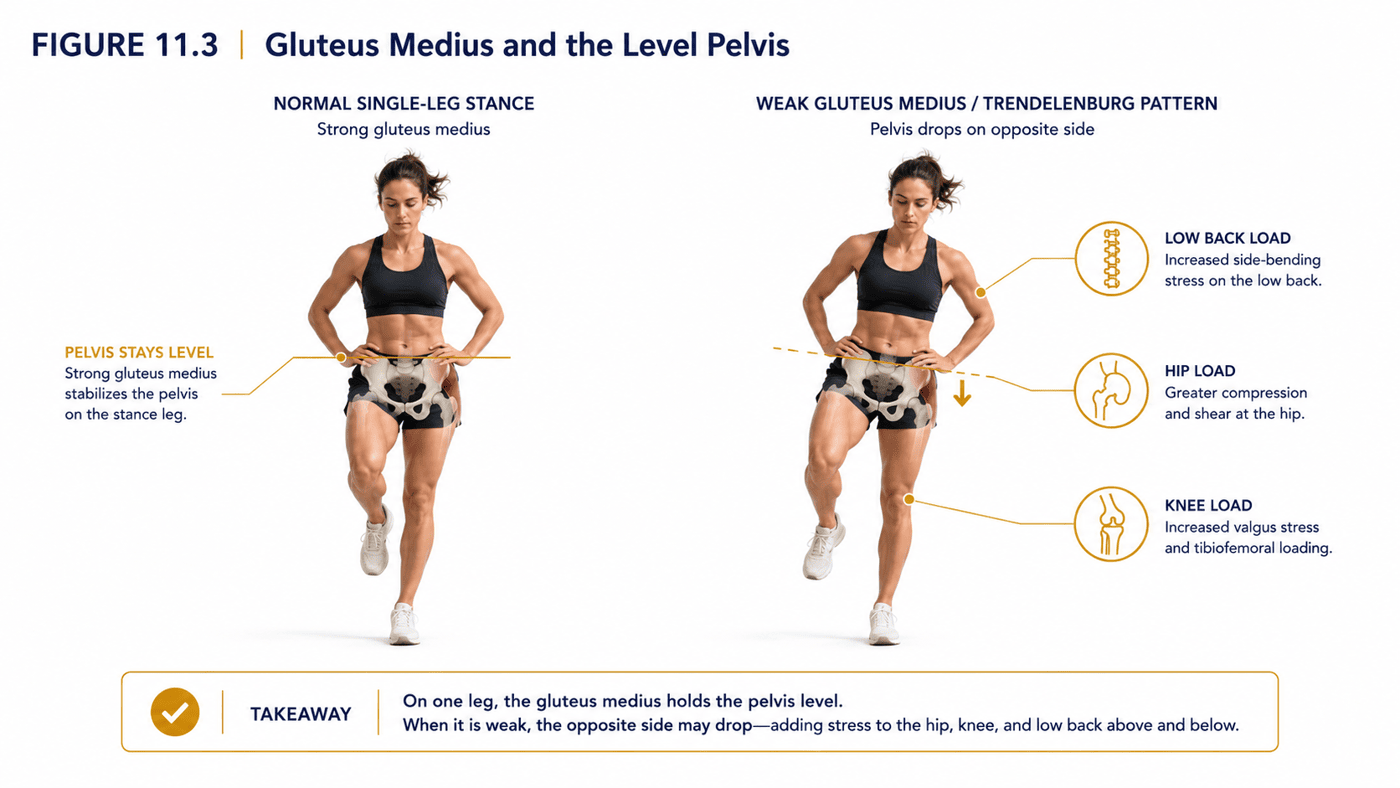
If the gluteus maximus is the engine of forward drive, the gluteus medius (with the smaller minimus beneath it) is the stabiliser of the pelvis, and its weakness has consequences that travel both up and down the leg. Its key role appears whenever the body stands on one leg — which, in walking, is most of the time. As the body passes over a single supporting leg, the gluteus medius on that side contracts to keep the pelvis level, preventing the opposite, unsupported side from dropping. Figure 11.3 shows what happens when it is too weak to do so: the opposite side of the pelvis sags, and the trunk often lurches toward the standing leg to compensate — the pattern clinicians call a positive Trendelenburg sign (Neumann, 2017).
A dropping, poorly controlled pelvis is not merely an inelegant gait; it loads the structures around it. A weak gluteus medius is associated with a cascade of problems down the leg — the knee falling inward into a valgus position, with the strain that places on the knee joint and its soft tissues — and up the chain, contributing to hip and low-back symptoms. Because so much of daily movement is effectively a series of single-leg stances, the pelvic stability provided by the gluteus medius underpins the health of the whole lower limb, and its weakening through disuse is quietly influential.
As with the maximus, the medius weakens through under-use and responds to being loaded — particularly through movements that challenge it to stabilise the pelvis on one leg. The practical point is that posterior-chain training should address not only the powerful hip extension of the maximus but the stabilising work of the medius, because a strong engine on an unstable pelvis is only half a functioning hip.
11.5 The Hamstring Tightness Myth
Few sensations are as familiar to the desk-bound as tight hamstrings, and few beliefs are as ripe for correction as the assumption that tight hamstrings are short hamstrings in need of stretching. The hamstrings span the back of the thigh, crossing both the hip and the knee, and they certainly feel tight in a great many sitters. But the evidence on what that tightness is, and on what stretching actually does about it, tells a surprising story — one that overturns decades of received gym wisdom.
The pivotal finding is that the increase in range of motion produced by a stretching programme is, for the most part, not due to the muscle becoming longer. Magnusson et al. (1996) showed that improvements in flexibility after stretch training were explained by an increased tolerance to the stretch sensation rather than by any change in the muscle’s mechanical properties. Ben and Harvey (2010) found that a regular stretching programme did not measurably increase muscle extensibility. And Weppler and Magnusson (2010), reviewing the whole question, concluded that the gains in range people experience from stretching are best explained by modified sensation — a greater willingness and ability to tolerate the stretch — rather than by lengthened tissue. Figure 11.4 captures the idea: the muscle’s underlying stiffness curve does not move; what moves is the point at which the stretch becomes intolerable.
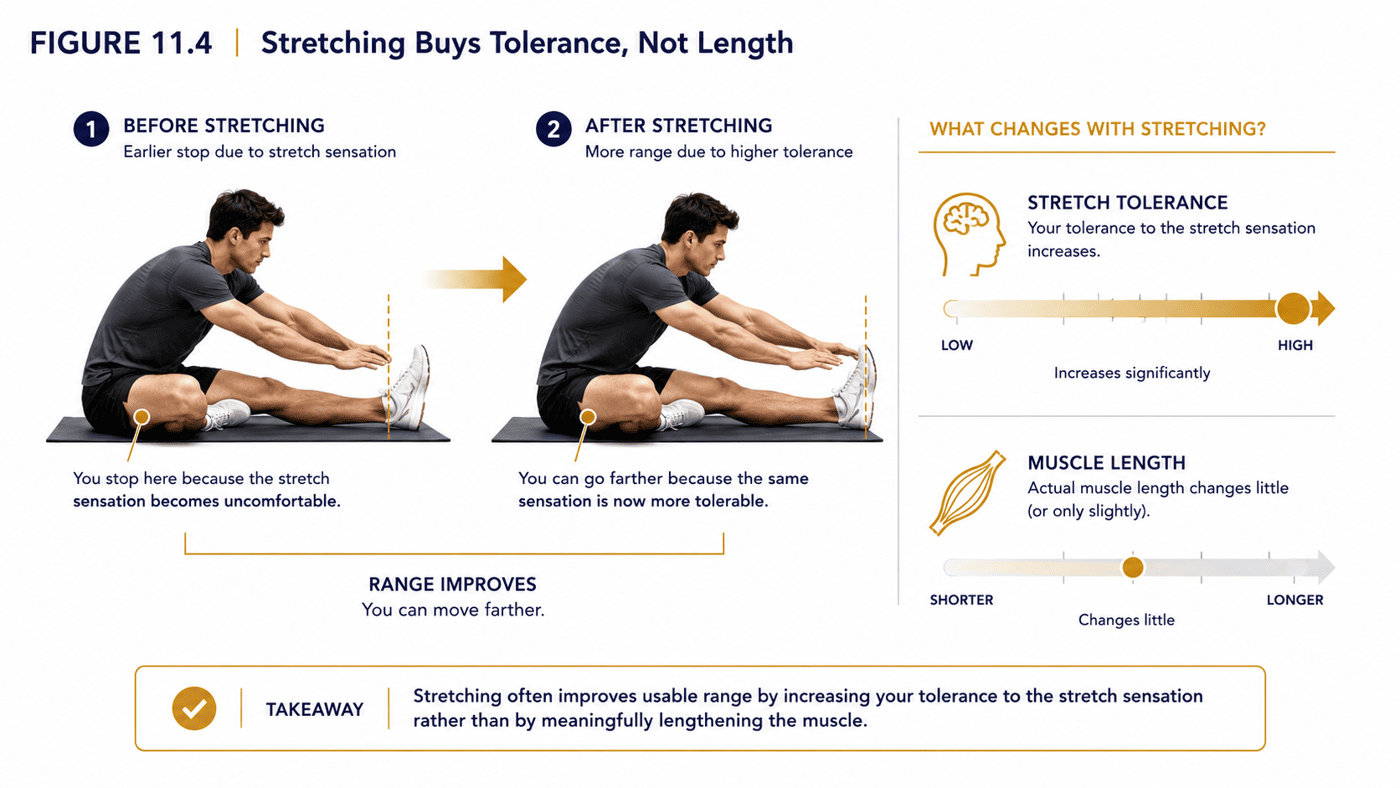
This reframes the tight hamstring entirely. If the hamstring is not, in most cases, physically short, then the tightness is better understood as a sensation — produced by the nervous system, influenced by how accustomed the tissue is to being lengthened, by protective guarding, and by the lumbopelvic posture that a slumped sitter habitually adopts (Sahrmann, 2002). A sitter whose pelvis is tipped and whose posterior chain is under-used will reliably feel tight hamstrings, not because the muscle has shortened but because it is unloaded, unaccustomed to stretch, and held in an unhelpful position. The feeling is real; the diagnosis of ‘shortness’ is usually wrong.
The slumped-sitting hamstring: neural, not just muscular
There is a further reason the desk worker’s hamstrings feel tight, and it has little to do with the muscle at all. The hamstrings lie close to the sciatic nerve and its branches, which run down the back of the thigh, and the nervous system’s tissues, like muscles, can become sensitive to stretch. A habitually slumped sitting posture, with the pelvis tipped back, places these neural structures under sustained tension; a sensitised nervous system then reports ‘tightness’ in the back of the thigh that is, in part, neural rather than muscular in origin.
This helps explain why stretching the hamstring so often gives only fleeting relief: pulling harder on a structure whose tightness is partly a protective neural response may simply provoke more of the same. Gentle movement, improved sitting posture that eases the tension on the neural structures, and loaded strengthening that builds the tissue’s tolerance tend to help far more than aggressive static stretching. The tight hamstring of the sitter is best understood not as a short muscle awaiting a good stretch, but as an under-used, poorly positioned and sometimes neurally sensitised structure awaiting movement and load.
11.6 Why Stretching the Hamstrings Often Disappoints
It follows that the lifelong project of stretching tight hamstrings, pursued by so many sitters with so little lasting result, is largely aimed at the wrong target. Stretching can temporarily raise tolerance and bring brief relief, and there is nothing wrong with it as one tool among several. But as a remedy for the underlying problem of the desk-bound posterior chain — which is under-use and weakness, not shortness — it disappoints precisely because it does not address the real deficit. A hamstring stretched daily for years can remain just as ‘tight’ as ever, because the stretching never asked it to do the one thing it lacked: work.
The more productive approach turns the problem around. If tight hamstrings in sitters are largely under-loaded, poorly tolerant and badly positioned, then the remedy is to load them through range — to strengthen the hamstrings and the whole posterior chain in movements that take them to length under tension. Loaded movement of this kind does what stretching cannot: it builds strength and tolerance together, it teaches the tissue to be comfortable at length while working, and it restores the capacity the chain has lost. Many a stubbornly tight hamstring loosens not when it is finally stretched enough, but when it is finally strengthened — a paradox that makes immediate sense once tightness is understood as a problem of capacity rather than of length.
A common case shows the principle in action. A recreational runner who sits at a desk all day complains of perpetually tight hamstrings and an aching low back, and stretches diligently before every run with no lasting benefit. Examined through this chapter, the cause is not short hamstrings but an under-used posterior chain: weak, sleepy glutes that fail to drive hip extension, so the hamstrings and low back take over the work and grow overloaded and ‘tight’. The stretching never helped because the hamstrings were never short — they were overworked deputies for an absent glute.
When she shifts from stretching to loading — building the glutes with bridges, hip thrusts and hinges, and strengthening the hamstrings through range — the picture changes within weeks. The glutes wake and resume their share of the work, the hamstrings are relieved of their overload, the low back settles, and the ‘tightness’ eases — not because the hamstrings were finally stretched enough, but because the powerhouse was finally strengthened. It is the paradox of the posterior chain made concrete: the cure for tightness was strength.
Sitting, the hamstrings and the hip hinge
One movement skill is quietly lost to a seated life and deserves rebuilding: the hip hinge. To hinge is to bend forward by folding at the hips while the spine stays relatively neutral, so that the movement and the load are taken by the hips and the posterior chain — the pattern that underlies every deadlift, every safe lift of a heavy object, and much of athletic movement. The hinge is how the body is designed to bend under load, and it is the posterior chain’s signature movement.
Sitters tend to lose this skill. Habituated to folding at the spine in the chair and with under-used hips and glutes, many people bend by rounding the back rather than hinging at the hips, leaving the powerful posterior chain uninvolved. Relearning to hinge — to push the hips back and load the hamstrings and glutes while keeping the spine comfortable — both rebuilds the chain and restores an efficient, powerful way to bend and lift. It is worth saying, consistent with Chapter 8, that this is not because bending the spine is dangerous — it is not — but because the hinge brings the body’s strongest muscles to the task and trains the very chain the chair switched off.
11.7 Building the Posterior Chain
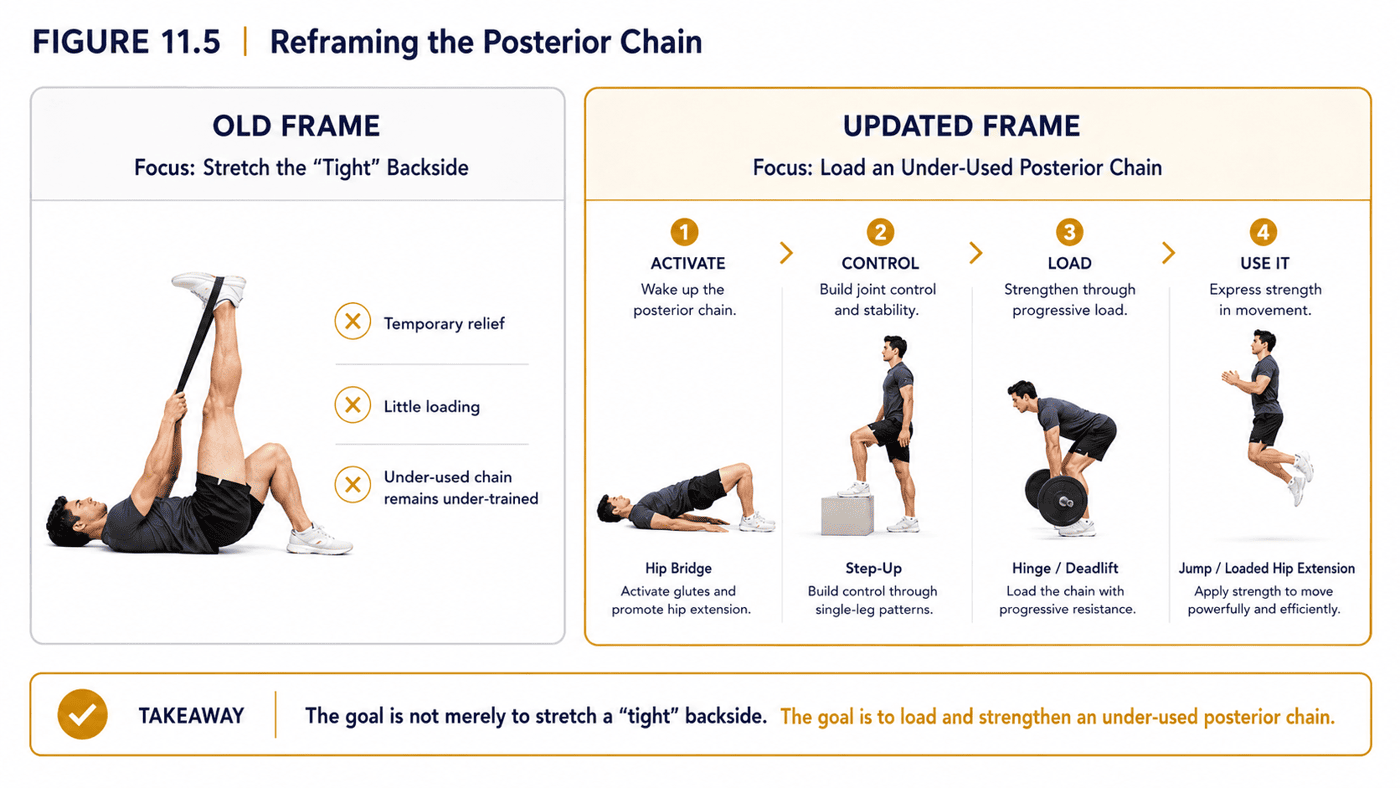
The strategy for the posterior chain is therefore the most straightforward in this book, because the deficit is so clearly one of under-use: the chain must be given work to do. This means waking the glutes with deliberate hip-extension exercises, loading the hamstrings through their range with hip-hinging movements, and training pelvic stability with single-leg work for the gluteus medius — progressively, over time, building strength and capacity where the chair created idleness. Figure 11.5 sets the conventional framing against the evidence-based one: the posterior chain is not a tight structure to be stretched but an under-used one to be loaded.
Which exercises actually wake the glutes?
A useful body of work has examined which exercises most effectively recruit the gluteal muscles, so that effort can be spent where it counts. Distefano et al. (2009) compared common exercises and found clear differences in how strongly each activated the gluteus maximus and medius — with movements such as single-limb squats and deadlifts, and side-lying hip abduction, ranking highly. The broad lesson is that the glutes respond best to movements that genuinely challenge hip extension and single-leg stability under load, rather than to incidental or unloaded activity. Bridges and hip thrusts, hip hinges and deadlifts, lunges, step-ups and single-leg work form the natural core of a posterior-chain programme; what unites them is that they ask the glutes and hamstrings to produce force through range, which is exactly what the chair removed.
Waking is not the same as strengthening
A useful distinction separates two stages of rebuilding the posterior chain. The first is waking the muscles — re-establishing the recruitment and coordination that sitting dulled, so that the glutes fire when they should. Simple, focused activation work — bridges, band walks, deliberate glute contractions — does this, and it is a sensible starting point, especially for someone whose glutes are genuinely sluggish. But waking a muscle is not the same as making it strong, and stopping at activation drills leaves much of the benefit unclaimed.
The second stage is strengthening — building genuine force-producing capacity through progressive loading over weeks and months. This requires challenging the chain with meaningful and gradually increasing load: heavier hip thrusts and bridges, deadlifts and hinges, loaded lunges and step-ups. It is this progressive loading, not endless light activation, that rebuilds the powerhouse to a level that protects the back, drives strong movement and lasts. The practical sequence is therefore to wake the chain first, then to spend the real effort strengthening it — because a glute that fires but cannot produce force is only half the job done.
The posterior chain protects the back
A final reason to prize the posterior chain ties this chapter back to the low back of Chapter 8. The glutes and hamstrings are the body’s primary engine for lifting and for extending the hip, and a strong posterior chain takes load that would otherwise fall upon the spine. When the glutes are weak and the chain under-used, the low back is left to do more of the work of bending, lifting and stabilising — one of the mechanical threads linking the desk hip to the desk back.
Building the posterior chain is therefore among the most effective things a person can do for a resilient back. A body that can hinge powerfully and extend the hip under load distributes the demands of lifting and daily life across its strongest muscles, rather than concentrating them on the spine. This is the constructive counterpart to the message of Chapter 8: the back is robust, and a strong posterior chain makes it more robust still, by ensuring the powerhouse — not the spine alone — does the heavy work.
| Common claim | What the evidence and mechanics suggest |
|---|---|
| My glutes are tight — stretch them | Desk glutes are under-used and weak, not tight; they need loading, not stretching (Distefano et al., 2009). |
| My hamstrings are short — stretch them | Tightness reflects tolerance and under-use far more than length (Weppler & Magnusson, 2010). |
| The ‘dead butt’ is permanent | The glutes are asleep, not dead; they wake quickly when loaded. |
| Posterior-chain work is just for athletes | It restores the body’s powerhouse for everyone — walking, lifting, standing and protecting the back. |
Table 11.2. Common posterior-chain claims set against current evidence and mechanical reasoning.
In summary
- The posterior chain — glutes, hamstrings and calves — is the body’s powerhouse, the engine of hip extension and of every step, jump and lift, and the muscle group a chair most completely switches off.
- Chronic sitting leaves the glutes under-recruited (‘gluteal amnesia’); reciprocal inhibition from tight hip flexors and Janda’s lower-crossed pattern help explain it (Page, Frank & Lardner, 2010).
- The gluteus maximus, the body’s largest muscle, is compressed and idle in sitting; when it weakens, the hamstrings and low back take over its job and pay for it.
- The gluteus medius stabilises the pelvis on one leg; its weakness causes the pelvis to drop (Trendelenburg) and loads the knee, hip and low back (Neumann, 2017).
- ‘Tight’ hamstrings are usually not short: the range gained from stretching reflects increased tolerance, not lengthened tissue (Magnusson et al., 1996; Ben & Harvey, 2010; Weppler & Magnusson, 2010).
- Stretching disappoints because the real deficit is under-use and weakness; loading the chain through range builds strength and tolerance together.
- The remedy is to load the posterior chain — wake the glutes, strengthen the hamstrings, train pelvic stability — progressively, restoring the powerhouse the chair left idle (Distefano et al., 2009).
References
Ben, M., & Harvey, L. A. (2010). Regular stretch does not increase muscle extensibility: A randomized controlled trial. Scandinavian Journal of Medicine & Science in Sports, 20(1), 136–144.
Distefano, L. J., Blackburn, J. T., Marshall, S. W., & Padua, D. A. (2009). Gluteal muscle activation during common therapeutic exercises. Journal of Orthopaedic & Sports Physical Therapy, 39(7), 532–540.
Magnusson, S. P., Simonsen, E. B., Aagaard, P., Sorensen, H., & Kjaer, M. (1996). A mechanism for altered flexibility in human skeletal muscle. The Journal of Physiology, 497(1), 291–298.
Neumann, D. A. (2017). Kinesiology of the musculoskeletal system: Foundations for rehabilitation (3rd ed.). Elsevier.
Page, P., Frank, C. C., & Lardner, R. (2010). Assessment and treatment of muscle imbalance: The Janda approach. Human Kinetics.
Sahrmann, S. A. (2002). Diagnosis and treatment of movement impairment syndromes. Mosby.
Weppler, C. H., & Magnusson, S. P. (2010). Increasing muscle extensibility: A matter of increasing length or modifying sensation? Physical Therapy, 90(3), 438–449.