Part IV · HIPS, LEGS AND LOST MOVEMENT CAPACITY
Hip Stiffness From the Chair
The hip is built for big movement — to carry, propel and rotate the whole body. Sitting asks it to do the opposite: to hold a single flexed position for hours. Over time the hip stiffens, its extension is lost, and the low back pays the price. As ever, the answer is movement and load, not stretching alone.
10.1 The Hip: Built for Big Movement
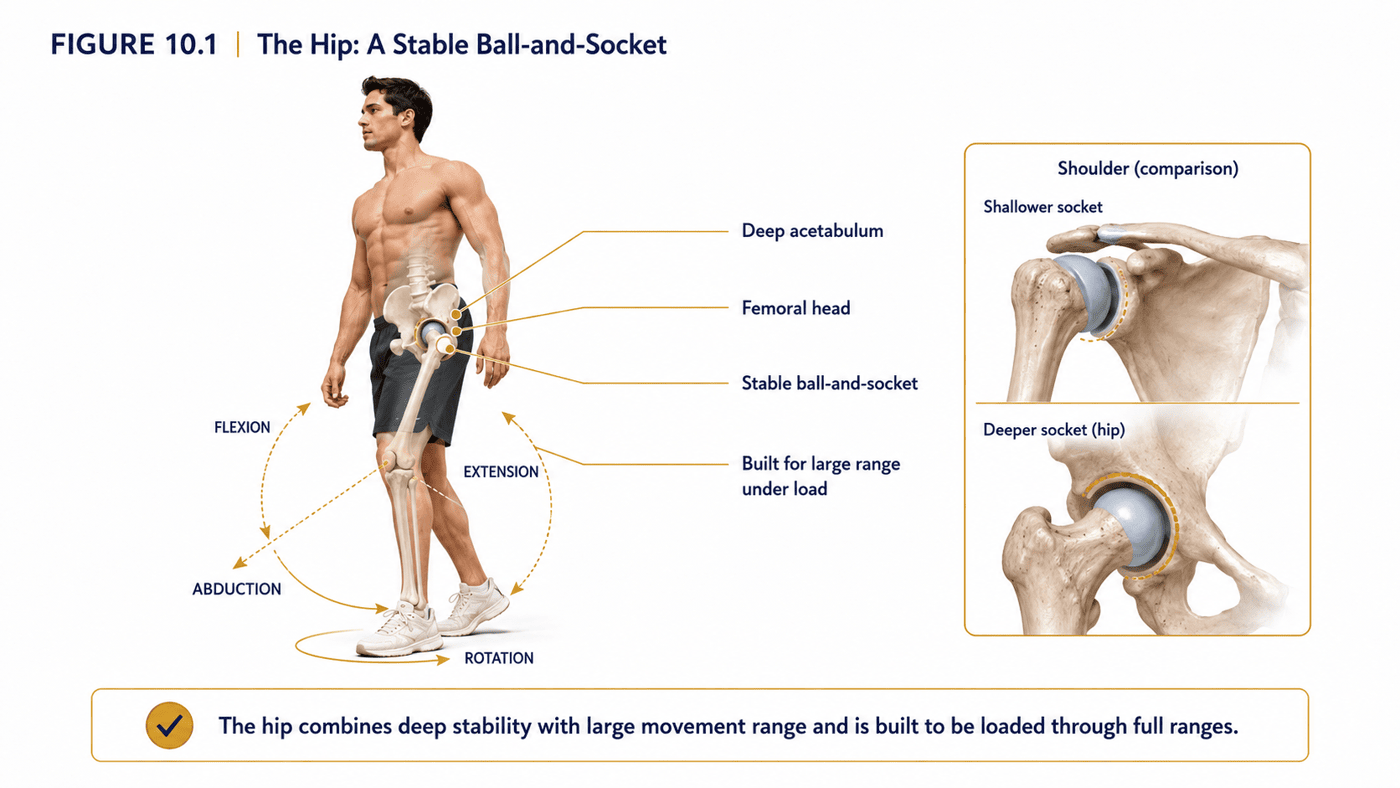
After the daily costs traced through the neck, shoulders, spine and rib cage, the descent of this book reaches the hip — arguably the structure most fundamentally at odds with a seated life. The hip is the great weight-bearing joint of the body, the hinge between the powerful muscles of the trunk and the long levers of the legs (Neumann, 2017). It is a ball-and-socket joint, like the shoulder, but built to a very different specification: where the shoulder trades stability for mobility with a shallow socket, the hip enjoys both, its deep, cup-shaped socket gripping the femoral head securely while still permitting a generous range of movement, as Figure 10.1 illustrates.
That range is the point. The hip is designed to flex deeply, to extend behind the body, to swing out to the side, to rotate — and, crucially, to do all of this repeatedly and under load. For almost the whole of human history it did exactly that: squatting to rest and to work, walking and running across uneven ground, climbing, carrying, rising from the floor many times a day (Bramble & Lieberman, 2004). The hip evolved as a structure that is loaded through large ranges, constantly. The modern chair offers it almost the opposite — a single, mid-range, flexed position, held without variation for the better part of the waking day.
This chapter follows what that does. It begins with the held-flexed position of the seated hip and the adaptive shortening of the muscles at its front; turns to the movement sitting most reliably steals, hip extension, and the price the low back pays for its loss; examines what ‘tight hips’ really are and whether stretching is the answer; and ends, as always, with the reconditioning that restores the hip’s lost capacity. The hip is not damaged by sitting; it is under-used — and an under-used hip is a recoverable one.
A quick tour of the hip’s muscles
Around this joint sit some of the body’s most important muscles. At the front, the hip flexors — chiefly the iliopsoas (the iliacus and psoas working together) and the two-joint rectus femoris — lift the thigh toward the trunk; the psoas is notable for attaching directly to the lumbar vertebrae, so its state has consequences for the lower spine. At the back, the powerful gluteal muscles and the hamstrings extend the hip, driving the body forward (the subject of Chapter 11). At the side, the gluteus medius and minimus stabilise the pelvis when standing on one leg. Sitting acts on this whole arrangement at once — shortening the front, lengthening and quietening the back — which is why the seated hip becomes imbalanced rather than simply stiff.
10.2 What Sitting Does to the Hip
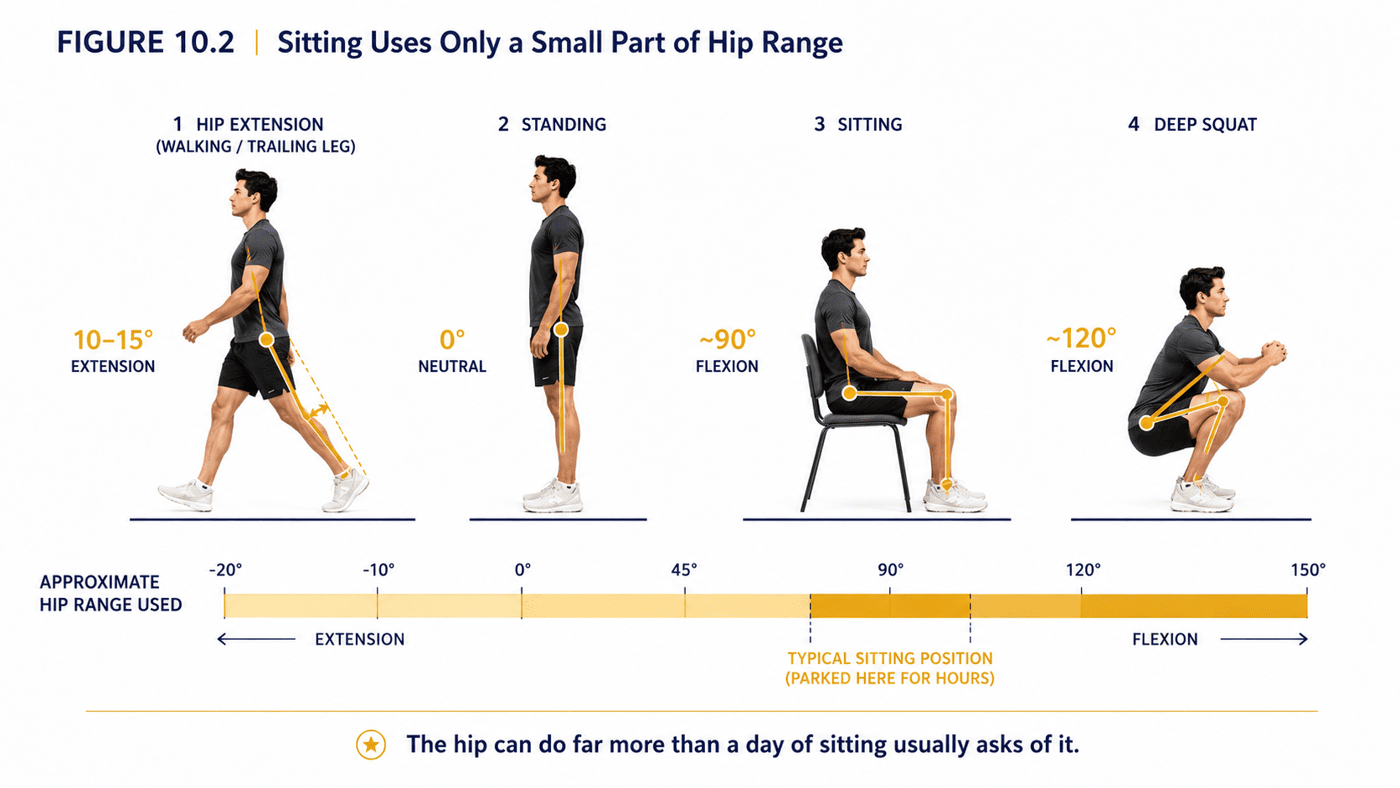
The mechanical heart of the matter is simple to state: sitting holds the hip in roughly ninety degrees of flexion, motionless, for hours. Figure 10.2 places that in context. The hip is capable of moving from extension behind the body through to deep flexion at the floor — a sweep of well over a hundred degrees — yet a sedentary day parks it near the middle of that range, in flexion, and rarely visits either end. Extension, in particular, is almost never reached; deep flexion, of the kind a squat or a cross-legged floor sit would demand, is equally neglected.
This is the now-familiar pattern of the desk body, expressed at the hip: not a heavy load that injures, but a narrow, unvarying use of a structure built for breadth. The joint that evolved to move constantly through large ranges spends its days in a single sustained position. And, exactly as Chapters 1 and 7 described for other tissues, the structures around a joint held still in one position begin to adapt to that position — the muscles at the front, held short, and the joint’s capsule and the muscles at the back, held long. The hip does not break; it remodels toward the shape of the chair.
| What sitting does | Mechanism | Consequence if sustained |
|---|---|---|
| Holds the hip flexed ~90° | Sustained mid-range flexion, no variation | Front muscles shorten; joint stiffens |
| Never reaches extension | Hip extension simply not used | Lost extension; low-back compensation |
| Never reaches deep flexion | Squatting and floor-sitting absent | Lost deep range and tissue tolerance |
| Switches off the glutes | Hip extensors idle while sitting | Under-used posterior chain (Ch 11) |
Table 10.1. Sitting narrows the hip to a single sustained position, neglecting both ends of its range and idling the muscles around it (Mueller & Maluf, 2002).
10.3 The Shortened Hip Flexor
The most discussed consequence of the seated hip is the shortening of the hip flexors, and here the mechanism deserves precision, because it is both real and widely misunderstood. When a muscle is habitually held in a shortened position — as the hip flexors are whenever the hip is flexed in sitting — it adapts to that length. The classic work of Williams and Goldspink (1978) showed that muscle held shortened over time reduces the number of sarcomeres (the contractile units) arranged in series along its length, effectively resetting itself to be comfortable and efficient at the shorter length. The hip flexors of a habitual sitter are not ‘damaged’; they have adapted, faithfully, to the length the chair imposes.
The trouble is that a hip flexor adapted to a short, seated length is then ill-prepared for the lengthened position the hip requires in standing and walking. When the person stands, the shortened flexors — the iliopsoas crossing the front of the hip, and especially the rectus femoris — pull on their attachments. Because the psoas attaches to the lumbar spine and the flexors attach to the pelvis, this pull tends to rotate the pelvis into an anterior tilt, tipping it forward and increasing the curve of the lower back, as Figure 10.3 shows. The shortened hip flexor thus reaches up to disturb the very lumbar spine examined in Chapters 7 and 8 — a vivid illustration of how the body works as a connected chain.
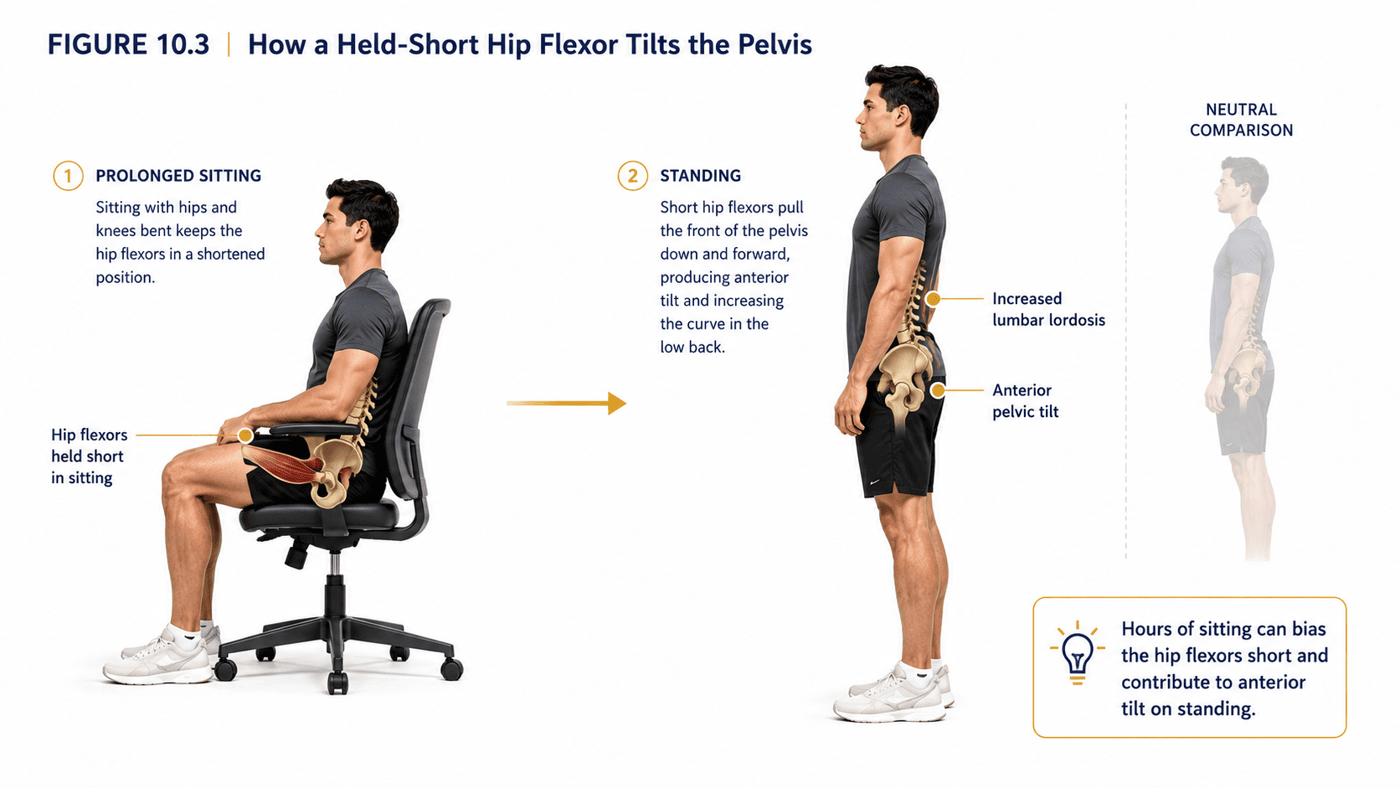
Sahrmann (2002), in her influential analysis of movement impairment, described exactly this kind of pattern, in which habitual postures alter muscle length and resting alignment in ways that load the spine and pelvis. It is worth emphasising, though, that this is a tendency, not a destiny, and not a structural fault: the shortening is an adaptation, and adaptations can be reversed by changing the demand. A hip flexor regularly taken to its full length — by reaching hip extension, by standing tall, by simply not sitting all day — re-lengthens just as it shortened. The problem is reversible precisely because it was a response to use in the first place.
The two-joint problem: rectus femoris
One hip flexor deserves particular mention, because its anatomy makes it especially relevant to the sitter. The rectus femoris is unusual among the hip flexors in crossing two joints: it runs from the pelvis, across the front of the hip, all the way down to the knee, where it also acts to straighten the leg. Sitting places this two-joint muscle in a complex position — the hip is flexed and the knee is bent — and its habitual shortening at the hip contributes, alongside the iliopsoas, to the anterior pelvic tilt described above.
Its two-joint nature also means the rectus femoris can carry the effects of the seated hip down to the knee as well as up to the pelvis, which is one reason hip and knee complaints so often travel together in the desk-bound. The practical lesson is that reclaiming length and control in the hip flexors should address this muscle specifically — movements that extend the hip while the knee is bent load the rectus femoris through its full length in a way that simpler hip-extension positions do not.
10.4 The Lost Movement: Hip Extension
If the shortened front of the hip is the most discussed consequence of sitting, the lost movement at the back of it is the most important. Hip extension — the backward movement of the thigh behind the body — is fundamental to human locomotion. Every stride drives the trailing leg into extension, powered by the gluteal muscles, propelling the body forward; standing tall depends on the hip sitting in neutral extension rather than perpetual slight flexion. Yet hip extension is precisely the movement a sedentary day never asks for, and the one most readily lost when the front of the hip is held short and the glutes fall idle.
The consequences of lost hip extension ripple upward, and Figure 10.4 shows the key one. When the trailing hip cannot extend adequately during walking, the movement does not simply vanish — the body finds it elsewhere. The most common compensation is for the pelvis to tip forward and the lower back to arch, borrowing the missing range from the lumbar spine. Step after step, mile after mile, a stiff hip thus quietly exports its workload to the low back, which extends and compensates with every stride. This is one of the clearest mechanical routes by which hip stiffness contributes to the low-back discomfort of Chapter 8 — the back paying, repeatedly, for what the hip can no longer do.
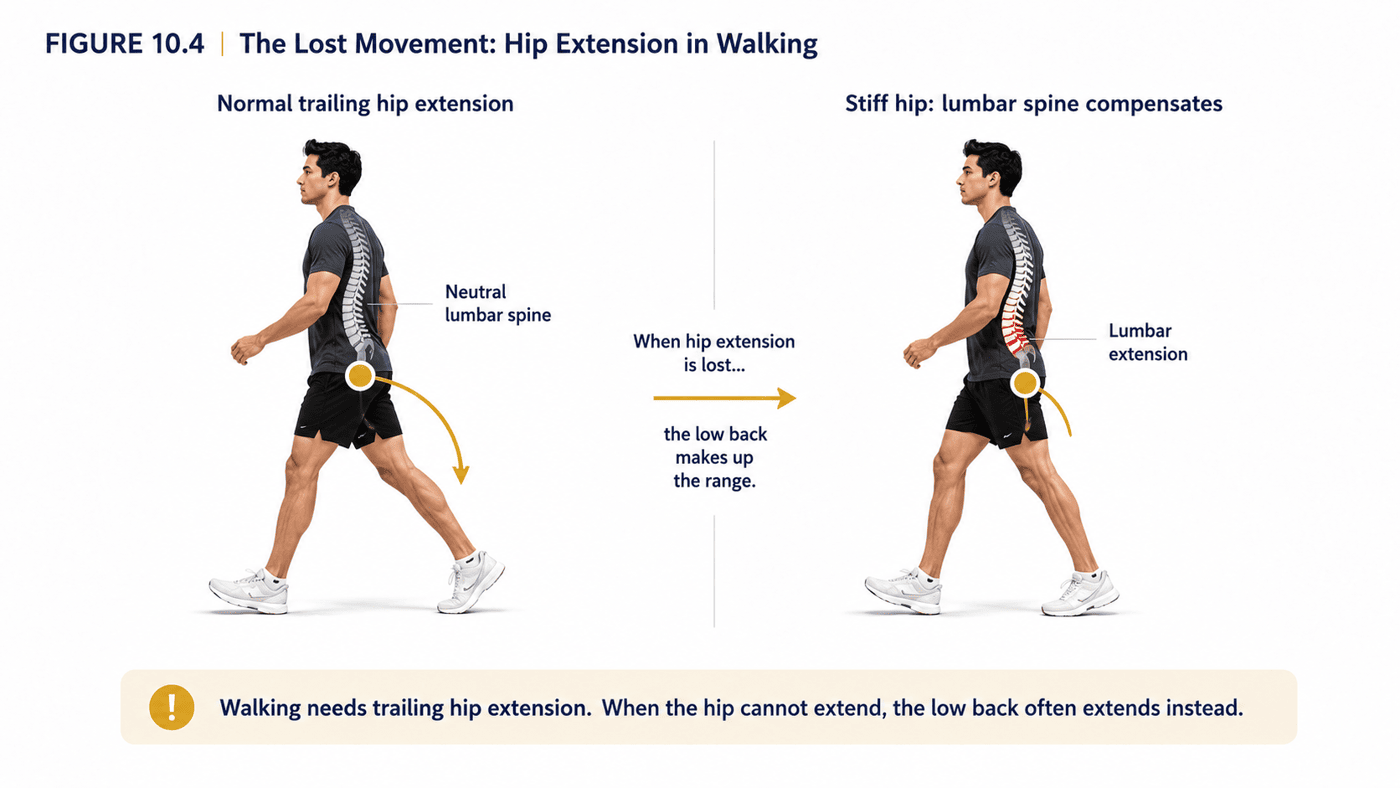
This regional interdependence, introduced for the spine in Chapter 7, is nowhere more practically important than at the hip. A person presenting with nagging low-back tightness that worsens with walking or standing may have, at root, a hip that will not extend — and no amount of attention to the back itself will resolve a problem whose source lies below it. Restoring hip extension often relieves the low back directly, by removing the demand that drove its compensation. The hip and the low back must be considered together, because mechanically they are inseparable.
What standing and walking restore
If sitting is what removes hip extension, standing and — above all — walking are what restore it. Every stride drives the trailing hip into extension and calls upon the glutes to power the push-off, so that walking is, in effect, a continuous natural rehabilitation of the very movement the chair takes away. This is part of why the daily step counts discussed in Part I matter so much beyond their metabolic benefit: each step is a repetition of hip extension and glute activation, and a day rich in walking keeps the hip mobile and the posterior chain awake almost incidentally.
The corollary is sobering for the sedentary. A person who sits through the day and takes few steps performs hip extension a mere handful of times, where an active person performs it thousands of times — a vast difference in the daily dose of the movement the hip most needs. Simply walking more, and breaking sitting to stand and move, does more to preserve hip extension than any amount of dedicated stretching, because it supplies the movement in the natural, loaded, repeated form the hip evolved to receive.
10.5 “Tight Hips”: Short, or Guarded?
‘Tight hips’ is among the most common complaints of the desk-bound, and it is worth examining what the word ‘tight’ actually means, because it is less obvious than it sounds. The intuitive assumption — reinforced by Section 10.3 — is that tightness means a physically shortened muscle that needs lengthening. Sometimes it does. But the sensation of tightness is not a reliable readout of muscle length. A muscle can feel tight because it is short; because it is weak and working near its limit; because the nervous system is guarding the area and resisting movement; or simply because it is unaccustomed to being stretched. Tightness is a sensation produced by the nervous system, and length is only one of its possible causes.
This matters because the remedy depends on the cause. If a hip feels tight because its flexors are genuinely shortened from sitting, then restoring length helps. But if it feels tight because the muscles are weak, or because the joint is being protectively guarded, then stretching may bring brief relief while doing nothing for the underlying problem — and the tightness returns within the hour, as anyone who has stretched the same tight hip for years can attest. Chapter 11 develops this point in detail for the hamstrings, where the evidence that stretching changes tolerance rather than length is strongest. For now, the lesson is to be suspicious of the simple equation of tightness with shortness, and to treat persistent ‘tightness’ as a prompt to ask what the hip actually lacks — length, strength, or confident movement — rather than reflexively to stretch it.
10.6 The Hip–Low-Back Connection
It will already be clear that the hip and the low back are intimately linked, and it is worth drawing the connection together explicitly, because it reframes a great deal of desk-related discomfort. Two mechanisms, both described above, tie the seated hip to the lumbar spine. The first is static: shortened hip flexors tip the pelvis into anterior tilt, increasing the lumbar curve and the load it carries even at rest. The second is dynamic: a hip that cannot extend forces the low back to compensate with every stride. Between them, these mechanisms mean that a stiff, imbalanced hip is a persistent, low-level source of lumbar loading throughout the day.
A brief word is warranted on the hip joint itself, because the language around hip problems can be as alarming as that around the spine. The term femoroacetabular impingement, or FAI, is increasingly applied to hip pain, and refers to a particular shape of the hip bones that can, in some people, contribute to symptoms (Frost, 2003). But as the Warwick Agreement on FAI made clear (Griffin et al., 2016), the bony shapes associated with FAI are common in people with no hip pain at all — a now-familiar pattern, echoing the asymptomatic imaging findings of the spine and shoulder. FAI is a clinical syndrome requiring symptoms and signs together, not merely a shape on a scan, and most desk-related hip stiffness is nothing of the kind. As with the back, the constructive reading is that the hip is robust, that stiffness is usually a matter of use rather than damage, and that frightening labels rarely help.
10.7 Building Hip Capacity
The strategy for the hip follows directly from the diagnosis, and it has three strands. The first is to reduce the dose: to break up sustained sitting and to stop holding the hip in flexion for unbroken hours, exactly as Chapter 7 urged for the spine. The second is to reclaim the lost ranges: to take the hip deliberately into extension and into deep flexion every day, restoring the movement the chair removes and, in the process, re-lengthening the shortened flexors through use rather than through passive stretching alone. The third is to build strength through range: to load the hip — its extensors above all — across its full movement, so that it regains not just mobility but the capacity to use that mobility under load.
This third strand marks the crucial departure from the conventional advice to stretch tight hips. As Figure 10.5 sets out, the productive shift is from chasing a passive range to building an active, loaded one. A hip that is regularly taken into extension against the resistance of the body’s own weight — and, in time, against additional load — develops lasting mobility and strength together, in a way that static stretching cannot match. The glutes that drive hip extension are the focus of the next chapter, and the two chapters are best read as one programme: a strong, mobile hip and a strong, active posterior chain are the same project viewed from front and back.
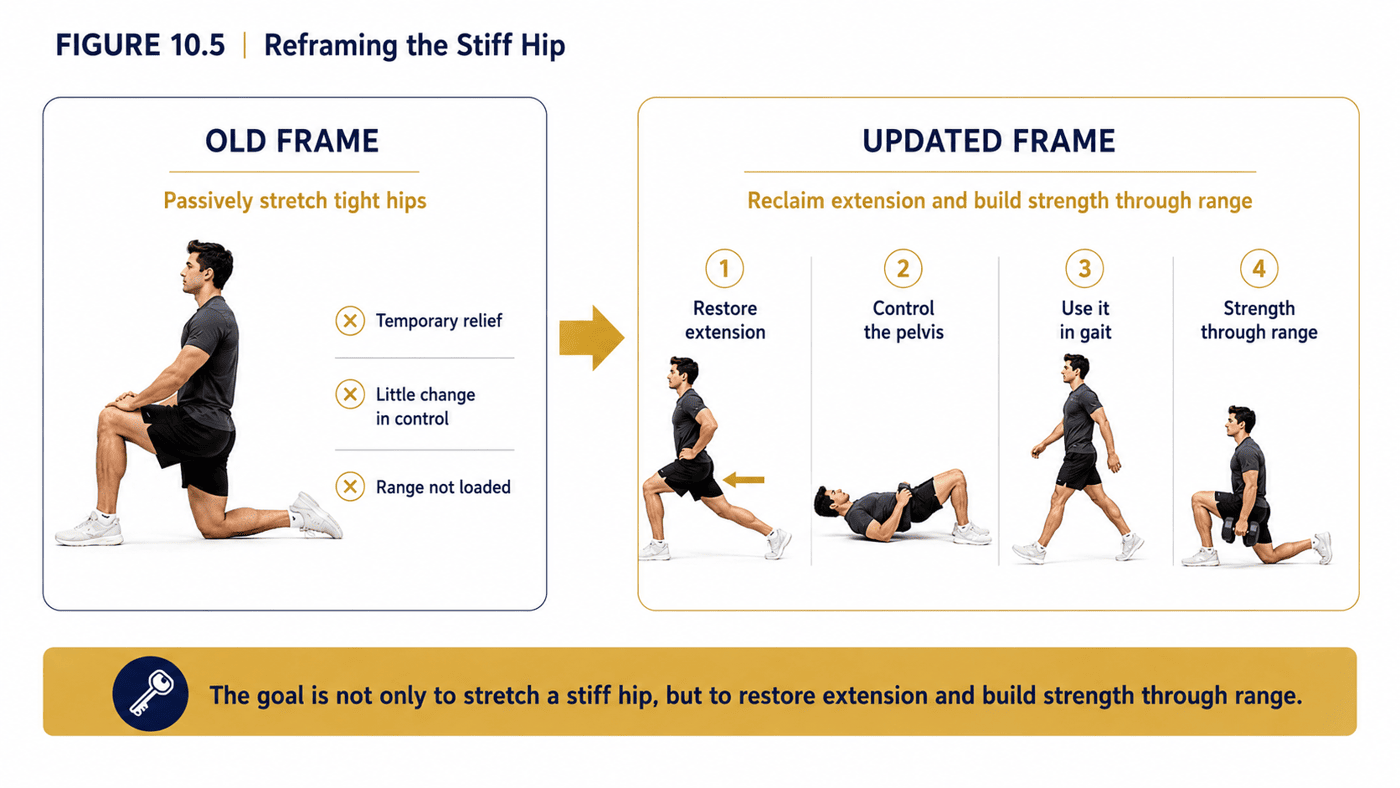
Loaded mobility, not just passive stretching
It is worth being concrete about why loaded movement outperforms passive stretching for the hip. Passive stretching holds a muscle at length and waits; at best it nudges tolerance and, over long periods, length. Loaded movement — taking the hip actively into extension or deep flexion while the muscles work — does more: it lengthens the tissues under tension, strengthens them at the new length, re-educates the nervous system to allow and control the range, and feeds the joint the varied loading it needs. A lunge that drives the back hip into extension, a deep squat that demands full flexion, a controlled hinge that loads the posterior chain — each builds usable, defended range rather than a fragile, passive one. The hip responds to being asked to do its job, through its whole range, under load.
Consider how this comes together in a familiar case. A senior manager in her fifties reports a stiff, restricted feeling in the hips and a nagging low-back tightness that builds through a day at the desk and on her feet. She has stretched her hip flexors for years with little lasting change, and has begun to fear that her back is simply ‘going’. Read through this chapter, the picture resolves: a lifetime of sitting has shortened the front of her hips and left them unable to extend, so her pelvis tips forward and her low back arches and compensates with every step — the stretching never helped because it addressed length without restoring extension, strength or movement.
The constructive path is equally clear. Breaking up her sitting, walking more, deliberately reclaiming hip extension each day, and loading her hips and glutes through range over a few patient weeks does what years of stretching could not: it restores the movement, rebuilds the capacity, and removes the demand that drove her back to compensate. Her ‘bad back’ turns out to have been, in large part, a stiff hip — and the remedy lay below the site of the symptom, in the joint the chair had quietly closed down.
The hip across a lifetime
The case for a mobile, well-loaded hip strengthens with age, and it is worth setting against a common fear. Hip osteoarthritis becomes more common in later life, and the language around it — of joints ‘wearing out’ from use — leads many people to protect the hip by using it less. The mechanics point the other way. Cartilage and the tissues of the joint, like bone and muscle, adapt to the loads placed on them; appropriate, regular loading helps keep them healthy, while disuse does not preserve a joint so much as let it deteriorate. The hip is not a set of brake pads with a fixed mileage; it is living tissue that responds to use.
This reframes the ageing hip in the now-familiar terms of this book. An active hip — moved through its range and loaded regularly across the years — tends to retain its mobility, strength and comfort far better than one spared and sat upon. Even where hip osteoarthritis is present, movement and strengthening are recommended and beneficial rather than dangerous. The desk habits formed in mid-life thus help set the trajectory of the hip for decades, and the investment of keeping it mobile and strong pays out longest of all in later life. As with the spine and the thorax, the hip ages best when it is used, not protected into stiffness.
| Common hip claim | What the evidence and mechanics suggest |
|---|---|
| My tight hips just need stretching | Tightness has several causes; loaded movement through range usually outlasts passive stretching (Sahrmann, 2002). |
| Hip stiffness is separate from my back | A stiff hip loads the lumbar spine statically and dynamically; the two are inseparable. |
| My scan shows impingement, so I’m damaged | FAI bone shapes are common in pain-free hips; a shape is not a diagnosis (Griffin et al., 2016). |
| Sitting has permanently shortened my hips | Shortening is a reversible adaptation; the hip re-lengthens with regular full-range use (Williams & Goldspink, 1978). |
Table 10.2. Common hip claims set against current evidence and mechanical reasoning.
In summary
- The hip is a deep, stable ball-and-socket built for big, loaded movement through large ranges — the opposite of what a chair provides.
- Sitting holds the hip near 90° flexion for hours, neglecting both extension and deep flexion and idling the muscles around it.
- Held short in sitting, the hip flexors adapt to a shorter length and can tilt the pelvis into anterior tilt on standing, arching the low back (Williams & Goldspink, 1978; Sahrmann, 2002).
- Lost hip extension is the most consequential change: a hip that cannot extend forces the low back to compensate with every stride, loading the lumbar spine.
- ‘Tight’ does not always mean ‘short’: tightness can reflect weakness or protective guarding, which is why years of stretching often fail.
- The hip and low back are mechanically inseparable, and FAI bone shapes are common in pain-free hips — a shape is not a diagnosis (Griffin et al., 2016).
- The remedy is to break the sitting, reclaim extension and deep flexion, and build strength through range — loaded movement, not stretching alone.
References
Bramble, D. M., & Lieberman, D. E. (2004). Endurance running and the evolution of Homo. Nature, 432(7015), 345–352.
Frost, H. M. (2003). Bone’s mechanostat: A 2003 update. The Anatomical Record Part A, 275(2), 1081–1101.
Griffin, D. R., Dickenson, E. J., O’Donnell, J., Agricola, R., Awan, T., Beck, M., … Bennell, K. L. (2016). The Warwick Agreement on femoroacetabular impingement syndrome (FAI syndrome): An international consensus statement. British Journal of Sports Medicine, 50(19), 1169–1176.
Mueller, M. J., & Maluf, K. S. (2002). Tissue adaptation to physical stress: A proposed “physical stress theory” to guide physical therapist practice, education, and research. Physical Therapy, 82(4), 383–403.
Neumann, D. A. (2017). Kinesiology of the musculoskeletal system: Foundations for rehabilitation (3rd ed.). Elsevier.
Page, P., Frank, C. C., & Lardner, R. (2010). Assessment and treatment of muscle imbalance: The Janda approach. Human Kinetics.
Sahrmann, S. A. (2002). Diagnosis and treatment of movement impairment syndromes. Mosby.
Williams, P. E., & Goldspink, G. (1978). Changes in sarcomere length and physiological properties in immobilized muscle. Journal of Anatomy, 127(Pt 3), 459–468.