Part III · SPINE, RIB CAGE AND BREATHING
The Rib Cage: The Forgotten Desk-Body Structure
Posture advice stops at the neck and the low back, and forgets what sits between them. The rib cage is the hub that links the spine, the shoulders and breathing itself — and when sitting stiffens and compresses it, all three quietly suffer. This chapter restores the thorax to its rightful place.
9.1 The Forgotten Structure
Of all the regions affected by desk work, the rib cage is the most overlooked. Discussions of desk posture dwell on the neck and the lower back; the thorax in between is treated, if at all, as a passive box that simply holds the organs. This is a serious omission, because the rib cage is in fact one of the most mechanically and functionally important structures in the desk body. It is the central hub where three things meet: the spine (the thoracic vertebrae form its back wall), the shoulders (the shoulder blades glide on its surface, as Chapter 5 described), and breathing (the cage expands and recoils with every breath). When the rib cage is compressed and stiffened by sitting, all three of these systems are affected at once.
The thorax is also unusual in being a structure of movement that we rarely think of as moving. We do not feel our ribs swinging with each breath, yet they do, tens of thousands of times a day; we do not notice the thoracic spine rotating as we reach and turn, yet good shoulder and trunk function depends on it. Because this movement is so automatic and unnoticed, its gradual loss in a sedentary, slumped life goes equally unnoticed — until it shows up as a stiff upper back, a restricted shoulder, or a habit of shallow, effortful breathing. This chapter brings the forgotten structure into focus: its anatomy, how sitting changes it, how it governs breathing, and how its stiffness feeds the very neck and shoulder problems of the previous chapters.
9.2 Anatomy of the Thorax
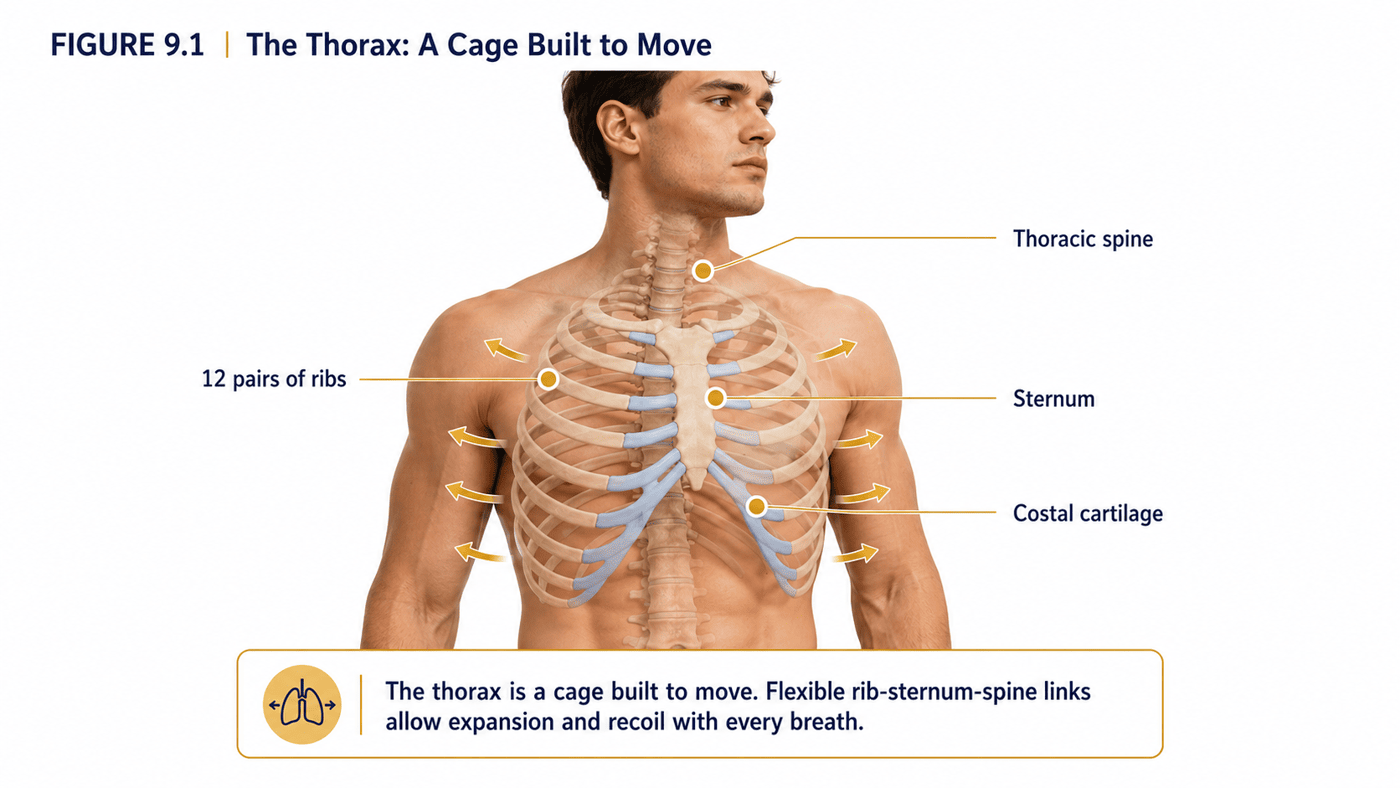
The rib cage is an elegant piece of engineering. Twelve pairs of ribs curve from the thoracic spine at the back to the sternum, or breastbone, at the front, where most of them attach not directly but through flexible costal cartilage. This arrangement — bony ribs joined to a central column behind and a central plate in front, with springy cartilage allowing give — makes the cage both protective and mobile. It shields the heart and lungs while remaining able to expand and contract, a combination of strength and flexibility that a rigid box could not achieve. Figure 9.1 shows the basic structure.
Each rib forms small synovial joints with the vertebrae behind — the costovertebral joints — and these, together with the joints of the thoracic spine itself, allow the cage to move in several ways. The thoracic spine can flex and extend, side-bend, and — importantly — rotate; indeed the thoracic spine is the principal site of rotation in the whole trunk. The ribs, meanwhile, swing upward and outward during breathing in two characteristic patterns: the upper ribs move like a pump handle, lifting the sternum up and forward to deepen the chest, while the lower ribs move like a bucket handle, swinging out to the sides to widen it. Together these movements enlarge the cage in every dimension to draw air in.
This anatomy carries an immediate lesson. A structure with this many joints and this much designed-in movement is, like every tissue in this book, governed by the principle of use: move it regularly through its range and it stays mobile; hold it still in one position and it stiffens. The costovertebral joints, the thoracic segments and the costal cartilage all remodel toward the demands placed on them. A thorax that spends its days flexed and motionless in a chair is a thorax being trained, faithfully, toward stiffness.
The costal cartilage deserves a final note, because it is the cage’s secret to staying springy. By joining the bony ribs to the sternum through a flexible, slightly elastic material rather than rigid bone, the body builds a cage that can deform and recoil with every breath and spring back to shape. Like all connective tissue, however, cartilage adapts to the demands placed on it, and a thorax that is rarely taken through full expansion gradually loses some of this suppleness. This is one more reason that breathing fully and moving the cage regularly is not a trivial matter of comfort but a way of preserving the very pliability that makes the thorax work.
9.3 How Sitting Compresses the Cage
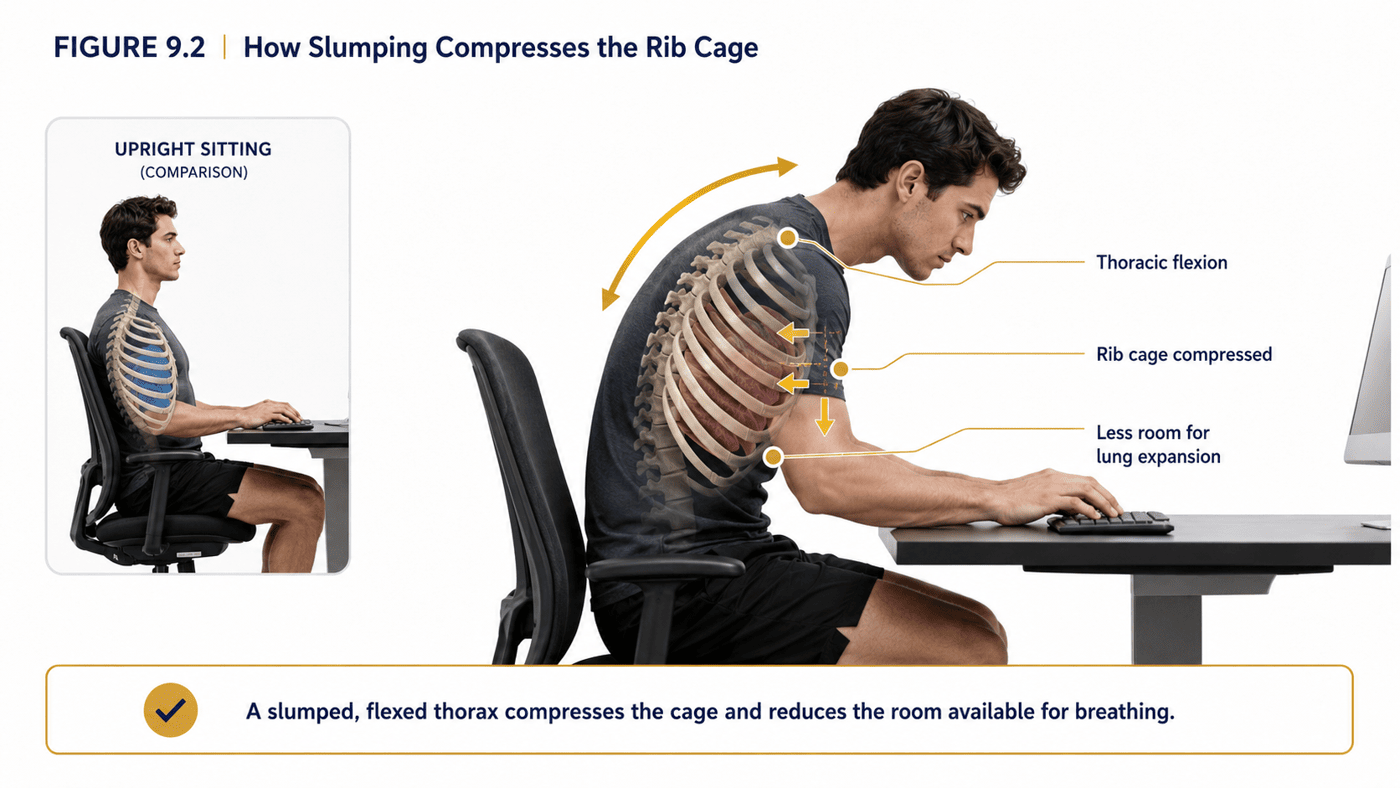
Recall from Chapter 7 the shape of the sitting spine: the pelvis tips backward, the lumbar curve flattens, and the thoracic spine rounds further into kyphosis. This rounding does not stay confined to the spine; it acts directly on the rib cage. As the thoracic spine flexes, the rib cage is drawn downward and forward, the front of the chest sinks toward the abdomen, and the ribs are pulled into a more depressed, compressed position. Figure 9.2 contrasts the open, expanded cage of an upright posture with the depressed, compressed cage of a slump.
The mechanical consequence is a loss of the room the cage needs to move. A depressed, flexed thorax has less capacity to expand — the ribs are already pulled down and in, so their range of upward, outward swing is reduced before a breath even begins. The thoracic spine, held flexed, also loses much of its ability to extend and rotate, stiffening in the very directions a desk day never demands. Over months and years, the combination of sustained flexion and absent movement allows the whole thorax to settle into a stiffer, more compressed default — the under-varied, under-loaded, over-repeated pattern of the desk body, expressed in the chest.
This compressed thorax is the hidden link behind several problems already met in this book. It is part of why the slumped shoulder loses overhead range, as Chapter 5 showed, because the scapula sits on this depressed cage and the stiff thoracic spine cannot extend to let the arm rise freely. And, as the next sections show, it is also why sitting can quietly change how a person breathes. The rib cage sits at the crossroads, and its stiffening radiates outward.
Why thoracic rotation matters
One lost movement deserves special mention, because its absence echoes far beyond the chest: thoracic rotation. The thoracic spine is the trunk’s principal site of rotation, and that rotation is woven into ordinary movement. Walking depends on a gentle counter-rotation of the rib cage against the pelvis with each stride; reaching across the body, turning to look behind, swinging a golf club or a tennis racket — all draw on the thorax’s ability to twist. A thoracic spine stiffened by sustained slumped sitting loses much of this rotation without the person ever noticing the loss directly.
The body, however, notices, and compensates. When the thorax will not rotate, the movement has to come from somewhere else, and the neighbouring regions oblige: the lower back and the neck take on rotational demands they are less suited to, and the shoulder is forced to work harder to make up for a trunk that no longer turns. In this way a stiff thorax quietly contributes to the very neck and low-back complaints of the previous chapters, and restoring thoracic rotation often relieves load on both — another reason the forgotten structure repays attention.
| Effect of slumped sitting | Mechanism | Consequence |
|---|---|---|
| Thorax depressed & compressed | Thoracic flexion pulls the ribs down and in | Less room for the cage to expand |
| Thoracic spine stiffens | Held flexed; never extends or rotates | Lost rotation and extension; stiff upper back |
| Rib expansion reduced | Ribs pre-pulled into a depressed position | Shallower breathing potential |
| Scapular base compromised | Scapula sits on a depressed, stiff cage | Reduced overhead shoulder range (Ch 5) |
Table 9.1. Slumped sitting compresses and stiffens the thorax, with consequences for breathing and for the shoulder above it.
9.4 Breathing Mechanics and the Diaphragm
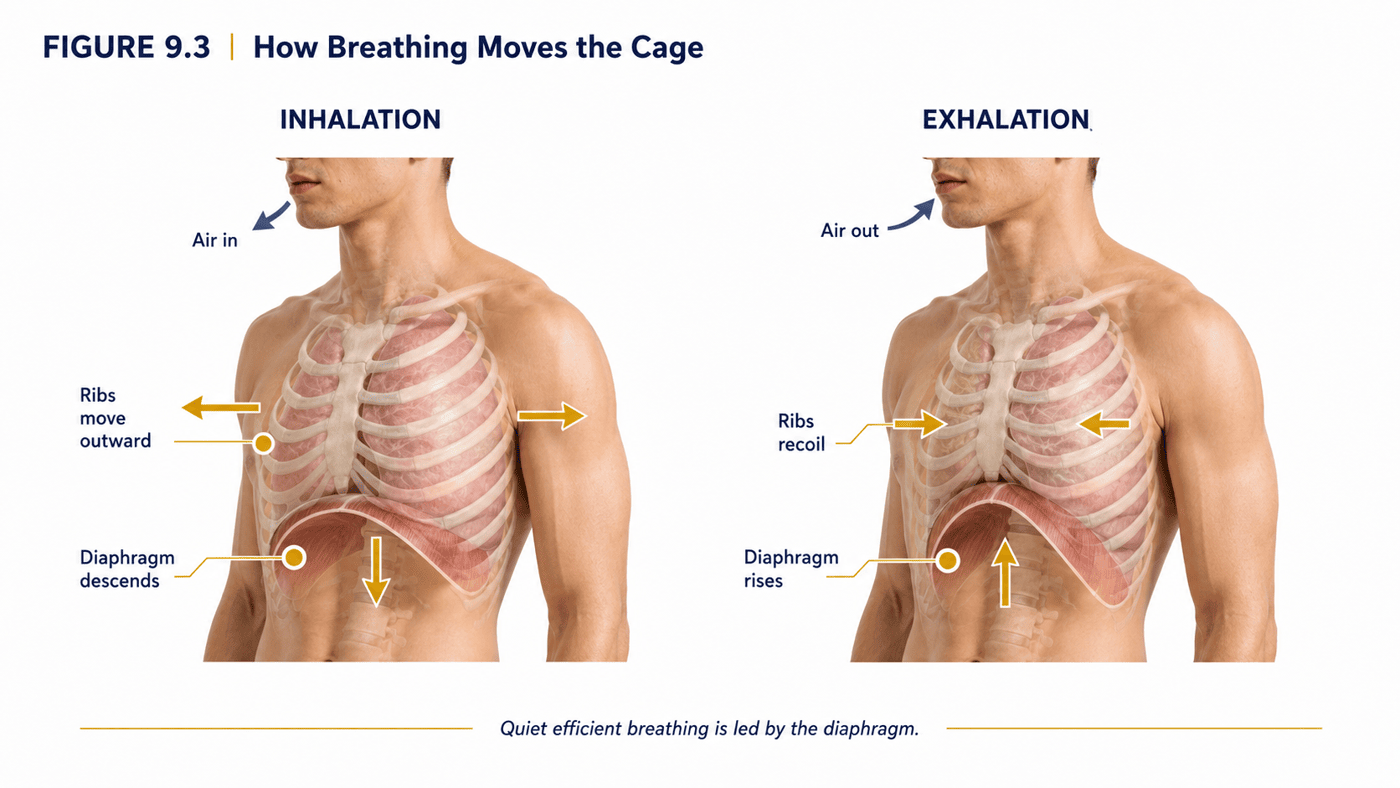
To see why a compressed cage matters, we need to understand how breathing actually works. Breathing is, mechanically, a matter of changing the volume of the thorax: enlarge the cavity and pressure falls, drawing air in; reduce it and air is pushed out. The principal engine of this volume change is the diaphragm, a large dome-shaped sheet of muscle that separates the chest from the abdomen. At rest it sits domed upward into the chest. When it contracts, it flattens and descends, pushing the abdominal contents down and dramatically increasing the vertical dimension of the thorax — the single most important movement in quiet breathing. Figure 9.3 shows the diaphragm descending on inhalation and recoiling on exhalation, with the ribs swinging outward to assist.
Working alongside the diaphragm, the intercostal muscles between the ribs help to lift and stabilise the cage, producing the pump-handle and bucket-handle rib movements described earlier. In calm, efficient breathing, the diaphragm does the great majority of the work and the chest moves relatively little; the belly gently rises and falls as the diaphragm descends and the abdominal contents shift. This is what is meant by diaphragmatic or belly breathing, and it is the low-effort, biomechanically sound pattern the body is designed to use at rest.
There is a second set of muscles that can assist breathing when demand is high — the accessory muscles, including the scalenes and sternocleidomastoid in the neck and the upper trapezius. During vigorous exercise these rightly contribute, helping to lift the upper rib cage. The problem, as the coming sections show, arises when these neck-based accessory muscles are recruited not occasionally for hard breathing but habitually for ordinary breathing — a pattern that a compressed, stiff thorax quietly encourages.
It is worth noticing how little effort good breathing should take. At rest, exhalation is largely passive: having contracted to draw air in, the diaphragm simply relaxes, and the natural elastic recoil of the lungs and the rib cage pushes the air back out, with no muscular work required. Quiet breathing, done well, is therefore an remarkably economical act — a gentle descent of the diaphragm on the inhale, a passive recoil on the exhale, the chest barely moving. When breathing instead becomes a visibly effortful, chest-heaving activity at rest, it is a sign that the efficient default has been lost and the accessory muscles have been pressed into routine service.
9.5 How Posture Changes Breathing
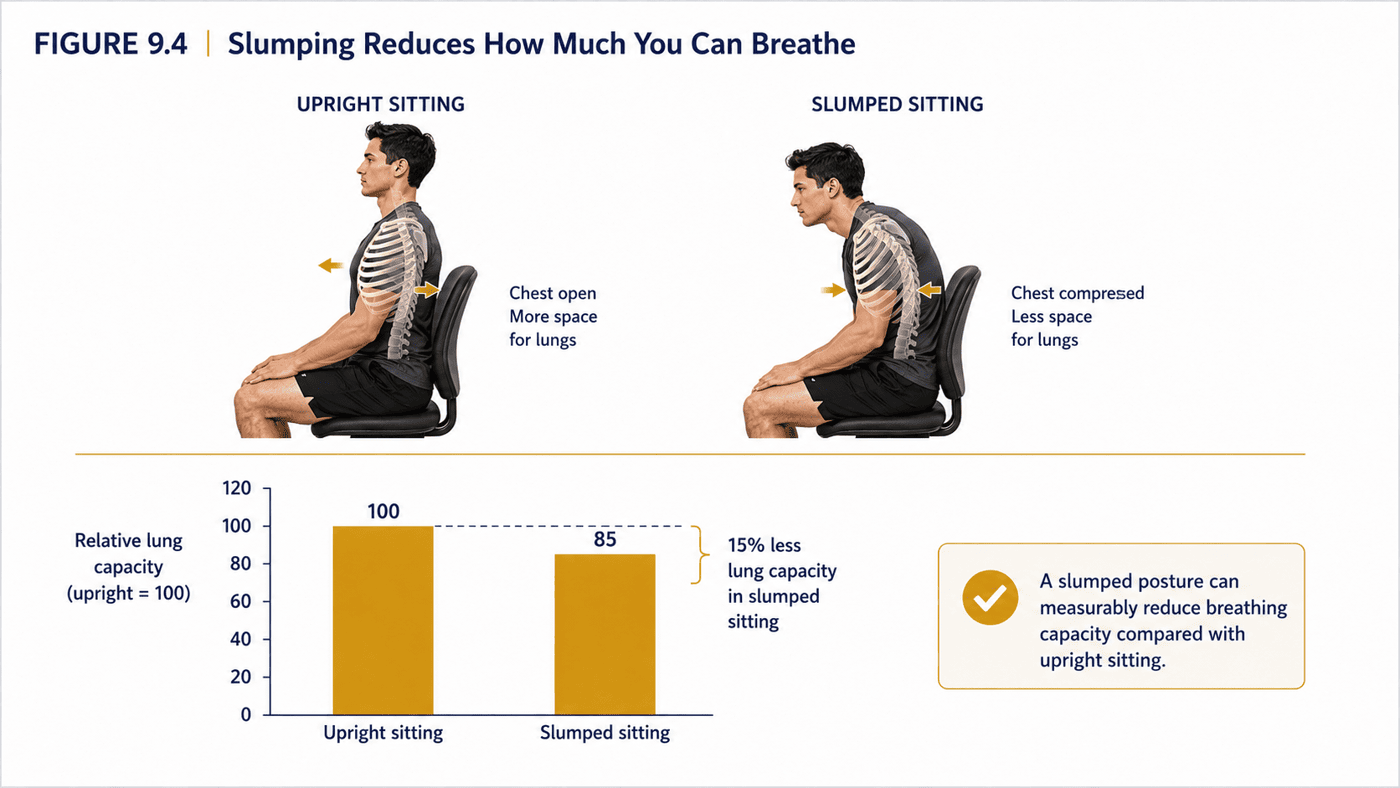
Because breathing depends on the thorax changing volume, and because a slumped posture compresses the thorax, it follows that posture should affect breathing — and it does, measurably. Lin et al. (2006) found that a slumped sitting posture reduced lung capacity and expiratory flow compared with an upright posture; the compressed cage and the diaphragm’s less favourable position in a slump leave less room for air. Figure 9.4 illustrates this reduction. Related work has shown that posture also alters the activity of the muscles involved in breathing (Kera & Maruyama, 2005). The effect of any single slumped breath is small and of no consequence; the concern is the cumulative effect of breathing, all day and every day, in a posture that subtly restricts the cage.
A compressed thorax does not only reduce capacity; it tends to change the pattern of breathing. When the diaphragm’s descent is restricted by a slumped, compressed posture — the abdomen folded, the cage pulled down — the body tends to compensate by drawing more of each breath through the upper chest, lifting the upper ribs using the accessory muscles of the neck. This shift toward shallow, upper-chest breathing is subtle and usually unconscious, but over a sedentary day it means the neck-based accessory muscles are recruited far more than they should be. What ought to be the occasional helpers of hard breathing become the habitual drivers of quiet breathing — with consequences that reach straight back into the neck and shoulders.
Breathing, comfort and concentration
The reach of breathing extends beyond the muscles and joints into how a person feels and functions through a working day. Efficient diaphragmatic breathing supports comfortable, adequate gas exchange with minimal effort; shallow, rapid, upper-chest breathing is less efficient and more effortful, and sustained over hours it can contribute to a vague sense of fatigue, tension and difficulty concentrating. The desk worker hunched and breathing high over a screen is, in a small way, working harder to breathe than they need to, hour after hour.
None of this should be overstated into grand claims, but the modest version is well founded and worth acting on: a body that sits a little taller, with a mobile cage and a diaphragm free to descend, breathes more easily, and breathing more easily tends to feel better. Among the quiet dividends of attending to posture and the rib cage, then, is not only a more comfortable neck and a freer shoulder but a breath that costs less — a benefit repeated with every one of the day’s many thousands of breaths.
9.6 The Breathing–Neck–Shoulder Loop
Here the chapters of Part II and this one connect into a single picture. The accessory breathing muscles — the scalenes, sternocleidomastoid and upper trapezius — are also neck and shoulder-girdle muscles. They are the very tissues identified in Chapter 4 as overworked in forward-head posture, and in Chapter 5 as part of the imbalanced shoulder. When a compressed thorax pushes breathing into the upper chest, these muscles are recruited for every one of the roughly twenty thousand breaths a person takes each day — a relentless, low-level demand on muscles that are already overworked by the desk posture itself.
This sets up a self-reinforcing loop. A slumped posture compresses the thorax; the compressed thorax drives upper-chest breathing; upper-chest breathing overworks the neck and shoulder muscles; and chronically tight, overworked neck and shoulder muscles reinforce the very posture that started the cycle. The neck tension, shoulder tightness and upper-back fatigue that desk workers so commonly report are, in part, a breathing problem wearing a musculoskeletal disguise — and no amount of neck stretching or shoulder massage will fully resolve a tension that is being topped up twenty thousand times a day by a dysfunctional breathing pattern (Bradley & Esformes, 2014).
The practical importance of this loop is large and frequently missed. It means that restoring relaxed, diaphragm-led breathing is not a separate ‘wellness’ add-on but a genuine part of addressing neck and shoulder tension; and that, conversely, freeing the thorax and improving posture supports better breathing. The neck, the shoulders, the thorax and the breath are one connected system, and the rib cage — the forgotten structure — sits at its centre.
Stress, breathing and the desk body
Breathing is unusual among bodily functions in being both automatic and consciously adjustable, and in being tightly linked to emotional state. Stress and anxiety reliably quicken and shallow the breath, pulling it up into the chest; and a habitual chest-led, slumped breathing pattern can, in turn, keep the body in a subtly aroused state. For the desk worker, these tendencies compound: a stressful, sedentary day spent slumped over a screen combines the postural push toward upper-chest breathing with the emotional one, so that shallow, rapid breathing can become a quiet default.
The encouraging side of this two-way link is that the breath is a lever one can actually pull (Neumann, 2017). Deliberately slowing the breath and breathing low, into the abdomen, tends to calm the body’s stress response as well as resting the overworked neck muscles — which is why slow diaphragmatic breathing is so consistently used to down-regulate tension (Bradley & Esformes, 2014). This is offered as ordinary physiology, not as a cure for clinical anxiety, which deserves proper professional support. But for the everyday tension of a desk day, a few minutes of calm, low breathing addresses the body and the mind at once — a small intervention with a reach well beyond the rib cage.
9.7 The Diaphragm’s Double Job
There is one more reason the breathing of the desk body matters, and it links the rib cage back to the spine of Chapter 7. The diaphragm is not only the engine of breathing; it is also a key contributor to the stability of the trunk and spine. When the diaphragm contracts, it raises the pressure within the abdominal cavity, and this intra-abdominal pressure helps to stiffen and support the lumbar spine from the front. Hodges and Gandevia (2000) demonstrated that the diaphragm contributes to intra-abdominal pressure and to postural control of the trunk, as well as to respiration — the diaphragm, in other words, has a double job, breathing and bracing at the same time.
This dual role has an elegant implication. Calm, diaphragmatic breathing does not merely oxygenate the body and spare the neck; it also rhythmically supports the spine from within. A breathing pattern that has shifted up into the chest, by contrast, under-uses the diaphragm in both of its roles, contributing less to trunk stability as well as overworking the neck. Restoring good breathing therefore supports the spine as well as the neck and shoulders — one more way in which the systems of the trunk are interconnected, and one more argument for treating the rib cage and the breath as central rather than peripheral to the desk body.
The thorax across a lifetime
The case for keeping the thorax mobile grows stronger with age. The natural tendency over a lifetime is toward increasing thoracic kyphosis — a gradual rounding of the upper back — and toward stiffer rib joints and reduced breathing capacity. A sedentary, slumped life accelerates each of these, while a life of regular movement and full breathing slows them. The desk habits formed in one’s thirties and forties, in other words, help set the trajectory of the thorax for decades to come.
This is the load-capacity principle of Chapter 1 written across a lifespan. A thorax that is regularly extended, rotated and fully breathed retains its mobility and its breathing reserve far longer than one left to settle into the chair; and because the thorax governs so much — shoulder function, spinal support, breathing itself — preserving its movement is an investment that pays out across the whole body and the whole of later life. The forgotten structure, attended to early, is among the quietest and most valuable of long-term health investments.
9.8 Restoring the Cage: Mobility and Breathing
The strategy for the rib cage follows naturally, and it has two strands that work together. The first is to restore thoracic mobility — to move the cage and the thoracic spine through the ranges that sitting neglects, especially extension and rotation. Regular thoracic extension over a chair back or foam roller, and gentle seated and standing rotations, remind the costovertebral joints and thoracic segments how to move and counter the settling toward stiffness. This is the same work that Chapter 5 prescribed for the shoulder, because a mobile thorax is the foundation of both good shoulder mechanics and good breathing.
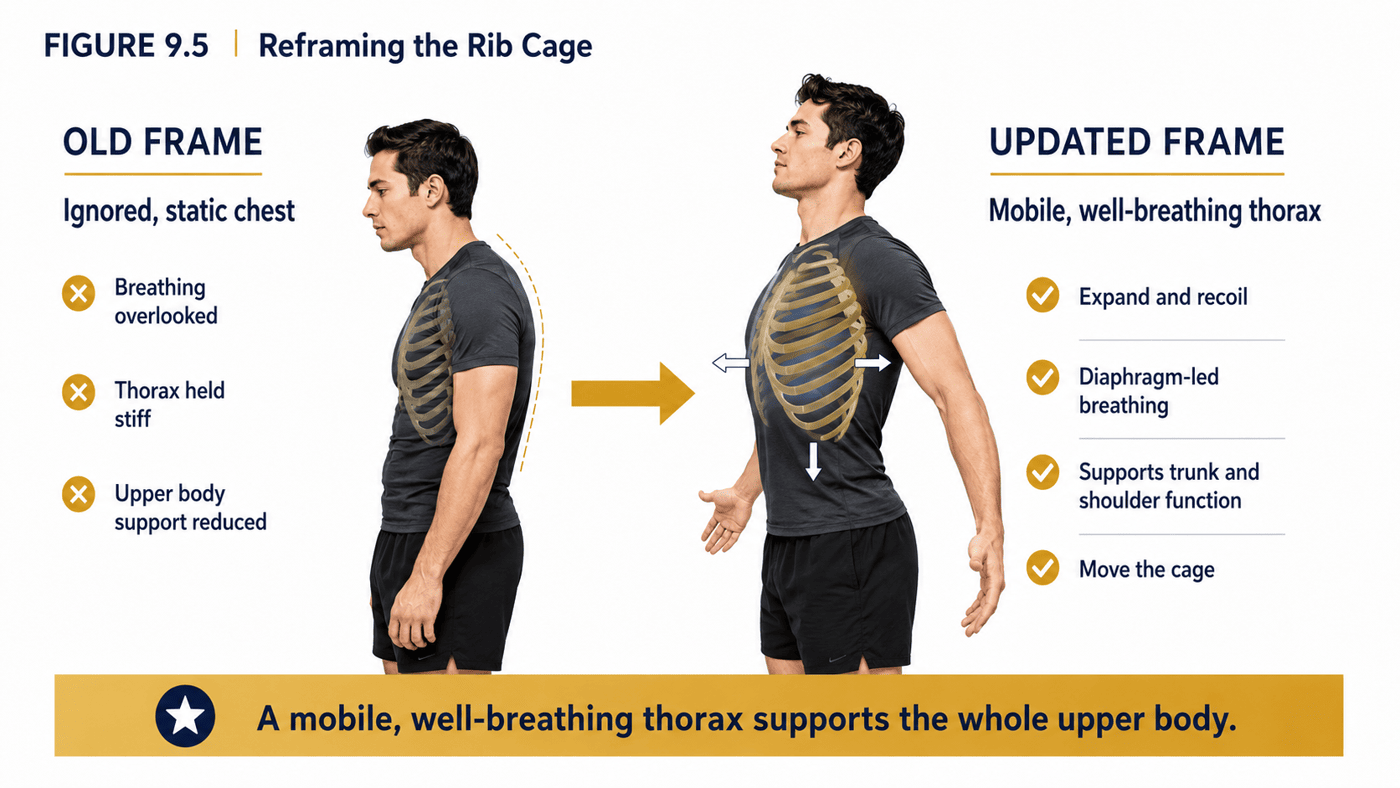
The second strand is to restore diaphragmatic breathing — to re-learn the low, relaxed, belly-led breathing pattern that a compressed posture and a busy, stressed life tend to erode. Simply bringing attention to the breath, allowing the abdomen to expand on the inhale while the chest stays relatively quiet, and practising this for a few minutes at a time, begins to re-establish the diaphragm as the primary breathing muscle and to relieve the neck-based accessory muscles. Figure 9.5 sets the old framing against the new: from an ignored, static chest and shallow, high breathing, to a mobile, well-breathing thorax that supports the neck, shoulders and spine alike. The practical chapters of Part VII develop both strands into routines; the box below gives the essentials.
| Old assumption | What the mechanics suggest |
|---|---|
| Posture is about the neck and back only | The thorax links spine, shoulders and breathing — and stiffens with sitting too. |
| Breathing is automatic; ignore it | Slumping reduces lung capacity and shifts breathing to the chest (Lin et al., 2006). |
| Neck tension is purely a muscle problem | Upper-chest breathing recruits the neck muscles for every breath, feeding tension (Bradley & Esformes, 2014). |
| The diaphragm only does breathing | It also stabilises the spine via intra-abdominal pressure (Hodges & Gandevia, 2000). |
Table 9.2. The rib cage and breathing, reframed from ignored afterthought to central hub of the desk body.
Putting it together: the upper-body chain
This chapter closes not only the rib-cage discussion but the whole arc of the upper body that Parts II and III have traced. The picture that emerges is of a single connected chain rather than a set of separate parts. The head sits forward over a screen; the neck holds it there; the shoulders round toward the keyboard; the thoracic spine flexes and stiffens; the rib cage is compressed; breathing rises into the neck-based accessory muscles — and each of these both causes and is caused by the others. The forward head feeds the rounded shoulder; the stiff thorax limits the shoulder and shifts breathing upward; the upper-chest breathing tightens the neck; the tight neck reinforces the forward head. It is one loop, turning slowly through a sedentary day.
The practical consequence is that the upper body responds best to being addressed as a whole. Mobilising the thoracic spine helps the shoulder and the breath; restoring diaphragmatic breathing relieves the neck; building neck and scapular capacity supports the posture that frees the cage. No single stretch or gadget aimed at one link will resolve a problem distributed across the chain, which is why the strategies of Chapters 4 through 9 are designed to work together. The desk worker who moves often, breathes low, frees the thorax and builds capacity across the upper quarter is not treating six problems but one — and that is the most efficient route to a comfortable, capable upper body.
In summary
- The rib cage is the overlooked hub of the desk body, linking the thoracic spine, the shoulder blades and breathing — a moving structure we rarely think of as moving.
- The thorax is built for mobility: ribs join the spine and sternum via flexible cartilage, and the thoracic spine is the trunk’s main site of rotation; held still, it stiffens.
- Slumped sitting depresses and compresses the cage and stiffens the thoracic spine, reducing both breathing room and shoulder range (linking to Chapters 5 and 7).
- Quiet breathing should be led by the diaphragm; a slumped posture measurably reduces lung capacity and shifts breathing to the upper chest (Lin et al., 2006; Kera & Maruyama, 2005).
- Upper-chest breathing recruits the neck-based accessory muscles for every breath, feeding a self-reinforcing loop of posture, breathing and neck/shoulder tension (Bradley & Esformes, 2014).
- The diaphragm has a double job — breathing and stabilising the spine via intra-abdominal pressure — so good breathing supports the back too (Hodges & Gandevia, 2000).
- The remedy is to restore thoracic mobility and diaphragmatic breathing, which together support the neck, shoulders, spine and breath as one connected system.
References
Bradley, H., & Esformes, J. (2014). Breathing pattern disorders and functional movement. International Journal of Sports Physical Therapy, 9(1), 28–39.
Hodges, P. W., & Gandevia, S. C. (2000). Changes in intra-abdominal pressure during postural and respiratory activation of the human diaphragm. Journal of Applied Physiology, 89(3), 967–976.
Kera, T., & Maruyama, H. (2005). The effect of posture on respiratory activity of the abdominal muscles. Journal of Physiological Anthropology and Applied Human Science, 24(4), 259–265.
Lin, F., Parthasarathy, S., Taylor, S. J., Pucci, D., Hendrix, R. W., & Makhsous, M. (2006). Effect of different sitting postures on lung capacity, expiratory flow, and lumbar lordosis. Archives of Physical Medicine and Rehabilitation, 87(4), 504–509.
Neumann, D. A. (2017). Kinesiology of the musculoskeletal system: Foundations for rehabilitation (3rd ed.). Elsevier.