Part III · SPINE, RIB CAGE AND BREATHING
Low-Back Pain and the Desk Worker
Low-back pain is the world’s leading cause of disability, and the desk worker is sure their chair is to blame. The evidence is more surprising, and far more reassuring: most back pain has no clear structural cause, sitting is a weaker culprit than assumed, and the back is far more robust than the fear surrounding it.
8.1 The Most Common Pain
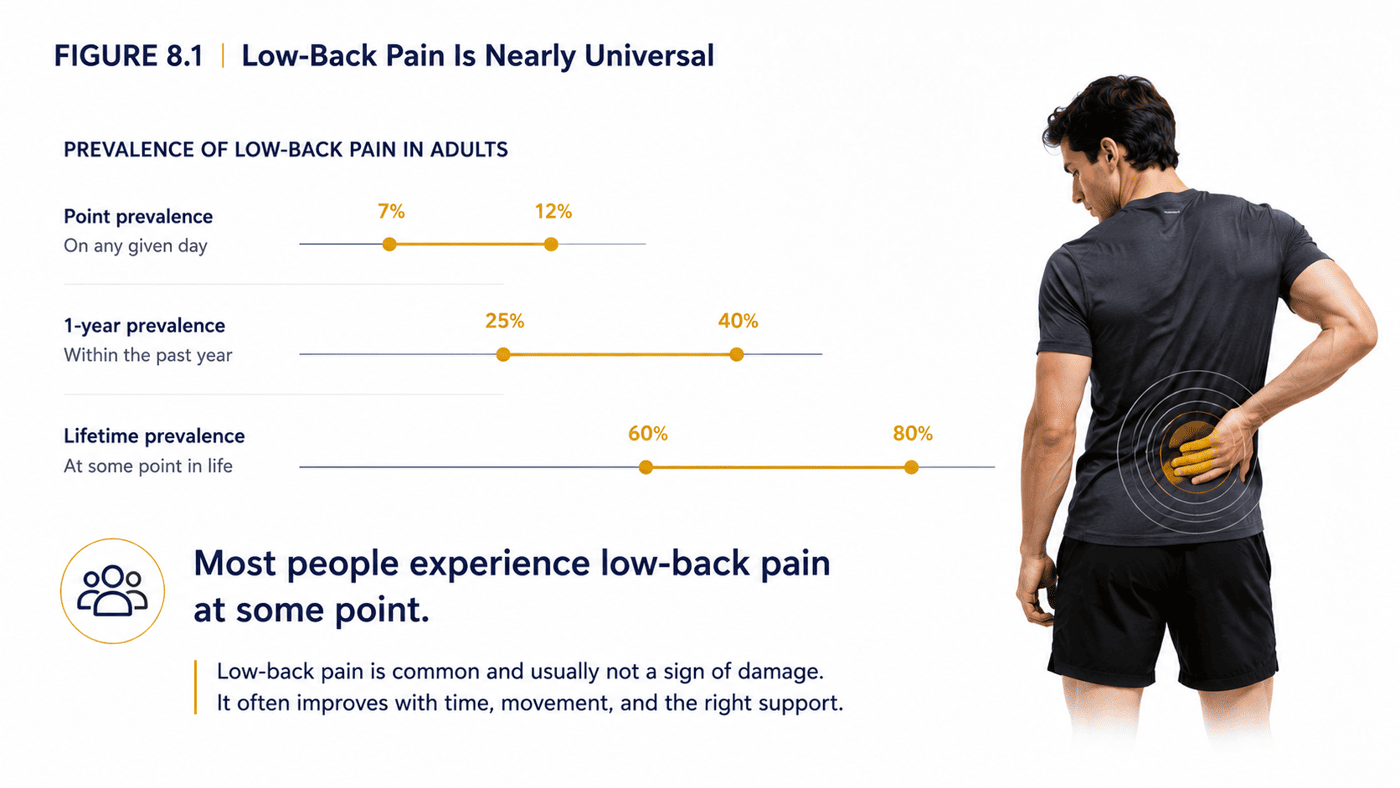
Few human experiences are as widely shared as low-back pain. The large majority of people will experience it at some point in their lives, and at any given moment a substantial fraction of the population is living with it. Globally it is the single leading cause of years lived with disability — ahead of every other condition — and its economic and personal costs are enormous (Hartvigsen et al., 2018). Figure 8.1 gives a sense of its reach: low-back pain is not an unusual misfortune but a near-universal part of being human, as ordinary as the common cold.
That ubiquity is itself the first clue to understanding it. A condition that affects almost everyone, across every kind of occupation and activity level, is unlikely to have a single simple cause — and it does not. This chapter sets out what the evidence actually shows about low-back pain in the desk worker: that most of it cannot be traced to a specific structural problem, that the link between sitting and back pain is weaker and more complex than intuition suggests, that the back is a robust structure rather than a fragile one, and that the things which genuinely help are movement, activity and confidence rather than rest, fear and protection. It is, in the end, a hopeful story — but one that requires unlearning a good deal of received wisdom.
It also helps to hold two facts together from the outset, because the rest of the chapter depends on them. The first is that low-back pain is overwhelmingly common and overwhelmingly benign: serious, sinister causes account for only a small fraction of cases, and most episodes settle. The second is that, despite this, low-back pain causes more disability worldwide than any other condition — not because the underlying problem is usually severe, but because of how it is managed, feared and allowed to limit life. The gap between how benign most back pain is and how disabling it becomes is, in large part, a gap created by misunderstanding — which is precisely why getting the understanding right is so powerful.
8.2 Most Back Pain Has No Clear Structural Cause
When the back hurts, the natural assumption — shared by patients and, historically, by clinicians — is that something must be structurally wrong: a disc, a joint, a vertebra. Yet in the great majority of cases, no specific structural cause can be identified at all. Maher, Underwood and Buchbinder (2017), reviewing the condition, note that around nine in ten cases are classed as non-specific low-back pain — pain for which no precise anatomical source can be pinned down. Only a small minority of back pain is attributable to a specific, serious cause; the rest is real, often distressing, but not traceable to a single broken part.
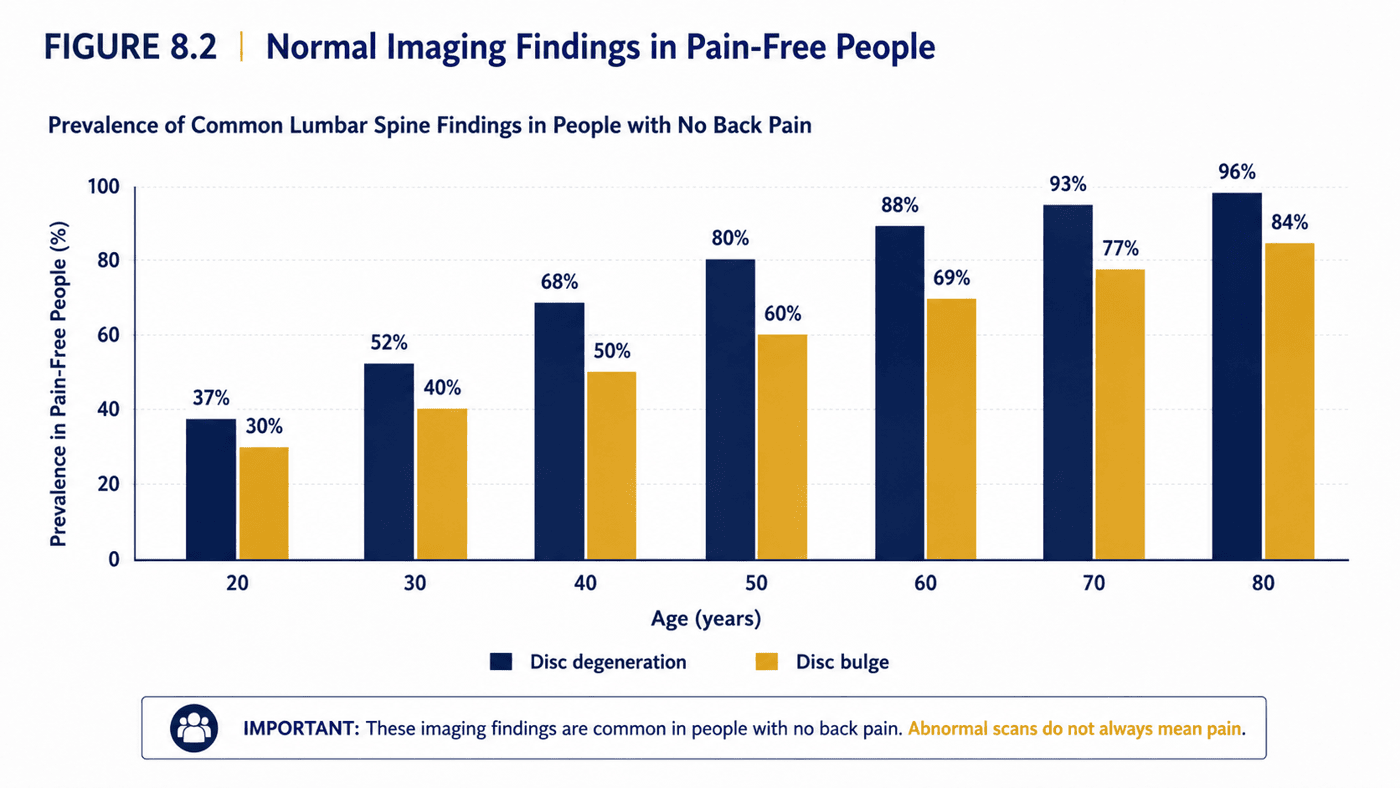
This is reinforced by one of the most important and counter-intuitive findings in the whole field: the things seen on back scans correlate poorly with pain. Brinjikji et al. (2015), pooling imaging studies of people with no back pain at all, found that the supposedly ‘abnormal’ findings so often blamed for pain — disc degeneration, disc bulges, and similar changes — are extremely common in pain-free people, and become more common with age. As Figure 8.2 shows, disc degeneration is present in roughly a third of pain-free people in their twenties and in the great majority by old age; disc bulges follow the same pattern. These changes are, in large part, the normal marks of a lived-in spine — more like wrinkles or grey hair than like injuries.
The implications are profound and, properly understood, liberating. A scan that shows ‘degeneration’ or a ‘bulging disc’ in someone with back pain has very often found something that is also present in their pain-free neighbour; the finding may be incidental rather than causal. This is why clinical guidelines now advise against routine imaging for ordinary low-back pain — it rarely changes management and frequently makes things worse, by attaching a frightening structural label to a problem that is usually not structural. A person told their spine is ‘degenerating’ or ‘crumbling’ understandably becomes fearful and protective, and, as the pain science of Chapter 3 showed, that fear tends to worsen and prolong the very pain it responds to.
Words that harm: the nocebo effect
The harm done by frightening structural language deserves a name. Just as a placebo can relieve symptoms through positive expectation, a nocebo can worsen them through negative expectation — and the words used to describe back pain are a potent source of nocebo. Telling a person their disc is ‘degenerated’, their spine ‘crumbling’, their back that of ‘a seventy-year-old’, or that they have ‘the worst disc I have seen’ attaches a frightening, damage-laden meaning to a problem that is usually neither serious nor structural.
The consequences are measurable. A person who believes their spine is damaged and fragile moves less, guards more, expects the worst and recovers more slowly — the fear-avoidance cycle of Chapter 3, set in motion by a sentence. This is why the language of reassurance is not mere bedside manner but active treatment, and why accurate, non-threatening explanation — that the back is robust, that the findings are common and normal, that movement is safe — is among the most valuable things a person with back pain can be given. Words, in the management of back pain, are mechanically active.
8.3 Does Sitting Cause Back Pain?
Given the theme of this book, the desk worker might reasonably expect this chapter to confirm that their sitting is the cause of their back pain. Honesty requires a more surprising answer. When researchers have examined the question carefully, the evidence that occupational sitting causes low-back pain is weak. Roffey, Wai, Bishop, Kwon and Dagenais (2010), in a systematic review specifically assessing whether occupational sitting is a cause of low-back pain, concluded that it is not independently associated with the development of back pain. Lis, Black, Korn and Nordin (2007), reviewing the association between sitting and occupational low-back pain, reached a broadly compatible conclusion: sitting alone does not appear to be a strong independent risk factor, though sitting combined with other exposures, such as whole-body vibration or awkward sustained postures, may matter more.
This deserves to be stated plainly because it cuts against intuition and against a great deal of marketing: there is no good evidence that sitting at a desk, by itself, causes low-back pain. People who sit for work are not, on the strength of the evidence, doomed to back trouble, and the chair is not the villain it is often made out to be. This is genuinely reassuring news for anyone whose work involves sitting.
Why, then, does this book devote so much attention to sitting? Because ‘sitting does not cause back pain’ is not the same as ‘sitting has no mechanical consequences’. As the next section explains, sustained sitting still shapes the back — through the creep and deconditioning described in Chapter 7 — and still contributes to stiffness, discomfort and reduced capacity, even if it does not, on its own, cause a discrete pain condition. The mechanical story and the epidemiological story are both true, and holding them together is the key to thinking clearly about the desk and the back.
8.4 What Sitting Actually Does
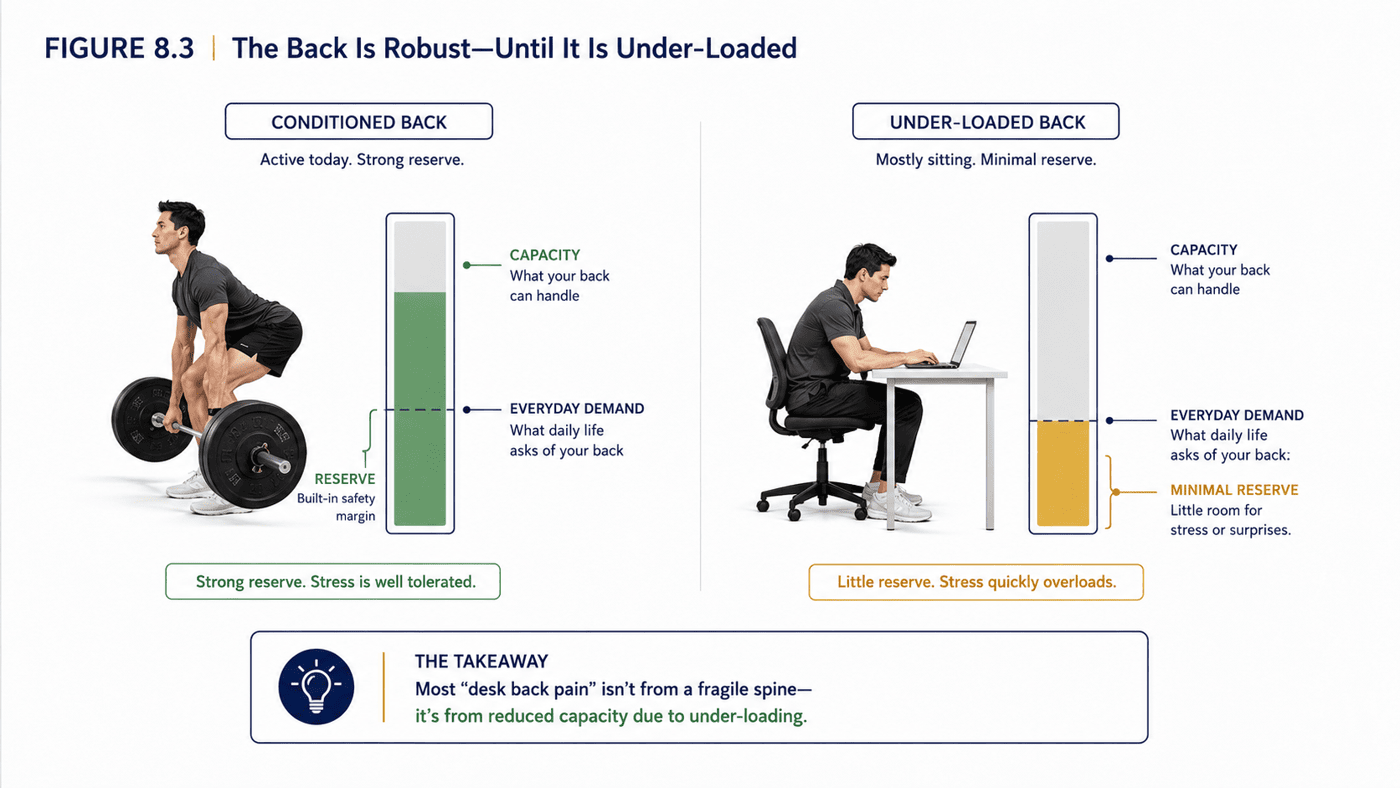
If sitting does not cause back pain outright, what does it do? Chapter 7 supplied the mechanics. Sustained, unbroken sitting holds the lumbar spine in flexion for long periods, producing tissue creep and temporarily dulling the protective muscle reflexes, and it deprives the discs of the cyclic loading they depend upon. Over the longer term, a life dominated by sitting under-loads the back: the muscles, discs and connective tissues that would be conditioned by bending, lifting, carrying and moving are instead held still, and, exactly as the load-response window of Chapter 1 predicts, their capacity quietly declines.
The desk worker’s back problem, then, is best understood not as damage inflicted by the chair but as a back made less capable by under-use, operating with a reduced mechanical reserve. Such a back is more easily provoked by the ordinary demands of life — a vigorous weekend, an awkward lift, a long journey — not because those demands are dangerous, but because the margin between everyday demand and available capacity has narrowed. This is a subtle but decisive shift in framing: the problem is too little loading rather than too much, and the solution is therefore more movement and more capacity, not more rest and more protection.
This also explains why the discomfort many desk workers feel — the stiff, achy back at the end of a sedentary day, eased by standing and moving — is real without being a sign of damage. It is the predictable sensation of a back held still too long, exactly as a limb held in one position grows uncomfortable. The remedy is not to fear the chair but to interrupt it, and to build, over time, a back robust enough that a desk day makes no impression on it at all.
Sitting, health and the bigger picture
A caveat keeps this chapter honest. To say that sitting does not, by itself, cause low-back pain is emphatically not to say that prolonged sitting is harmless (Callaghan & McGill, 2001). Part I set out the substantial evidence that high volumes of sedentary time carry real cardiometabolic risks — for cardiovascular disease, type 2 diabetes and all-cause mortality — that are partly independent of how much a person exercises. Those risks are serious and well established, and they are reason enough to sit less and move more, quite apart from any question of back pain.
So the desk worker has two distinct reasons to break up sitting, and it helps to keep them separate. The first is musculoskeletal comfort and capacity: moving relieves the stiffness of a held spine and, over time, builds a more capable back. The second is whole-body health: interrupting sedentary time benefits the metabolism and the cardiovascular system regardless of the back. Both point to the same simple action — sit less, move more, move often — but understanding that they are different reasons guards against the mistake of treating every ache as damage from the chair, or of ignoring the deeper health case for movement simply because one’s back happens to feel fine.
8.5 Pain Is Biopsychosocial
No account of low-back pain is complete without the insight that has most transformed the field: pain is biopsychosocial. As Chapter 3 set out in detail, pain is not a simple readout of tissue damage but an output of the whole person, shaped by biological, psychological and social factors together (Hartvigsen et al., 2018). In low-back pain this is especially pronounced, given how poorly structural findings predict symptoms. Mood, stress, sleep, beliefs about the back, fear of movement, work satisfaction and life circumstances all genuinely influence whether back pain arises, how much it hurts, and whether it persists.
Two consequences matter most for the desk worker. First, the fear-avoidance cycle (Vlaeyen & Linton, 2000) is a powerful driver of persistent back pain: believing the back is fragile and movement dangerous leads to avoidance, avoidance leads to deconditioning, and deconditioning worsens both pain and disability. Second, and more hopefully, understanding pain differently can itself reduce it (Moseley & Butler, 2015); learning that hurt does not equal harm, that the back is robust, and that movement is safe is not mere reassurance but an active ingredient of recovery. Modern, evidence-based approaches such as cognitive functional therapy are built on exactly this combination of confident movement and accurate understanding (O’Sullivan et al., 2018). The way a person thinks about their back is part of the mechanics of how it feels.
Yellow flags: when recovery stalls
Clinicians working with back pain have a useful shorthand for the psychosocial factors that predict whether pain will persist: yellow flags. Where the red flags mentioned later in this chapter point to rare, serious physical conditions, yellow flags point to the psychological and social circumstances that make ordinary back pain more likely to become long-lasting and disabling. They include a belief that the back is badly damaged and that activity is dangerous, a tendency to expect the worst (catastrophising), low mood and high stress, low expectation of recovery, and dissatisfaction or difficulty at work.
The reason yellow flags matter so much is that they, far more than any structural finding, predict who will still be in pain months later. This reframes what ‘treatment’ should target. For most people with persistent back pain, the productive levers are not found on a scan but in these modifiable beliefs and circumstances: rebuilding confidence in the back, restoring activity, addressing fear and low mood, and re-engaging with work and life. It is not that the pain is ‘in the mind’ — the pain is entirely real — but that the path out of it runs as much through understanding, confidence and activity as through anything done to the tissues.
8.6 The Back Is Robust
Underlying everything in this chapter is a single corrective message: the back is a robust, resilient structure, not the fragile one the surrounding culture implies. The spine is built to bend, lift, twist and bear load; it does so safely countless times in a normal life. The language that so often surrounds back pain — of slipped discs, crumbling spines, things going ‘out’ — is both mechanically misleading and actively harmful, because it frames an ordinary, recoverable experience as evidence of fragility and damage.
Figure 8.3 places the desk worker’s situation in the load-capacity terms that organise this book. A well-loaded, conditioned back carries the demands of everyday life — lifting, bending, sitting, the occasional surprise — with ample reserve. The desk problem is not that the back is inherently weak but that under-loading has lowered its capacity, narrowing the margin until ordinary demands begin to provoke symptoms. The answer this points to is not to protect a fragile structure but to rebuild a capable one. A back treated as strong, and progressively loaded so that it becomes strong, tolerates sitting and almost everything else — which is precisely the goal.
8.7 What Actually Helps
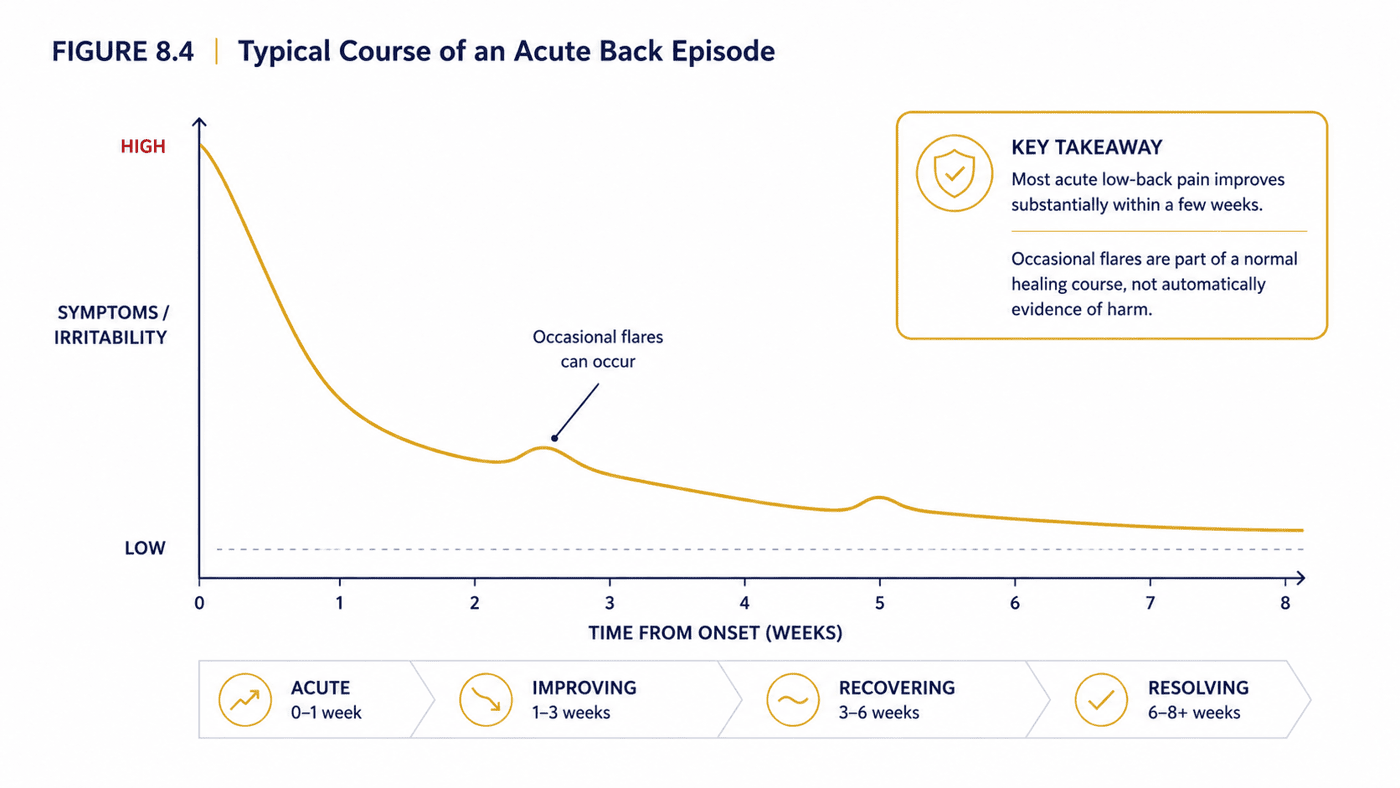
If the back is robust, most back pain is non-specific, sitting is not the cause, and fear makes things worse, then what genuinely helps? The evidence points consistently in one direction: stay active. For acute low-back pain, the old prescription of bed rest has been firmly overturned; remaining active and continuing ordinary movement as much as pain allows leads to better outcomes than resting. Reassurance that the pain is not dangerous, that it will very likely settle, and that movement is safe is itself part of effective care (Foster et al., 2018). Figure 8.4 shows the usual course of an acute episode — most improve substantially within a few weeks — and understanding this natural trajectory helps replace alarm with patience.
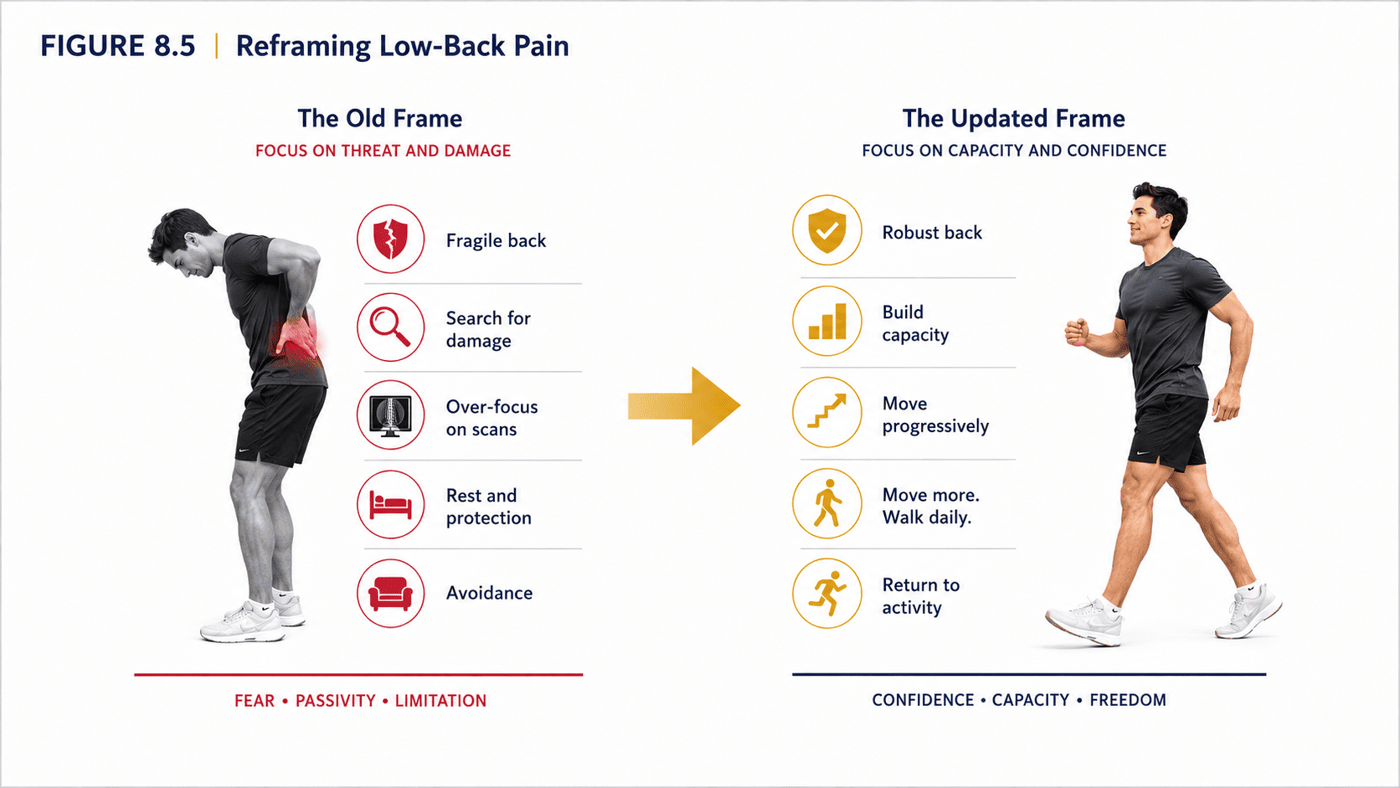
For preventing recurrence, the evidence is equally clear and points to the same place. Steffens et al. (2016), in a large review of what actually prevents low-back pain, found that exercise — alone or combined with education — was among the few strategies with good supporting evidence, while measures aimed at posture and external support, such as back belts and special insoles, were not. The protective ingredient, once again, is a capable, well-loaded, regularly moved body. Figure 8.5 sets the old framing against the new: from treating back pain as a damage signal demanding rest, scans and protection, to treating it as a multifactorial, manageable experience best met with confident movement and built capacity.
Which kind of exercise?
If exercise is the most reliably helpful thing for the back, the obvious next question is which exercise. Here the evidence is liberating rather than prescriptive: no single type of exercise has been shown to be clearly superior to the others for back pain. General aerobic activity, strengthening, Pilates, yoga, walking programmes and motor-control approaches all show broadly comparable benefits, and none has emerged as the definitive answer. This is not a weakness of the evidence so much as a clue about what is really working: the common ingredient across all of them is regular, confident movement and progressive loading of a body that had been under-used.
The practical upshot is encouraging. The best exercise for the back is, to a first approximation, the one a person will actually do and keep doing — because adherence, not the precise choice of method, is what determines the result. Someone who enjoys walking should walk; someone who likes lifting should lift; someone drawn to yoga should practise yoga. What matters is that the back is moved, loaded and trusted regularly over the long term. This frees the desk worker from the search for a single corrective exercise and points instead toward building an active life that happens to keep the back robust.
What a helpful message sounds like
Because words and beliefs are mechanically active in back pain, the message a person receives about their back matters as much as anything done to it — and the difference between a harmful and a helpful message is stark. The harmful version, still common, runs: your scan shows damage, your spine is worn and vulnerable, rest it, avoid bending and lifting, be careful. Each clause feeds fear, fuels avoidance and invites the deconditioning that prolongs the problem.
The helpful version, grounded in the evidence of this chapter, runs very differently: your back pain is real but your back is robust; the findings on a scan are common in people with no pain at all; hurting does not mean you are harming yourself; movement is safe and good for you; this will very likely settle, and the best thing you can do is stay active and gradually build the back’s capacity. This is not false comfort — it is the accurate account, and delivering it is among the most effective interventions in the whole of back care. A desk worker armed with the second message is already most of the way to recovery.
| Common back-pain claim | What the evidence and mechanics suggest |
|---|---|
| My scan shows the cause of my pain | Degeneration and bulges are common in pain-free people; findings are often incidental (Brinjikji et al., 2015). |
| Sitting at my desk caused my back pain | Occupational sitting is not an independent cause of low-back pain (Roffey et al., 2010; Lis et al., 2007). |
| Rest until the pain goes away | Bed rest worsens outcomes; staying active leads to better recovery (Foster et al., 2018). |
| I must protect my fragile back | The back is robust; fear and avoidance worsen pain (Hartvigsen et al., 2018; Vlaeyen & Linton, 2000). |
| A gadget or belt will prevent it | Exercise prevents recurrence; belts and insoles do not (Steffens et al., 2016). |
Table 8.1. Common low-back-pain claims set against current evidence and mechanical reasoning.
In summary
- Low-back pain is near-universal and the world’s leading cause of disability; its ubiquity is the first clue that it has no single simple cause (Hartvigsen et al., 2018).
- Around nine in ten cases are non-specific, with no identifiable structural cause, and imaging findings such as degeneration and bulges are common in pain-free people (Maher et al., 2017; Brinjikji et al., 2015).
- Careful reviews find occupational sitting is not an independent cause of low-back pain — the chair is not the villain (Roffey et al., 2010; Lis et al., 2007).
- Sitting still has mechanical consequences — creep, stiffness, deconditioning — producing a back of reduced capacity and reserve, more easily provoked but not damaged.
- Pain is biopsychosocial; fear and avoidance drive persistence, while understanding that hurt does not equal harm aids recovery (Vlaeyen & Linton, 2000; Moseley & Butler, 2015).
- The back is robust, not fragile; the desk problem is under-loading, and capacity can be rebuilt.
- What helps is staying active, moving with confidence and building capacity through exercise — not rest, routine scans, belts or protecting a fragile spine (Foster et al., 2018; Steffens et al., 2016).
References
Brinjikji, W., Luetmer, P. H., Comstock, B., Bresnahan, B. W., Chen, L. E., Deyo, R. A., … Jarvik, J. G. (2015). Systematic literature review of imaging features of spinal degeneration in asymptomatic populations. American Journal of Neuroradiology, 36(4), 811–816.
Callaghan, J. P., & McGill, S. M. (2001). Low back joint loading and kinematics during standing and unsupported sitting. Ergonomics, 44(3), 280–294.
Foster, N. E., Anema, J. R., Cherkin, D., Chou, R., Cohen, S. P., Gross, D. P., … Buchbinder, R. (2018). Prevention and treatment of low back pain: Evidence, challenges, and promising directions. The Lancet, 391(10137), 2368–2383.
Hartvigsen, J., Hancock, M. J., Kongsted, A., Louw, Q., Ferreira, M. L., Genevay, S., … Woolf, A. (2018). What low back pain is and why we need to pay attention. The Lancet, 391(10137), 2356–2367.
Lis, A. M., Black, K. M., Korn, H., & Nordin, M. (2007). Association between sitting and occupational low back pain. European Spine Journal, 16(2), 283–298.
Maher, C., Underwood, M., & Buchbinder, R. (2017). Non-specific low back pain. The Lancet, 389(10070), 736–747.
Moseley, G. L., & Butler, D. S. (2015). Fifteen years of explaining pain: The past, present, and future. The Journal of Pain, 16(9), 807–813.
O’Sullivan, P. B., Caneiro, J. P., O’Keeffe, M., Smith, A., Dankaerts, W., Fersum, K., & O’Sullivan, K. (2018). Cognitive functional therapy: An integrated behavioral approach for the targeted management of disabling low back pain. Physical Therapy, 98(5), 408–423.
Roffey, D. M., Wai, E. K., Bishop, P., Kwon, B. K., & Dagenais, S. (2010). Causal assessment of occupational sitting and low back pain: Results of a systematic review. The Spine Journal, 10(3), 252–261.
Steffens, D., Maher, C. G., Pereira, L. S. M., Stevens, M. L., Oliveira, V. C., Chapple, M., … Hancock, M. J. (2016). Prevention of low back pain: A systematic review and meta-analysis. JAMA Internal Medicine, 176(2), 199–208.
Vlaeyen, J. W. S., & Linton, S. J. (2000). Fear-avoidance and its consequences in chronic musculoskeletal pain: A state of the art. Pain, 85(3), 317–332.