Part III · SPINE, RIB CAGE AND BREATHING
The Sitting Spine
The spine is the column the whole desk body bends around. For decades the advice has been to keep it in one ‘correct’ position; the evidence tells a different story. The spine is a robust, mobile structure that suffers far less from imperfect posture than from being held still in any posture for too long.
7.1 The Spine Is a Movement Structure
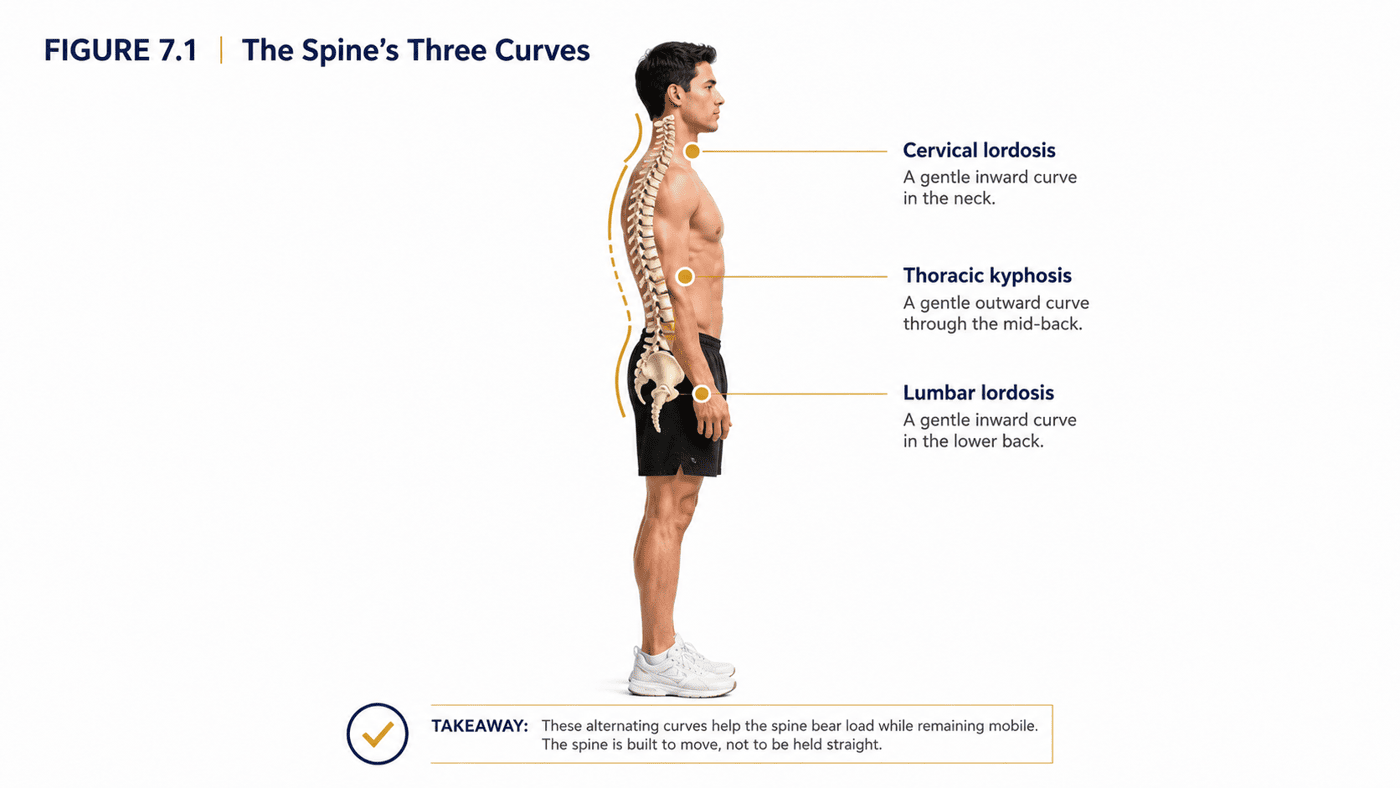
The human spine is often imagined as a fragile tower of blocks that must be kept perfectly stacked or it will topple. A more accurate picture is of a flexible, load-bearing column built specifically to move. It is composed of twenty-four mobile vertebrae — seven cervical, twelve thoracic, five lumbar — stacked above the fused sacrum, separated by intervertebral discs and linked by joints, ligaments and muscles. Far from being straight, it carries three gentle curves: a forward curve (lordosis) in the neck, a backward curve (kyphosis) through the chest, and a forward curve again in the lower back, as Figure 7.1 shows.
These curves are not imperfections to be corrected; they are engineering. An alternating set of curves allows the spine to absorb and distribute load far better than a straight rod could, combining strength with the springy compliance that lets it bend, twist and shock-absorb. Each segment contributes a small amount of movement that, summed along the column, produces the remarkable range of the whole. The spine is, in short, a structure optimised for varied, repeated movement — which makes the sustained stillness of desk work precisely the kind of demand it is least suited to.
This chapter examines what sitting does to that movement structure: how it changes the position of the pelvis and lumbar spine, what happens inside the discs and tissues under sustained load, and why the long-standing prescription of a single ideal posture has proved both unfounded and unhelpful. The conclusion it builds toward is the one that runs through the whole book — that the spine asks not to be held correctly but to be moved often and loaded well.
7.2 What Sitting Does to the Spine
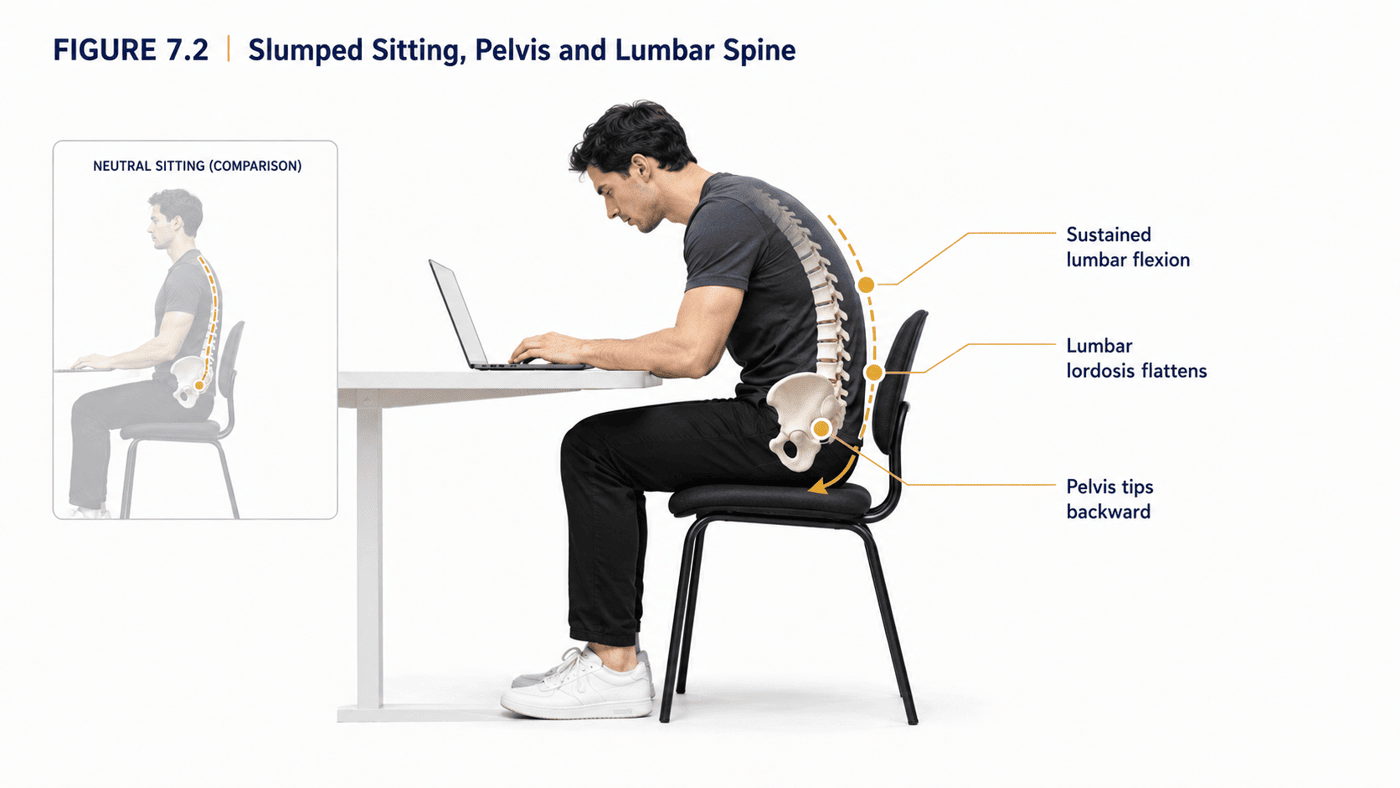
When a person sits, and especially when they slump, a predictable chain of changes runs through the lower spine. The pelvis, which in upright standing is tipped gently forward, rotates backward into a posterior tilt. Because the lumbar spine sits atop the pelvis, this backward rotation pulls the lower back out of its forward curve, flattening or even reversing the lumbar lordosis so that the lower spine moves into flexion. Figure 7.2 contrasts the forward-tipped pelvis and preserved lumbar curve of upright posture with the backward-tipped pelvis and flattened curve of slumped sitting.
This is the defining mechanical signature of the sitting spine, and it has knock-on effects up the column. As the lumbar spine flexes and the pelvis rolls back, the thoracic spine tends to round further into kyphosis, and the head and neck drift forward to keep the eyes level — the very forward-head posture examined in Chapter 4. The whole spine, in other words, adopts a more flexed, more uniform C-shape, losing the dynamic interplay of its curves. Whether a chair has a well-designed backrest, whether the seat encourages an active or a passive posture, and whether the person sits forward or reclines all modulate the degree of this change, which is why workstation setup (Part V) is worth attention.
It is important, though, not to over-dramatise this. Lumbar flexion in sitting is not an injury, and a flexed spine is not a damaged one — the spine flexes fully and safely thousands of times in ordinary life. The genuine issue is not that the seated spine flexes, but that it then stays flexed, in much the same position, for long unbroken periods. As the following sections show, it is this sustained, unchanging loading, rather than the flexed position itself, that the tissues find difficult.
| Region | Change in slumped sitting | Consequence if sustained |
|---|---|---|
| Pelvis | Rotates backward (posterior tilt) | Pulls the lumbar spine out of its curve |
| Lumbar spine | Lordosis flattens; moves into flexion | Sustained flexion load; tissue creep |
| Thoracic spine | Rounds further into kyphosis | Stiffer thorax; reduced rib and shoulder movement |
| Neck & head | Drift forward to keep eyes level | Forward-head loading (see Chapter 4) |
Table 7.1. Sitting, and slumping in particular, tends to flex the whole spinal column. The problem is sustaining the position, not adopting it briefly.
The relief of standing
Anyone who has sat through a long meeting knows the involuntary pleasure of finally standing up — the stretch, the shift, the sense of relief. That sensation is not trivial; it is the body reporting a genuine mechanical change. Standing restores the lumbar lordosis that sitting flattens, redistributes load off the crept posterior tissues, re-engages the muscles that sitting had quietened, and allows the discs a different pattern of loading. The urge to stand and move after prolonged sitting is, in effect, the spine asking for the variation it needs.
This is why fidgeting, shifting and the restlessness of a long sit are not signs of poor discipline but of healthy physiology — the body spontaneously seeking the movement that sustained postures deny it. Rather than suppressing that urge in the name of sitting still and ‘properly’, the desk worker does better to heed it: to treat the impulse to move as useful feedback and act on it often. A body that is allowed to shift and stand freely is doing, of its own accord, much of what the sitting spine requires.
7.3 Inside the Disc: Loading and Flexion
To understand why sustained sitting matters, it helps to look inside the intervertebral disc. Each disc is a remarkable hydraulic structure: a tough outer ring of fibrous cartilage (the annulus fibrosus) surrounding a soft, water-rich centre (the nucleus pulposus). Under load, the nucleus distributes pressure outward against the annulus, allowing the disc to bear and cushion force while permitting movement between the vertebrae. As Chapter 1 noted, the disc is largely without a blood supply and depends on cycles of loading and unloading to drive fluid, nutrients and waste across its matrix — so movement is, quite literally, how the disc is fed.
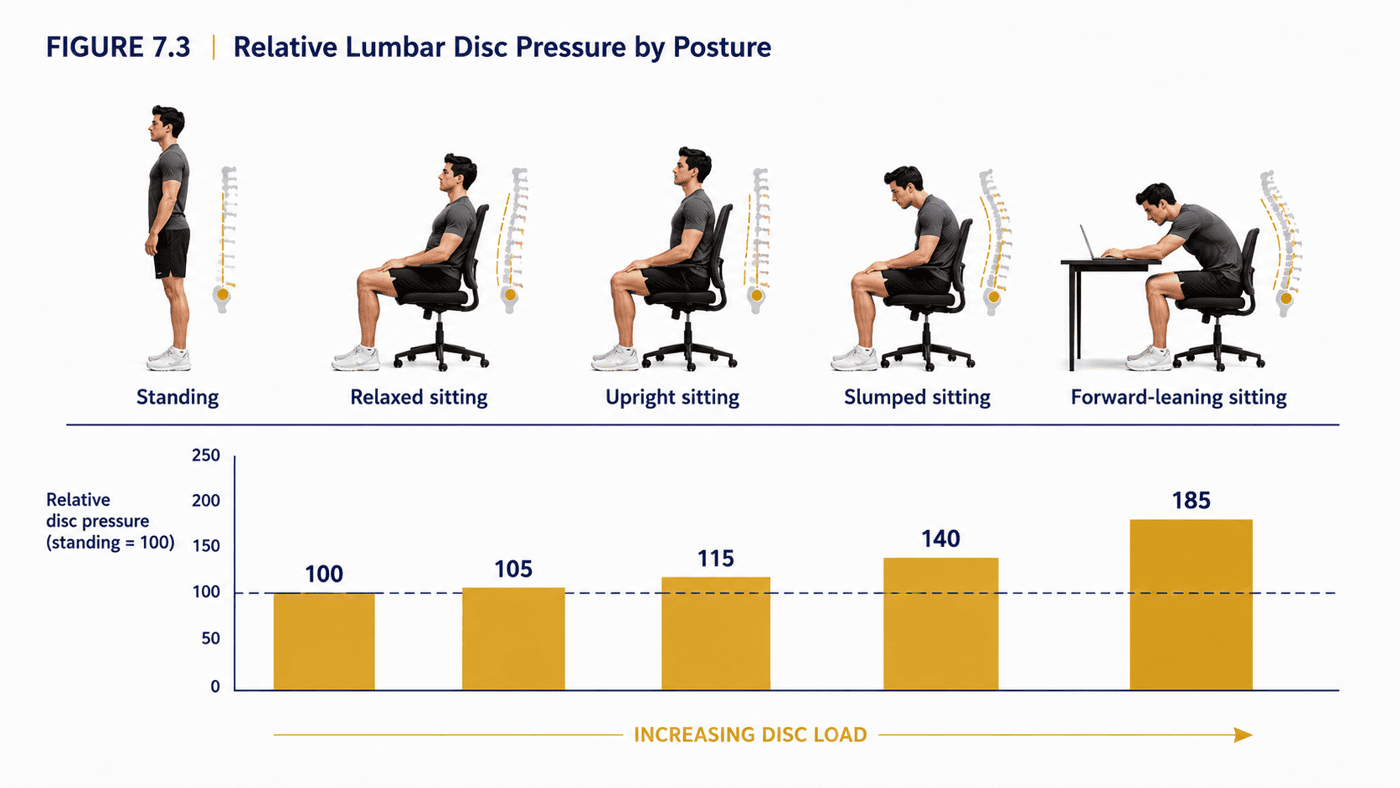
Posture changes how that load is distributed. Early measurements by Nachemson (1981) suggested that sitting dramatically increased lumbar disc pressure compared with standing, and the resulting figures — that sitting might roughly double disc pressure — became received wisdom. Later, more sophisticated in-vivo measurement told a more nuanced story. Wilke et al. (1999), recording pressure directly from a living disc across everyday activities, found that relaxed sitting was not dramatically worse than standing, and that posture and muscle activity made a considerable difference. Figure 7.3 reflects this refined picture: relaxed upright sitting loads the disc similarly to standing, slumped sitting somewhat more, and leaning forward in the seat more again.
Two lessons follow. The first is that sitting, in itself, is not the disc catastrophe it was once portrayed to be — a reassuring correction to a great deal of fear. The second is that flexed, forward-leaning sitting does load the discs more than an upright or varied posture, and that this load, sustained for hours, prevents the cyclic loading and unloading the disc relies on. The disc is not harmed by being loaded; it is under-served by being loaded in one way, without variation, for a very long time. The remedy this points to is not a perfect posture but movement — changing position frequently so the disc experiences the variation it needs.
This nutritional point is worth dwelling on, because it overturns a common assumption. Because the adult disc has almost no blood supply of its own, it cannot rely on circulation to deliver nutrients and remove waste in the ordinary way. Instead it depends on a kind of pumping action: as load is applied and released across the day, fluid is squeezed out of the disc and then drawn back in, carrying nutrients with it. Movement and changes of posture drive this exchange; sustained static loading suppresses it. Adams and Hutton (1983) showed that posture itself alters the fluid content of the discs. The implication is striking — a disc held in one position for hours is not merely loaded but, in a sense, under-nourished, and the simplest way to feed it is to move. Stillness starves the disc of the very loading variation that sustains it.
7.4 Creep, Ligaments and the Flexion-Relaxation Phenomenon
The deepest reason sustained sitting matters lies in the behaviour of the spine’s soft tissues under prolonged load. As Chapter 3 introduced, connective tissue is viscoelastic: held under a constant load, it slowly and progressively deforms, a phenomenon called creep. Callaghan and McGill (2001) documented this creep in the spine during prolonged sitting, and Solomonow (2004) showed that sustained loading of the spinal ligaments produces not only creep in the tissue but measurable changes in the reflexive muscle activity that normally protects the joints — a temporary dulling of the spine’s protective responses that resolves with rest and movement. A spine held flexed for an hour is therefore a slightly different mechanical system at the end of that hour than at the start: its ligaments have crept, and its protective reflexes have quietened.
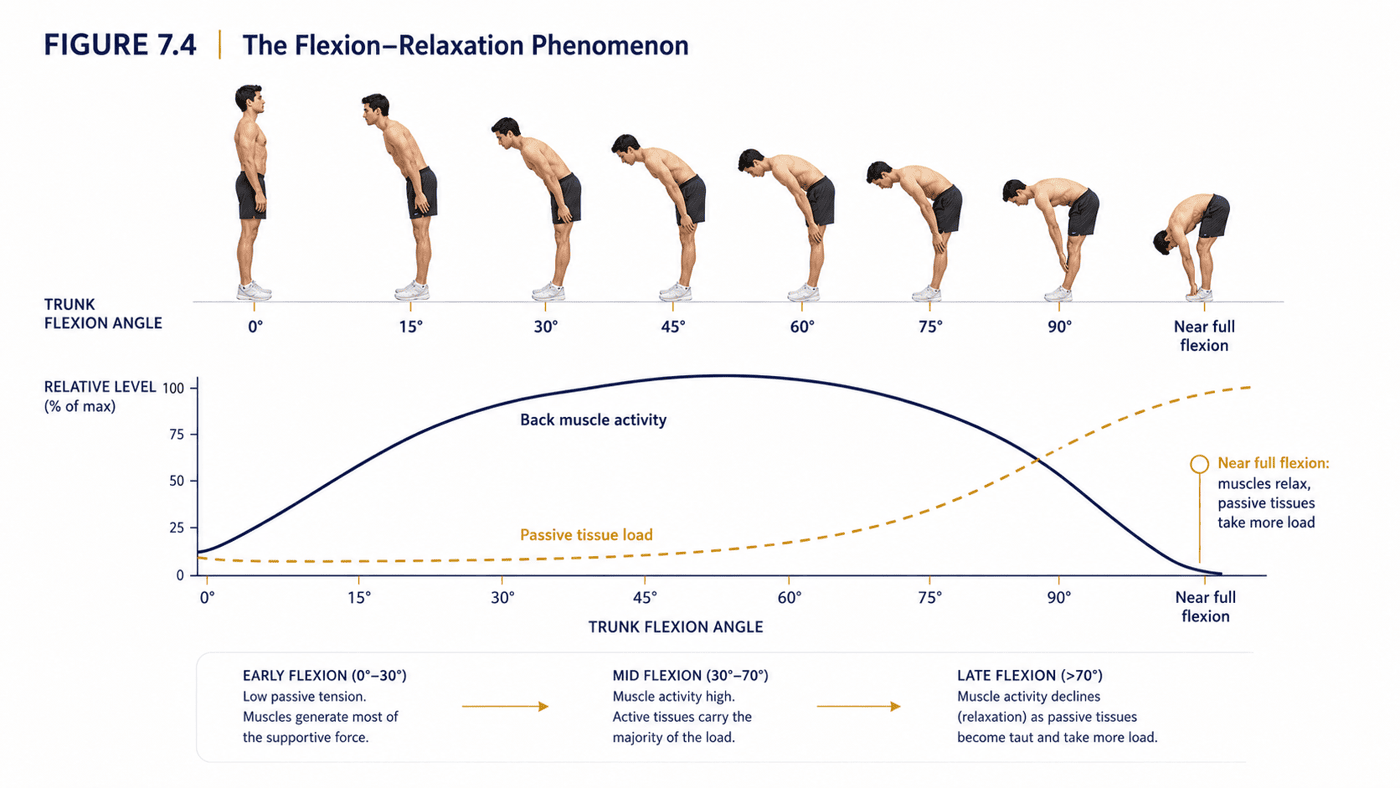
A related phenomenon makes the point vivid. As the trunk bends forward from upright, the back-extensor muscles work progressively harder to control the descent — up to a point. Near full forward flexion, something striking happens: the extensors fall almost silent, and the load is handed over to the passive tissues, the ligaments and the discs. This is the flexion-relaxation phenomenon, shown in Figure 7.4. It is an efficient arrangement for a brief bend — why work the muscles when the passive structures can hold the position? — but it becomes a liability when a flexed posture is sustained, because the passive tissues then bear a prolonged load with the muscular safety system switched down.
This is the precise mechanical explanation for why an unbroken slump is more demanding than the same posture interrupted. It is also why the discomfort of a long seated stretch often eases the moment a person stands and moves: the load is transferred off the crept passive tissues and the protective musculature reawakens. The tissues are not damaged; they are temporarily altered by sustained loading, and they recover with movement. Once again, the lever is duration, not position.
How quickly does the spine recover?
A natural question follows: if sustained loading creeps the tissues and dulls the protective reflexes, how long does it take to recover, and how often should the loading be broken? The biology gives a useful steer. Tissue creep reverses gradually once the load is removed, and the protective changes Solomonow (2004) documented take time to settle — longer, in general, than the brief moment it takes to stand up. This means that recovery is not instantaneous, and that the timing of breaks matters as much as their existence.
The practical consequence favours frequency over duration. Many short interruptions — standing and moving for a moment every twenty to thirty minutes — prevent creep from accumulating in the first place far more effectively than a single long break after hours of unbroken sitting, by which point the tissues have already crept and the reflexes already quietened. The lesson is not to earn a long rest by enduring a long slump, but never to let the slump run long enough to matter. Small, frequent movement keeps the spine continuously within its comfortable, well-protected range.
7.5 The “Perfect Posture” Trap
If sustained loading is the problem, the obvious response might seem to be to find the single best sitting posture and hold it. This is exactly the trap. A large body of work now shows that there is no one ideal spinal posture that suits everyone, and that the search for it is misguided. Claus, Hides, Moseley and Hodges (2009), measuring spinal curves across four commonly recommended ‘ideal’ sitting postures, found that they produced quite different spinal shapes — there was no single ‘correct’ curve that they converged on. O’Sullivan et al. (2006) similarly showed that different upright sitting postures load the spine and recruit the trunk muscles in different ways, none of them uniquely ‘right’.
The notion of a universal perfect posture fails for several reasons. People differ in their natural spinal curves, proportions and flexibility, so a posture that is comfortable and well-aligned for one person is strained for another. More fundamentally, as Chapter 3 established, the link between any specific posture and pain is weak and inconsistent (Lederman, 2011); spinal posture is a far weaker predictor of who experiences back pain than the intuitive model assumes. And crucially, even if a perfect posture existed, holding it would reintroduce the very problem this chapter has described — sustained, unchanging loading. A perfectly held posture is still a held posture.
There is an important subtlety worth drawing out. Among people who already have back pain, the way they habitually sit can matter, and sub-grouping patients by their characteristic posture and movement patterns can help guide treatment (Dankaerts et al., 2006). This is not a contradiction of the ‘no perfect posture’ message; it is a refinement of it. The point is not that posture never matters to anyone, but that there is no single alignment that everyone should adopt and hold, and that for most people the variable worth changing is not which posture they sit in but how long they stay in any one of them.
7.6 Why Variation Beats Position
Putting these threads together yields the chapter’s central, liberating conclusion: for the spine, movement and variation matter far more than position. Because the harm of sitting comes from sustained, unchanging loading rather than from any particular posture, the most powerful intervention is simply to change posture often. A spine that shifts regularly between a range of comfortable positions — more upright, more relaxed, leaning back, sitting forward, occasionally standing — never lets creep accumulate in one set of tissues, keeps the discs supplied through cyclic loading, and keeps the protective musculature engaged. Variation does, automatically, what no single posture can.
This reframes the whole idea of ‘good sitting’. The goal is not to discover and maintain one correct alignment but to become a mobile sitter: to treat any posture as temporary and to move between many. The clinical adage from Chapter 3 applies as much to the spine as to the neck — the best posture is your next posture. A moderately slumped position changed every twenty minutes is kinder to the spine than a textbook-perfect posture held rigidly for two hours, because the spine was built for the former and is quietly taxed by the latter.
Does a special chair fix it?
If sitting is the concern, surely the answer is a better chair? The market certainly says so, offering ergonomic chairs, kneeling stools, balance balls and standing desks as solutions to the sitting spine. The evidence is more sobering. No particular chair or seating device has been shown to prevent back pain, and given that occupational sitting is not even an independent cause of back pain (a point Chapter 8 develops), this is unsurprising. A chair cannot solve a problem of duration, because whatever its design, it is still a device for sitting still.
This does not mean seating is irrelevant. A good chair that supports a comfortable posture and, crucially, makes movement and changes of position easy is worth having, and alternating between sitting and standing through a sit-stand desk can help by breaking up sustained postures — though standing rigidly all day simply trades one static load for another. The principle is consistent: the value of any seating lies in how well it enables variation and movement, not in some perfect supported posture it holds you in. The best chair is the one you do not stay still in. Part V takes up workstation and seating decisions in detail.
Transitions and confident lifting
Two moments of the desk day load the spine more than sitting itself, and both are worth getting right: standing up, and lifting. The sit-to-stand transition asks the spine and hips to move from a flexed, loaded position to an upright one, and people who have sat still for a long time often do this stiffly and gingerly, precisely because the tissues have crept and the muscles quietened. The remedy is not to fear the movement but to do it more often: a spine that stands and sits many times a day stays supple in the transition, while one that rises only rarely makes heavy weather of it.
Lifting — a box of files, a child, the shopping — raises a related question that the core-bracing culture has muddled. For ordinary loads, the spine does not need to be rigidly braced and held in a fixed neutral; it is designed to bend and lift, and confident, normal lifting is safe. For genuinely heavy or awkward loads, a brief, purposeful increase in trunk tension is sensible and automatic — the body does it without instruction. The key distinction is between this momentary, task-appropriate bracing and the mistaken advice to clench the trunk constantly. Lift confidently, brace briefly when the load is heavy, and trust a back that is built for the job.
When one region stiffens, others pay
A final principle prepares the ground for the chapters that follow: the spine works as a chain, and stiffness in one region throws demand onto its neighbours. The spinal regions have complementary jobs — the thoracic spine is built mainly for rotation, the lumbar spine mainly for flexion and extension, the cervical spine for fine positioning of the head. When sustained sitting stiffens the thoracic spine in particular, the movements it can no longer provide do not simply disappear; they are demanded instead of the regions above and below, which take on rotations and ranges they are less designed to handle.
This regional interdependence is why a desk-related back or neck problem is so rarely confined to one spot. A stiff mid-back can express itself as an aching low back or a tight neck; freeing the thoracic spine often relieves both. Chapter 9 develops this for the rib cage and breathing, and Part VI returns to it for specific pain patterns. The lesson for now is that the spine should be kept mobile and capable along its whole length, because a stiffness tolerated in one region is quietly paid for in another.
Consider, to close, a familiar case. A desk worker reports a nagging, stiff lower back that worsens through the afternoon and eases on the weekend. Convinced their posture is to blame, they have bought an ergonomic chair, tried to sit straight, and grown more anxious as nothing helped. Read through this chapter, the picture is clear: the problem is not a bad posture but sustained, unbroken sitting in a stiffening spine of reduced capacity. The remedy is equally clear, and has nothing to do with finding the perfect chair — move often, vary the posture, free the thoracic spine, and build the back’s capacity over time. It is the same answer the whole book keeps arriving at, because it is the one the mechanics keep pointing to.
7.7 Building a Resilient Spine
Movement and variation address the daily loading problem, but there is a second, longer-term strand: building a spine with the capacity to tolerate whatever postures and loads life brings. As with every region in this book, what most reliably distinguishes a comfortable back from an uncomfortable one is not how it is held but how much it can tolerate. A spine that is regularly loaded — that bends, lifts, rotates and carries through a full range — develops the tissue tolerance and muscular control to handle a desk day with reserve to spare. A spine that is only ever held still, by contrast, slowly loses that capacity, exactly as the load-response window of Chapter 1 predicts.
What about the core?
No discussion of the spine can avoid the idea of ‘the core’, and few ideas are more misunderstood. A popular narrative holds that a weak core is the root of back trouble and that the remedy is to brace the abdominal muscles constantly to protect a vulnerable spine. Both halves are oversimplified. The evidence that a weak core causes back pain is far less robust than the narrative implies, and Lederman (2011) directly challenged the core-stability model as a general explanation for back pain. Worse, the advice to brace continuously is mechanically counterproductive: holding the trunk muscles in constant tension adds load to the spine, restricts the very movement the spine needs, and reintroduces the sustained-loading problem this chapter has spent its length describing.
This is not to dismiss trunk strength. The muscles of the trunk matter, and building their capacity is part of a robust spine — as part of general, varied, progressive loading, not as a programme of constant bracing or endless abdominal exercises. A healthy spine is controlled automatically and adaptively, stiffening when a task demands it and relaxing when it does not; it does not require, and is not helped by, being permanently clenched. The goal, once again, is a capable, well-loaded, freely moving back — not a rigidly braced one.
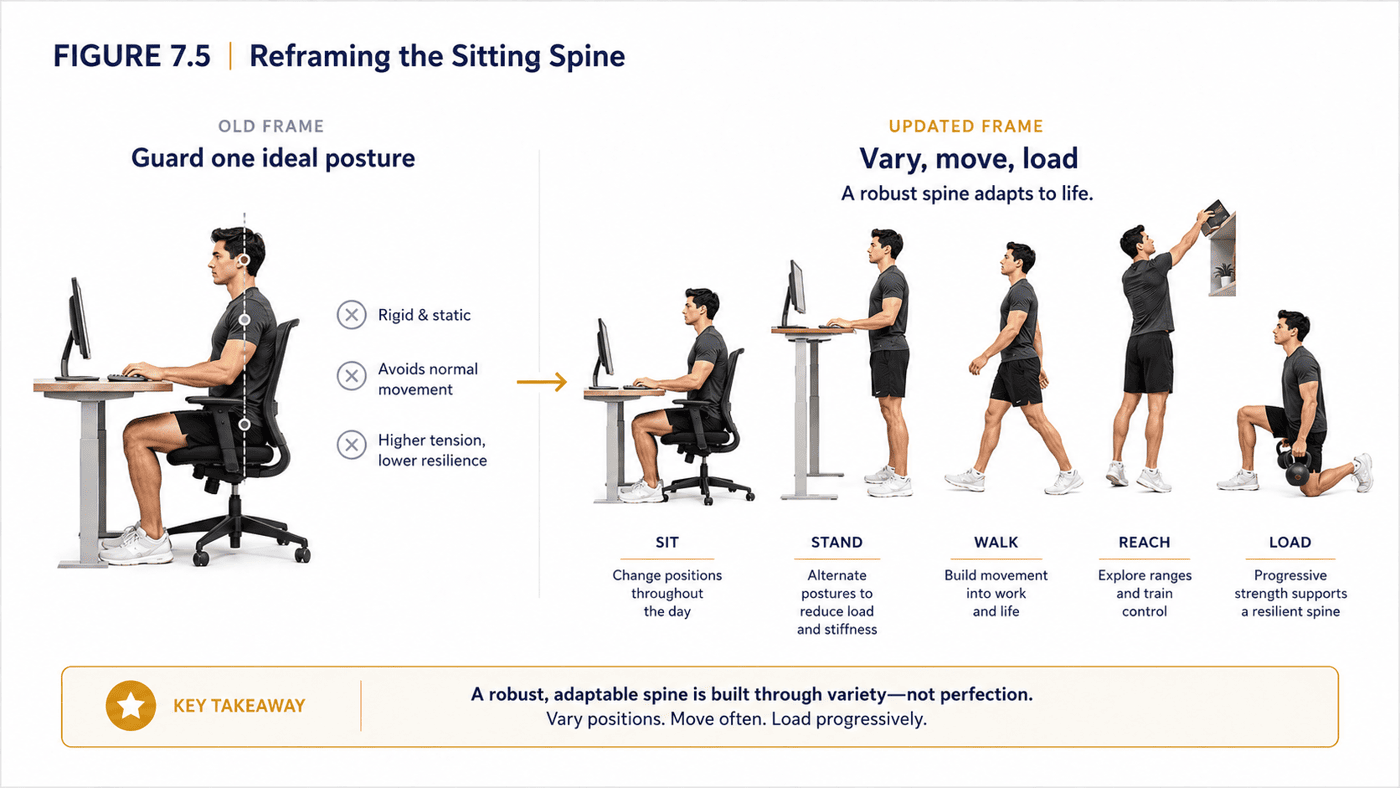
Figure 7.5 sets the old framing against the new. The fragile-stack model asks us to find and guard one perfect posture, treats flexion as dangerous, and casts the spine as something to be protected. The robust-structure model — the one the evidence supports — treats the spine as strong and adaptable, normalises flexion and movement, and aims to build capacity through varied loading. Everything in the practical chapters of Parts VI and VII is an application of the second column: not a better way to sit still, but a way to need stillness less and to make the spine more capable of the life around it. The box below distils the practical essentials.
| Common spine claim | What the evidence and mechanics suggest |
|---|---|
| There is a perfect posture to hold | No single ideal posture exists; ‘ideal’ postures produce different spinal shapes (Claus et al., 2009). |
| Sitting doubles disc pressure | Relaxed sitting loads the disc much like standing; in-vivo data refined the old figure (Wilke et al., 1999). |
| Flexing or slouching damages the spine | Flexion is normal and safe; sustained, unbroken flexion — not the position — is the issue (Callaghan & McGill, 2001). |
| Brace and hold your back rigidly | Rigid holding sustains load and adds effort; variation and movement serve the spine better. |
| A weak core is the cause of back trouble | The spine benefits from varied loading and capacity, not from constant bracing of one ideal posture (Lederman, 2011). |
Table 7.2. Common spine claims set against current evidence and mechanical reasoning.
In summary
- The spine is a mobile, load-bearing column with three curves built to move; sustained stillness is the demand it is least suited to.
- Sitting, and slumping especially, tips the pelvis backward and flexes the lumbar spine, rounding the whole column — a normal position that becomes a problem only when sustained.
- In-vivo measurement shows relaxed sitting loads the discs much like standing; the old ‘sitting doubles disc pressure’ claim was over-simplified (Nachemson, 1981; Wilke et al., 1999).
- Sustained flexion causes tissue creep, dulls protective muscle reflexes, and (near full flexion) hands load to passive tissues via the flexion-relaxation phenomenon (Callaghan & McGill, 2001; Solomonow, 2004).
- There is no single perfect posture: ‘ideal’ postures produce different spinal shapes, posture predicts pain weakly, and any held posture sustains load (Claus et al., 2009; Lederman, 2011).
- For the spine, variation and movement matter far more than position; the best posture is your next one.
- The durable solution is a resilient, well-loaded spine — built by varied movement and progressive loading, not by guarding one ideal alignment.
References
Adams, M. A., & Hutton, W. C. (1983). The effect of posture on the fluid content of lumbar intervertebral discs. Spine, 8(6), 665–671.
Callaghan, J. P., & McGill, S. M. (2001). Low back joint loading and kinematics during standing and unsupported sitting. Ergonomics, 44(3), 280–294.
Claus, A. P., Hides, J. A., Moseley, G. L., & Hodges, P. W. (2009). Is “ideal” sitting posture real? Measurement of spinal curves in four sitting postures. Manual Therapy, 14(4), 404–408.
Dankaerts, W., O’Sullivan, P., Burnett, A., & Straker, L. (2006). Differences in sitting postures are associated with nonspecific chronic low back pain disorders when patients are subclassified. Spine, 31(6), 698–704.
Lederman, E. (2011). The fall of the postural–structural–biomechanical model in manual and physical therapies: Exemplified by lower back pain. Journal of Bodywork and Movement Therapies, 15(2), 131–138.
Nachemson, A. L. (1981). Disc pressure measurements. Spine, 6(1), 93–97.
O’Sullivan, P. B., Dankaerts, W., Burnett, A. F., Farrell, G. T., Jefford, E., Naylor, C. S., & O’Sullivan, K. J. (2006). Effect of different upright sitting postures on spinal-pelvic curvature and trunk muscle activation in a pain-free population. Spine, 31(19), E707–E712.
Solomonow, M. (2004). Ligaments: A source of work-related musculoskeletal disorders. Journal of Electromyography and Kinesiology, 14(1), 49–60.
Wilke, H. J., Neef, P., Caimi, M., Hoogland, T., & Claes, L. E. (1999). New in vivo measurements of pressures in the intervertebral disc in daily life. Spine, 24(8), 755–762.