Part II · SCREEN MECHANICS AND UPPER-BODY PAIN
Shoulder Rounding and the Arm-Forward Life
Desk work is an arm-forward life. The hands reach toward a keyboard and mouse for hours, the shoulders round to follow, and the shoulder blade quietly changes its resting position. The familiar advice — ‘pull your shoulders back’ — misreads the problem; the real story is one of scapular control and capacity.
5.1 The Arm-Forward Life
The human shoulder is the most mobile joint in the body, built to position the hand almost anywhere in a large sphere of reach. Desk work asks it to do something quite different: to hold the arms in a narrow, forward, slightly elevated position for hours, with the hands occupied by keyboard and mouse and almost never travelling overhead or behind the body. The shoulder, faithful to the principle of adaptation, obliges — and over time the arm-forward life leaves its signature on how the shoulder sits and moves.
That signature is what people call ‘rounded shoulders’, and the standard response is to tell them to pull the shoulders back and stick the chest out. As with ‘sit up straight’, this targets a posture rather than the mechanics beneath it, and it shares the same weaknesses: it is effortful, it does not last, and it leaves the underlying capacity untouched. This chapter looks beneath the silhouette to the shoulder blade — the scapula — whose position and control are the heart of the matter, and then sets out a strategy built on loading and movement rather than holding a pose.
The price of mobility
The shoulder’s remarkable range comes at a price. Unlike the hip, a deep and bony socket, the shoulder’s main joint is shallow — a large humeral head resting against a small, flat surface, rather like a golf ball on a tee. That design buys enormous mobility but sacrifices bony stability, so the joint depends heavily on muscles, tendons and coordinated control to stay centred and to move well. This is why the shoulder is so sensitive to the muscular changes of desk life: when the controlling muscles are under-used or imbalanced, there is little bony architecture to compensate. Mobility and dependence on control are two sides of one coin.
Four joints working together
What we casually call ‘the shoulder’ is really a complex of four linked joints that must cooperate. The glenohumeral joint is the ball-and-socket between the arm and the shoulder blade; the scapulothoracic interface is where the scapula glides on the rib cage; and the acromioclavicular and sternoclavicular joints connect the shoulder blade and collarbone to the trunk. Smooth overhead movement requires all four to contribute in a coordinated sequence.
Desk posture acts on this whole complex, not on one joint alone. A rounded, protracted scapula changes the scapulothoracic interface; a slumped thorax alters the base the collarbone joints work from; and the ball-and-socket joint must then operate from a compromised foundation. Understanding the shoulder as a cooperative complex, rather than a single hinge, makes sense of why desk-related shoulder trouble responds best to broad work on position, control and capacity rather than to a single local fix.
5.2 What “Rounded Shoulders” Means at the Scapula
To understand the rounded shoulder, look not at the front of the body but at the back of it, where the scapula sits on the rib cage. The scapula is not fixed; it glides, tilts and rotates on the rib cage to position the socket of the shoulder joint for whatever the arm is doing. In the arm-forward posture, the scapula tends to drift into protraction (sliding forward and around the rib cage) and anterior tilt (the top tipping forward, the lower tip lifting away from the ribs). As it does so it carries the head of the humerus forward with it. Figure 5.1 contrasts a scapula resting well on the rib cage with one drawn into this protracted, anteriorly-tilted position.
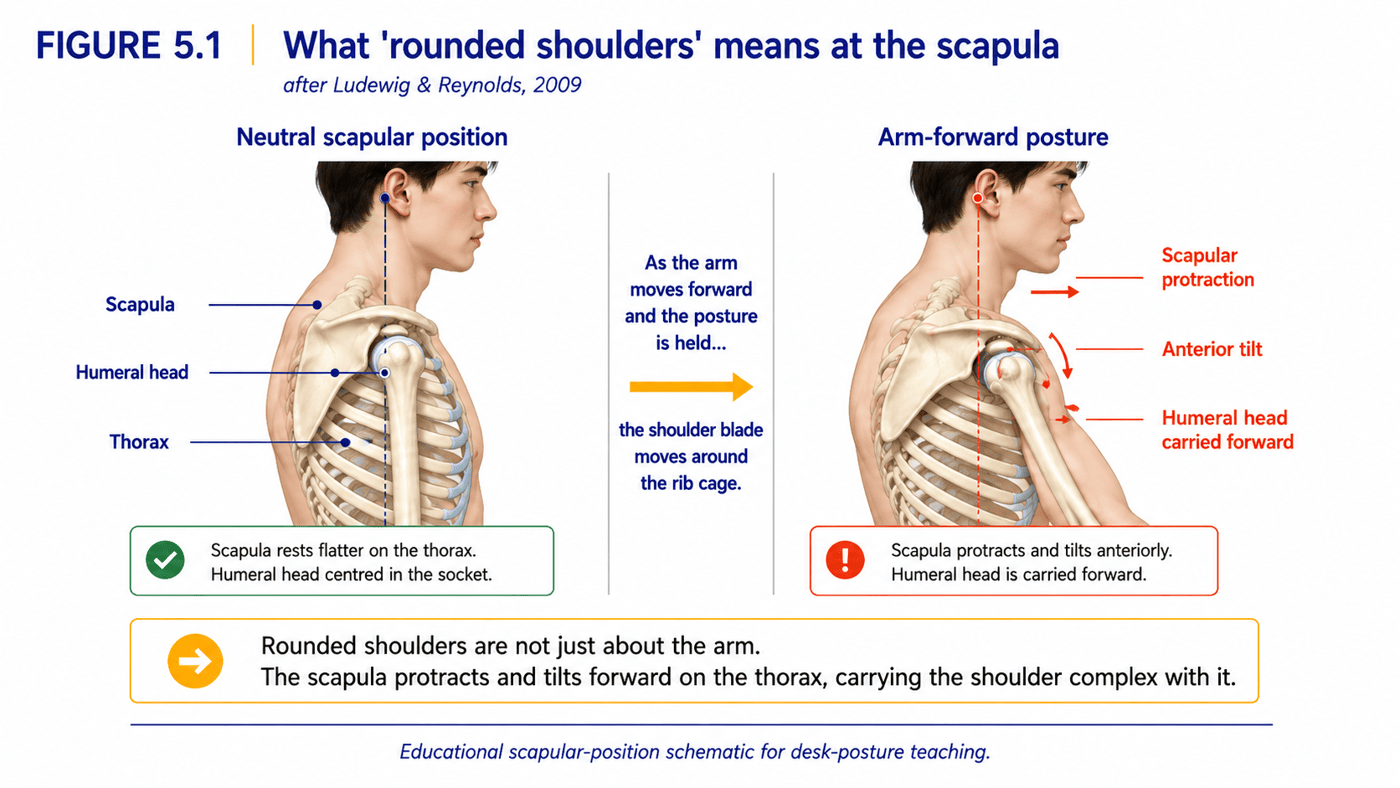
This altered resting position is the mechanical core of the rounded shoulder, and it is why pulling the shoulders back is such a superficial remedy: it briefly drags the scapula into retraction by brute effort, without changing the muscular control that governs where the scapula naturally sits. Altered scapular position and motion — sometimes termed scapular dyskinesis — has been associated with shoulder pain and injury, though, as later sections discuss, the relationship is one of correlation and contribution rather than simple cause (Kibler, Sciascia & Wilkes, 2012). The constructive question is not ‘how do I hold my scapula back?’ but ‘how do I restore the muscular control that positions it well without my thinking about it?’
5.3 The Scapular Force Couple
Good scapular position and movement are produced by a coordinated balance of muscles known as a force couple — two or more forces acting together to produce rotation. For the scapula, the key players in upward rotation, which the blade must perform whenever the arm rises, are the upper trapezius, the lower trapezius and the serratus anterior. Working in concert, as shown in Figure 5.2, they rotate the scapula upward and hold it stable against the rib cage so the arm can travel freely overhead (Neumann, 2017).
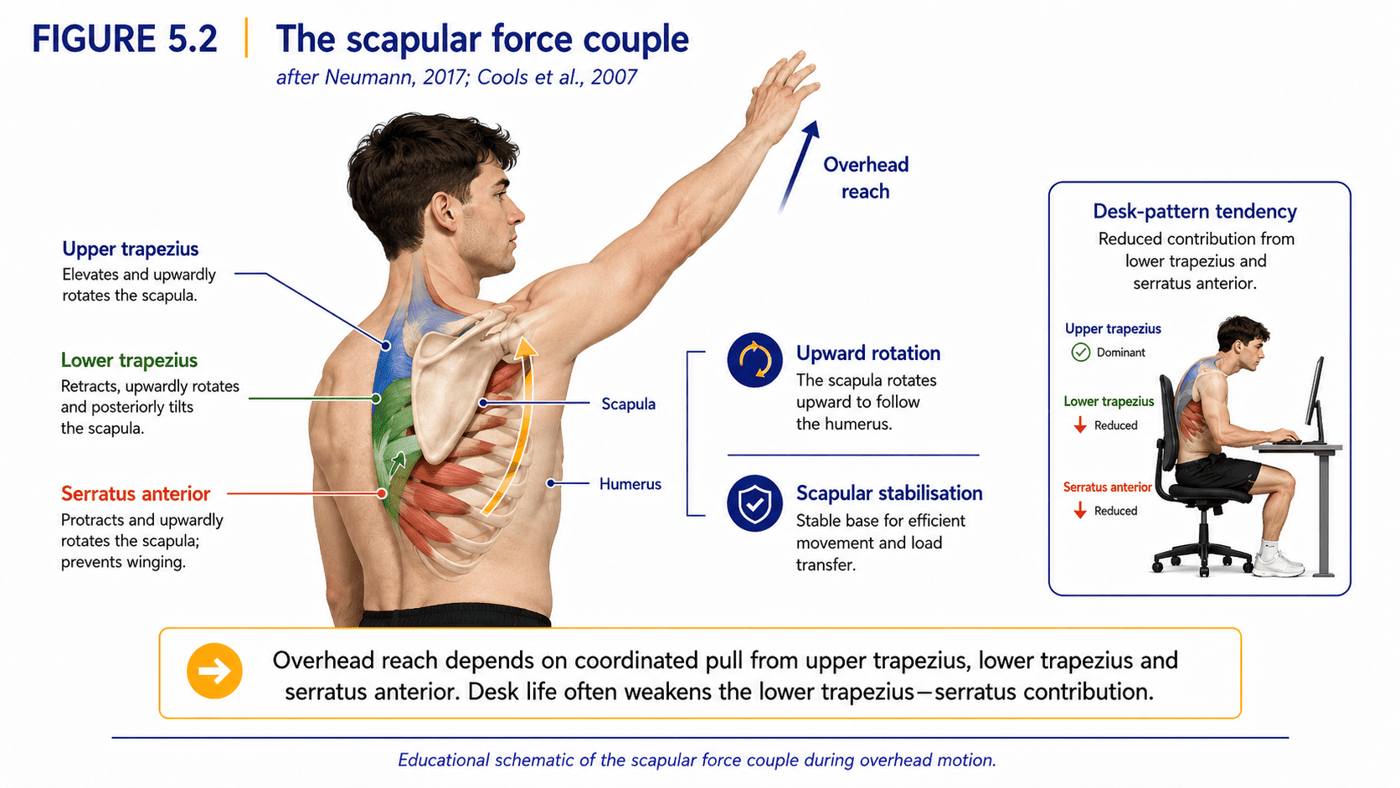
The arm-forward life disturbs this balance in a characteristic way. The lower trapezius and serratus anterior — the muscles that hold the scapula down and flat and rotate it upward — tend to become under-used and under-conditioned, while the upper trapezius and the chest muscles tend to dominate. The result is a force couple that no longer rotates the scapula cleanly: the blade tilts and shrugs rather than rotating smoothly, and overhead movement loses its efficiency. Cools et al. (2007) showed that this imbalance can be addressed directly through exercises that preferentially recruit the lower trapezius and serratus anterior — evidence that the answer is targeted loading of the under-used muscles, not stretching or retracting alone. Restoring the force couple, rather than holding the shoulders back, is what gives the scapula a good resting position that lasts.
The force couple also governs the timing of movement, captured in the idea of scapulohumeral rhythm — the coordinated way the arm bone and the shoulder blade share the work of raising the arm. As the arm elevates, roughly two degrees of movement at the ball-and-socket joint are accompanied by about one degree of scapular upward rotation, so that across a full overhead reach the scapula contributes a substantial share of the total range. When desk posture weakens the lower trapezius and serratus anterior, this rhythm is disturbed: the scapula rotates too little or too late, the ball-and-socket joint is asked to do more than its share, and overhead movement loses both range and smoothness. Restoring the rhythm is therefore as much about coordination as about raw strength.
| Muscle | Role in the shoulder | Tendency in the desk body |
|---|---|---|
| Serratus anterior | Protracts & upwardly rotates; holds scapula to ribs | Under-used, weak — a key target |
| Lower trapezius | Depresses & upwardly rotates the scapula | Under-active, lengthened |
| Middle trapezius / rhomboids | Retract and stabilise the scapula | Lengthened, under-conditioned |
| Upper trapezius | Elevates and helps upward rotation | Often dominant / overworked |
| Pectoralis minor | Tilts and protracts the scapula | Tends to shorten / tighten |
Table 5.1. The scapular muscles and their tendencies in the desk body. The desk shoulder is typically strong and tight above, under-used below — which is why loading the lower trapezius and serratus anterior matters most.
5.4 The Subacromial Space and Why It Matters
Scapular position is not merely cosmetic; it changes the geometry of the shoulder joint itself. Beneath the bony roof formed by the acromion, and above the head of the humerus, lies the subacromial space, through which the rotator-cuff tendons (notably the supraspinatus) and a lubricating bursa must pass. When the scapula is well positioned, these structures have room. When the scapula tilts forward and downwardly rotates — the desk-shoulder tendency — the space available can narrow, as Figure 5.3 illustrates. Ludewig and Cook (2000), in a landmark study, documented exactly these altered scapular kinematics in people with symptoms of shoulder impingement.
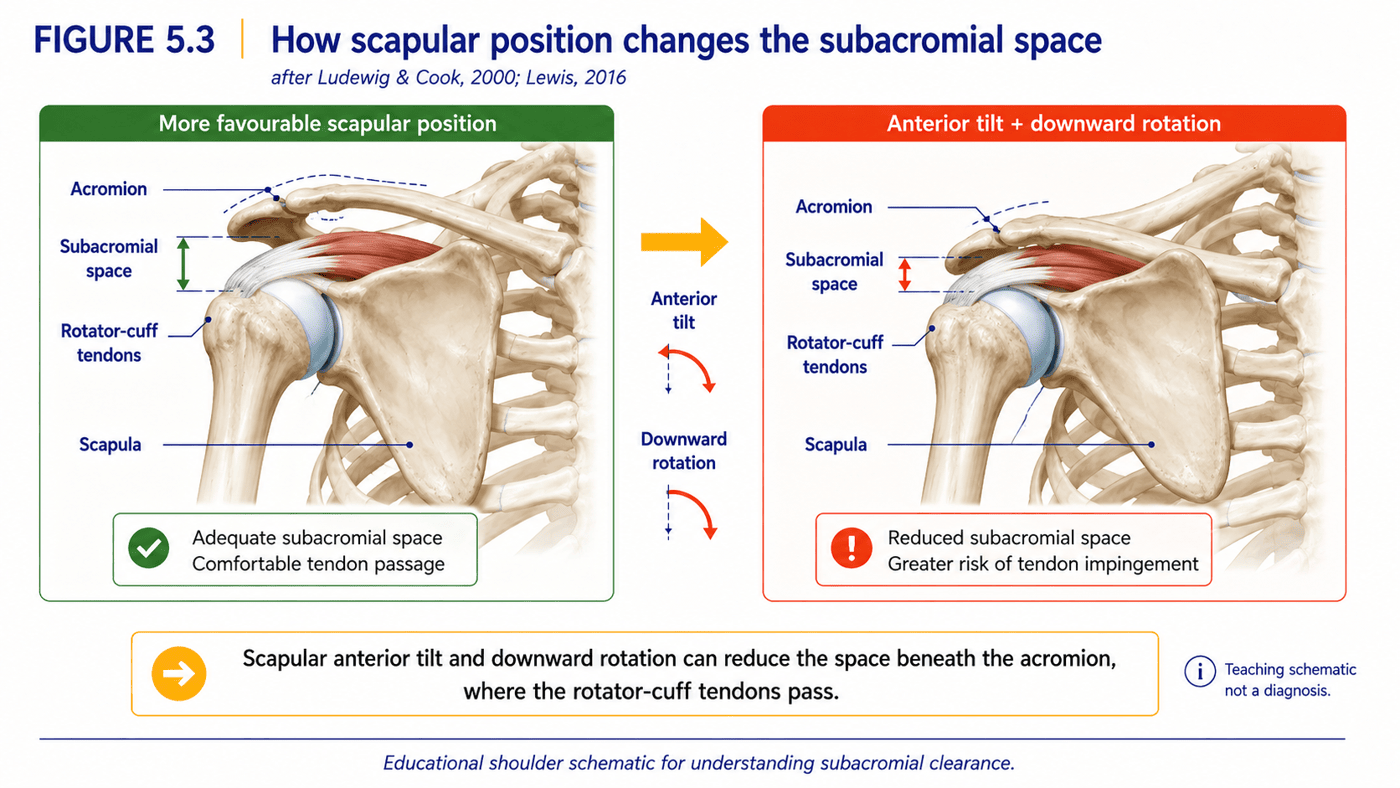
It is worth introducing the structures most often involved, the rotator cuff. These are four small muscles — supraspinatus, infraspinatus, teres minor and subscapularis — whose tendons wrap around the head of the humerus. Their job is subtle but vital: rather than producing large movements, they fine-tune the position of the humeral head, holding it centred in its shallow socket while the bigger muscles move the arm. When the scapula is poorly positioned and the force couple imbalanced, the cuff must work in a less favourable alignment, and the supraspinatus tendon in particular passes through the very subacromial space that scapular tilt can narrow (Sahrmann, 2002). This is why scapular control and rotator-cuff health are intertwined, and why the strategy that follows aims to restore the whole system rather than to chase a single muscle or a single position.
A note of caution is essential here, and it reflects how the field has matured. For decades shoulder pain in this region was attributed straightforwardly to mechanical ‘impingement’ — the tendons being pinched in a narrowed space — and treatment aimed to enlarge the space. More recent analysis, led by clinicians such as Lewis (2016), argues that this purely mechanical picture is oversimplified: the space narrows and widens with normal movement, many people with narrow spaces have no pain, and shoulder pain is better understood as multifactorial, involving tendon health, load, capacity and the same biopsychosocial factors discussed in Chapter 3. The honest position, therefore, is that scapular position is one contributor to shoulder comfort — worth improving — but not the single mechanical cause of pain it was once thought to be. This nuance matters because it again points away from chasing a perfect posture and toward building a healthy, capable, well-controlled shoulder.
5.5 Posture Changes How Far You Can Reach
There is a further, very practical consequence of the rounded, slumped upper-body posture: it reduces how far the arm can actually travel. Because the scapula must rotate freely on the rib cage for the arm to elevate, and because a slumped thoracic spine restricts that rotation, sitting in a slumped posture measurably reduces available shoulder elevation compared with sitting upright. Kebaetse, McClure and Pratt (1999) demonstrated that thoracic position alters shoulder range of motion, strength and scapular kinematics, and Bullock, Foster and Wright (2005) found that upright sitting increased shoulder flexion range and reduced pain in people with shoulder symptoms compared with slumped sitting. Figure 5.4 shows this difference schematically.
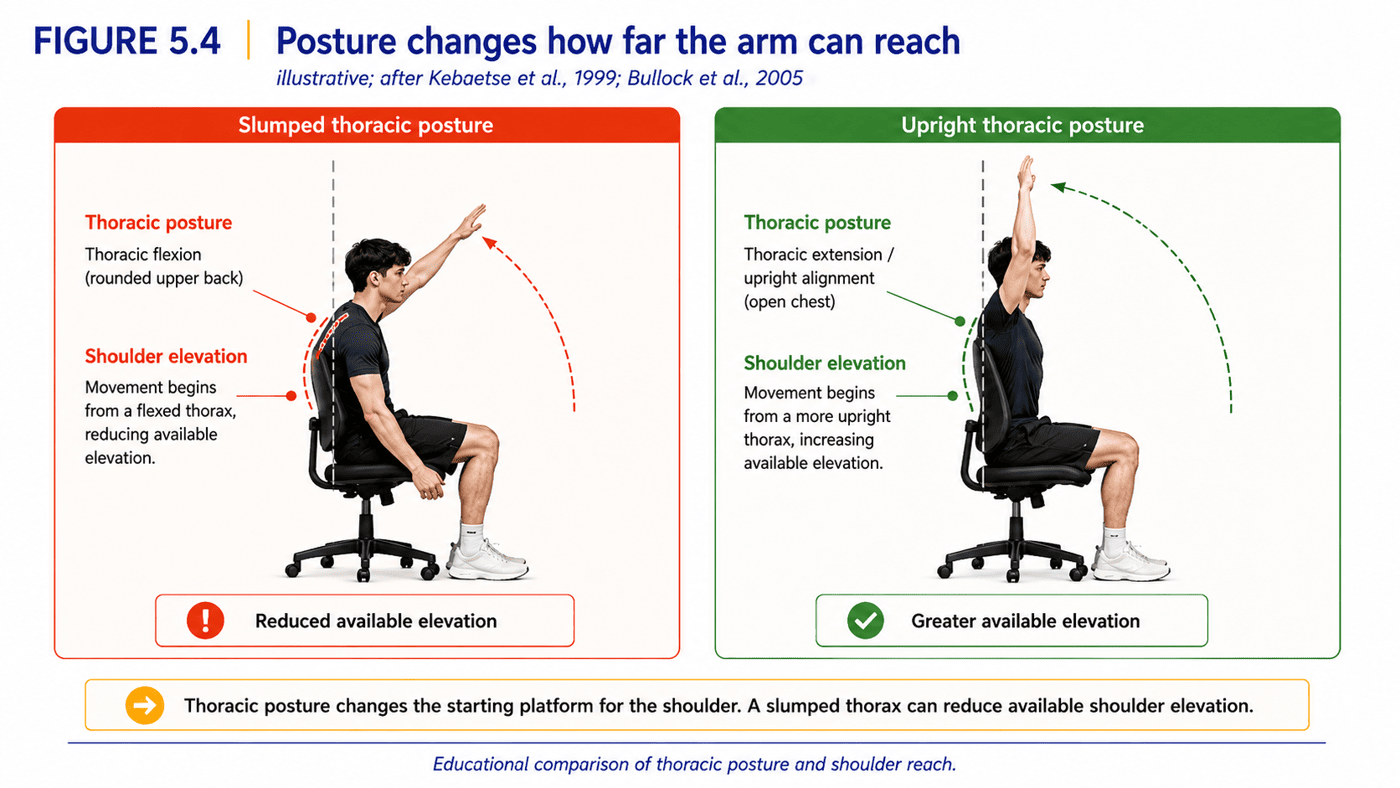
This finding is doubly useful. It shows, first, that posture and movement are linked — a freer thoracic spine gives the shoulder more room to work — which is why the spine and rib cage of Part III matter to the shoulder. And it offers an encouraging, immediate demonstration to anyone sceptical that their desk posture affects them: sit slumped and raise the arm overhead, then sit tall and repeat, and the difference in available range is usually obvious within seconds. The lesson is not to sit rigidly upright forever, but that a mobile, well-supported thorax and a well-controlled scapula give the shoulder the freedom it was built for.
This shared territory also explains why neck and shoulder complaints so often travel together. Several muscles span both regions — the upper trapezius and levator scapulae attach to both the neck and the shoulder blade — so the overworked, tightened muscles of the forward-head neck in Chapter 4 are often the very tissues implicated in the rounded shoulder here. A desk body rarely presents a tidy, isolated neck problem or shoulder problem; far more often the upper quarter adapts as a unit, which is why the strategies of Chapters 4 and 5 are best applied together.
The thoracic spine: the shoulder’s foundation
Behind the reach finding lies a structural truth worth making explicit: the shoulder blade has no direct bony joint with the spine. It floats on the rib cage, and the rib cage is shaped by the thoracic spine. When the thoracic spine is stuck in the rounded, flexed position that desk life encourages, the rib cage tips the scapula forward and limits how far it can upwardly rotate — which is exactly why a slumped posture steals shoulder range. The shoulder, in other words, can only be as free as the thorax beneath it.
This is the mechanical bridge to Part III, which treats the spine and rib cage in their own right. For the shoulder, the practical consequence is clear: no amount of scapular exercise fully succeeds on a rigidly flexed thorax. Restoring thoracic extension and rotation — giving the rib cage and the scapula room to move — is part of rebuilding the shoulder, not a separate project. A mobile upper back is the quiet foundation on which good shoulder mechanics are built.
5.6 The Pec-Tightness Story, Reconsidered
A popular account of the rounded shoulder runs as follows: the chest muscles (pectoralis major and minor) become tight from the arm-forward posture, pulling the shoulders forward, so the remedy is to stretch the chest. There is truth in the first half: pectoralis minor in particular tends to adopt a shortened length and can contribute to anterior tilt of the scapula. But the inference that stretching the chest is the primary solution is weaker than it sounds, and on its own it tends to disappoint.
Pectoralis minor repays a closer look, because it is the chest muscle most implicated in the rounded shoulder. Unlike the broad pectoralis major, which moves the arm, pectoralis minor is a small muscle running from the ribs to the coracoid process — a hook of bone on the front of the scapula. When it shortens, it physically tips the top of the scapula forward and down, producing the anterior tilt seen in Figure 5.1. That much supports the popular story. But pectoralis minor is deep, short and difficult to lengthen durably by stretching alone, and even a successful stretch achieves little if the muscles that should hold the scapula in good position remain weak. The blade is positioned by a balance of forces; relieving one tether without restoring the opposing pull simply lets it drift forward again.
The reason returns to the force couple. A scapula sits well when the muscles that position it — especially the under-used lower trapezius and serratus anterior — are strong and well-controlled. Lengthening the front without conditioning the back removes one restraint but leaves the positioning system weak, so the scapula drifts forward again as soon as attention lapses. The more durable strategy, supported by the scapular-rehabilitation literature (Cools et al., 2007), pairs any needed mobility work at the front with active loading of the under-used muscles at the back. In short: by all means restore length where it is genuinely short, but stretch less and load more — the rounded shoulder is rebuilt, not merely stretched out.
5.7 Building Shoulder Capacity
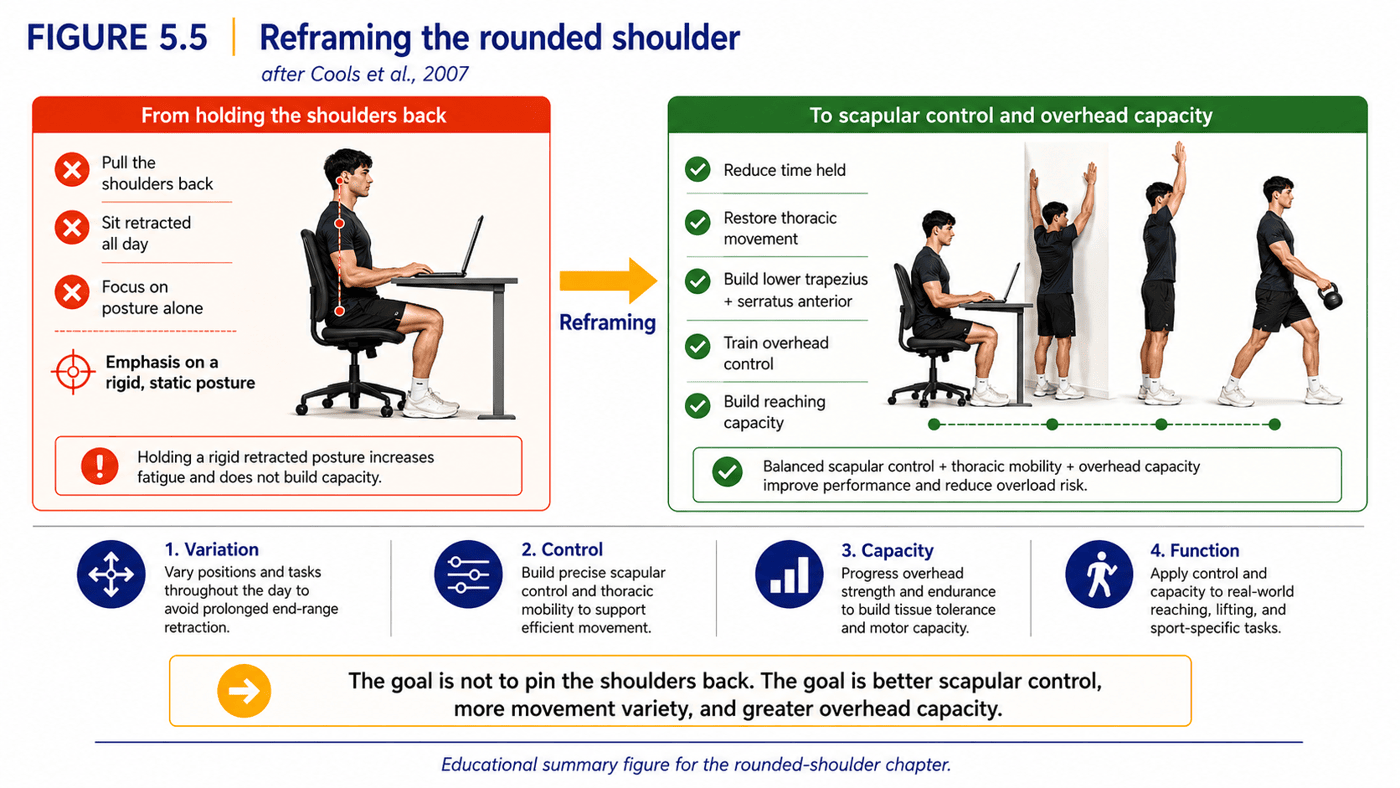
The strategy that follows from all of this is, once again, not a posture but a programme. Its first element is to restore the force couple: load the lower trapezius and serratus anterior so they once more position and stabilise the scapula without conscious effort. Its second is to rebuild overhead capacity: take the shoulder through the full range it rarely visits at a desk, progressively, so the tissues that elevate and rotate the arm regain their tolerance. Its third is to free the thorax, so the scapula has a mobile base to rotate upon (developed in Part III). And its fourth, threading through all of them, is to vary the arm-forward posture across the day, reaching, rotating and moving so the shoulder is not held in one narrow position for hours.
Figure 5.5 contrasts the old framing with the new. The rounded shoulder is not a posture fault to be corrected by retraction; it is an under-conditioned, under-varied shoulder to be reloaded and re-mobilised. A shoulder with a strong, well-controlled scapula, full overhead capacity and a mobile thoracic base sits well of its own accord and tolerates the arm-forward life with ease — which is the goal, not a momentarily squared posture. The practical chapters of Parts VI and VII turn this into specific exercises; the box below gives the essentials.
The confidence to load rather than merely hold rests on good evidence. Cools et al. (2007) showed that specific exercises can selectively recondition the under-used lower trapezius and serratus anterior, restoring the force couple; and the broader rehabilitation literature consistently favours active, progressive loading of the scapular and rotator-cuff muscles over passive correction of posture. The desk shoulder responds to being asked to work — through range, against load, with good control — far more reliably than to being held in a retracted position it cannot sustain.
Reclaiming overhead, safely
One particular fear deserves addressing, because it keeps many desk workers from the very movement they most need: the worry that lifting the arms overhead is dangerous for a cranky shoulder. For the large majority, the opposite is true. Overhead reach is a fundamental human movement that desk life simply stops rehearsing, and a shoulder that never goes overhead loses the capacity to do so comfortably — the deconditioning spiral of Chapter 1, played out in a single joint. Avoiding overhead movement to protect the shoulder tends to shrink its tolerance further.
The constructive approach is graded exposure: reintroduce overhead reaching gradually, beginning within the range that feels easy and building range and load patiently over weeks, supported by the scapular and rotator-cuff work described above. Confidence matters as much as mechanics; treating the shoulder as robust and trainable, rather than as fragile and to be guarded, is part of the intervention. A shoulder that is regularly and progressively asked to work overhead becomes a shoulder that tolerates overhead — which is, after all, the point. Persistent or severe shoulder pain, of course, warrants assessment by a healthcare professional (see Appendix C) before loading is progressed.
A brief illustration ties the chapter together. Picture a developer with an aching, clicky shoulder who has spent months stretching her chest and reminding herself to sit up, with little change. Read mechanically, the reasons are plain: the stretching addressed one tether while leaving the lower trapezius and serratus anterior under-conditioned; the postural reminders added effortful holding without building capacity; and a stiff, flexed upper back kept the scapula tipped forward throughout. Shift the work to loading the under-used scapular muscles, reclaiming overhead range and freeing the thoracic spine, and the shoulder that resisted months of correction often changes within weeks — not because a posture was fixed, but because a capacity was built.
| Old cue | Why it underperforms | Better cue |
|---|---|---|
| “Pull your shoulders back.” | Drags the scapula by effort; doesn’t last | “Build the muscles that hold the shoulder blade in place.” |
| “Stretch your tight chest.” | Removes one restraint; leaves the back weak | “Mobilise the front if needed, but load the back of the shoulder.” |
| “Sit up to fix your shoulders.” | A held posture, not a capacity change | “Free the upper back and reach overhead often.” |
| “Your shoulder is impinging.” | An over-simple, sometimes alarming label | “Your shoulder is robust — let’s build its control and capacity.” |
Table 5.2. Reframing common shoulder advice into control-and-capacity language.
In summary
- Desk work holds the arms forward for hours; the shoulder adapts, and ‘rounded shoulders’ is the visible result of a scapula drawn into protraction and anterior tilt (Ludewig & Reynolds, 2009).
- Good scapular position comes from a force couple — upper trapezius, lower trapezius and serratus anterior; desk posture weakens the lower trapezius and serratus, disturbing it (Neumann, 2017; Cools et al., 2007).
- Scapular position affects the subacromial space, but the old ‘impingement’ model is now seen as too simple — shoulder pain is multifactorial (Ludewig & Cook, 2000; Lewis, 2016).
- A slumped thoracic posture measurably reduces available shoulder elevation; a mobile thorax and well-controlled scapula give the arm its full reach (Kebaetse et al., 1999; Bullock et al., 2005).
- Tight chest muscles contribute, but stretching alone rarely lasts; the durable fix is to load the under-used muscles at the back of the shoulder — stretch less, load more.
- The strategy is to restore the force couple, rebuild overhead capacity, free the thorax and vary the arm-forward posture — not to pull the shoulders back and hold them there.
References
Bullock, M. P., Foster, N. E., & Wright, C. C. (2005). Shoulder impingement: The effect of sitting posture on shoulder pain and range of motion. Manual Therapy, 10(1), 28–37.
Cools, A. M., Dewitte, V., Lanszweert, F., Notebaert, D., Roets, A., Soetens, B., Cagnie, B., & Witvrouw, E. E. (2007). Rehabilitation of scapular muscle balance: Which exercises to prescribe? The American Journal of Sports Medicine, 35(10), 1744–1751.
Kebaetse, M., McClure, P., & Pratt, N. A. (1999). Thoracic position effect on shoulder range of motion, strength, and three-dimensional scapular kinematics. Archives of Physical Medicine and Rehabilitation, 80(8), 945–950.
Kibler, W. B., Sciascia, A., & Wilkes, T. (2012). Scapular dyskinesis and its relation to shoulder injury. Journal of the American Academy of Orthopaedic Surgeons, 20(6), 364–372.
Lewis, J. (2016). Rotator cuff related shoulder pain: Assessment, management and uncertainties. Manual Therapy, 23, 57–68.
Ludewig, P. M., & Cook, T. M. (2000). Alterations in shoulder kinematics and associated muscle activity in people with symptoms of shoulder impingement. Physical Therapy, 80(3), 276–291.
Ludewig, P. M., & Reynolds, J. F. (2009). The association of scapular kinematics and glenohumeral joint pathologies. Journal of Orthopaedic & Sports Physical Therapy, 39(2), 90–104.
Neumann, D. A. (2017). Kinesiology of the musculoskeletal system: Foundations for rehabilitation (3rd ed.). Elsevier.
Page, P., Frank, C. C., & Lardner, R. (2010). Assessment and treatment of muscle imbalance: The Janda approach. Human Kinetics.
Sahrmann, S. A. (2002). Diagnosis and treatment of movement impairment syndromes. Mosby.