Part II · SCREEN MECHANICS AND UPPER-BODY PAIN
The Screen–Neck Problem
The neck spends the working day holding the head toward a screen. More than any other region, it pays for the geometry of the modern workstation — and the popular fear of ‘text neck’ has obscured a clearer, more useful account of what is actually happening and what to do about it.
4.1 The Most Loaded Joint in the Building
Of all the tissues affected by desk work, the neck is the most exposed, because it performs a task that never stops: holding up the head. The adult head weighs roughly four to five kilograms — about the weight of a large bag of flour — and the cervical spine and its muscles must support that mass through every waking hour. When the head is balanced over the shoulders, the load passes efficiently down the vertebral column and the muscular cost is modest. The trouble begins when the head drifts forward toward a screen, which, across a working population, it very reliably does.
Neck pain is among the most common musculoskeletal complaints worldwide, and office-based work features prominently in its epidemiology (Hogg-Johnson et al., 2008). This chapter sets out the mechanics behind that statistic — the forward head, the geometry of the screen, the muscular imbalance it encourages, and the decisive role of sustained loading — and then turns, as every chapter in this book does, from describing the problem to building the capacity that resolves it. Along the way it addresses the term that dominates popular discussion, ‘text neck’, and explains why it is a useful caution but a poor diagnosis.
Why the neck in particular? Several features make it uniquely exposed at a desk. Its muscles are comparatively small, yet they perform continuous antigravity work that never fully rests while a person is upright (Caneiro et al., 2010). The head it supports is also the body’s primary sensory platform, carrying the eyes, ears and balance organs, so the neck must constantly fine-tune the head’s position to keep the gaze level and steady on a screen. And the cervical spine is the most mobile region of the whole vertebral column, trading bony stability for range — which means it leans heavily on muscular control. A region that is mobile, muscularly modest and perpetually on duty is precisely the one a static, head-forward posture taxes first.
4.2 The Mechanics of the Forward Head
The forward head is best understood through the idea of a moment arm — the perpendicular distance between a load and the joint that supports it. When the head sits over the cervical spine, that distance is small and the muscles need generate little force. As the head moves forward, the distance grows, and because torque is force multiplied by distance, the muscles at the back of the neck must work disproportionately harder to stop the head dropping. A few centimetres of forward drift multiplies the demand rather than merely adding to it.
Hansraj (2014), using a computational model of the cervical spine, estimated that the effective load borne by the neck rises from the head’s true weight of about five kilograms in neutral to figures several times greater at the forward-tilt angles common during screen use. The exact numbers from any single model should be treated as illustrative rather than precise, and the model has been debated; but the shape of the relationship — a steep, accelerating rise in load with increasing tilt — is robust and is the durable lesson. Crucially, how far the head tilts depends heavily on what it is looking at. Lee, Kang and Shin (2015) measured substantial head-flexion angles during smartphone use, and the principle generalises across devices: the lower and closer the screen, the deeper the bow, as Figure 4.1 summarises.
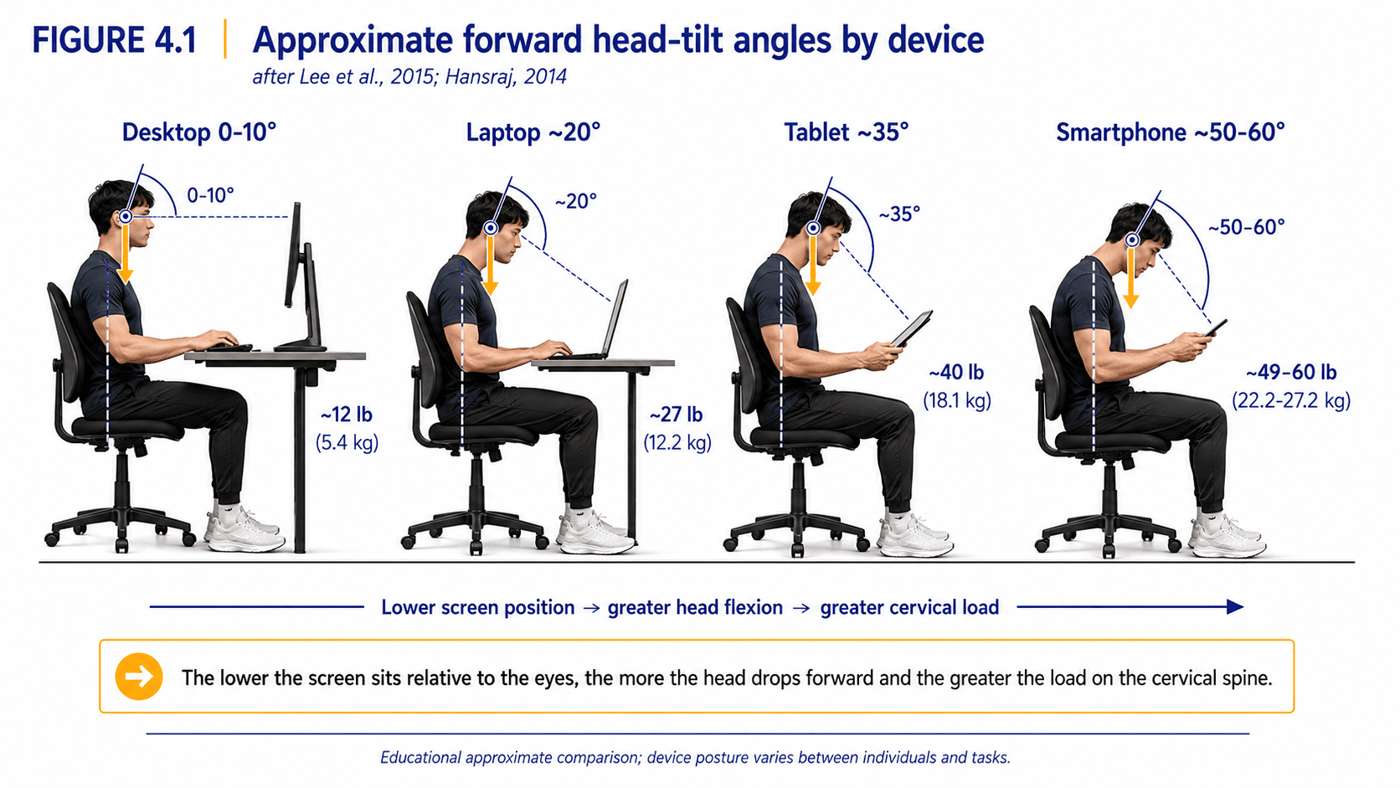
This single relationship explains a great deal of desk-related neck discomfort. A laptop, whose screen and keyboard are fixed together, forces a compromise in which either the screen is too low or the hands are too high; a phone held in the lap produces the deepest flexion of all. The desktop monitor, by contrast, can be placed wherever we choose — which makes its position the single most powerful lever in the entire screen-neck problem, and the subject of the next section.
A worked example: how the numbers grow
A simple, approximate calculation makes the moment-arm idea concrete. Torque is force multiplied by the length of the moment arm. With the head balanced over the spine, the centre of mass of the roughly five-kilogram head sits only a short distance — perhaps a couple of centimetres — in front of the supporting joints, so the neck extensors resist a modest torque. Let the head travel forward until that distance trebles, and the torque the muscles must generate trebles with it, even though the head has not gained a gram. This is why posture feels deceptively cheap in the moment and proves costly over hours: the expense is hidden in the geometry, not in the weight, and it scales with how far forward the head drifts.
A brief tour of the cervical spine under load
It helps to know what is actually bearing the load. The cervical spine is a stack of seven small vertebrae, separated by intervertebral discs at the lower levels and linked at the back by paired facet joints that guide and limit movement. Between them pass the nerve roots that travel down into the arms and hands. In a neutral, stacked posture, load is shared sensibly across the discs and facets and the muscular demand is low. As the head moves forward, the lower cervical segments flex while the upper segments extend to keep the eyes level, redistributing load across the discs and facet joints and increasing the sustained pull required of the muscles behind.
None of this should be read as fragility. These structures are robust and built to be loaded; the cervical spine tolerates movement in every direction many thousands of times a day without complaint. The point of the tour is simply to locate where sustained forward-head posture concentrates its demand — on the lower cervical discs and facets and on the muscles that hold the head — so that the strategy later in the chapter, which reduces that sustained demand and builds the capacity to meet it, makes mechanical sense.
4.3 Where the Screen Sits Decides Where the Neck Goes
If forward-head load rises with tilt, and tilt is largely set by screen height, then the geometry of the workstation becomes a mechanical decision rather than a matter of willpower. The aim is to let the eyes do the looking while the neck stays close to neutral. In practice this means placing the top of the screen at or just below eye level, so that the natural resting gaze falls gently — around ten to twenty degrees below horizontal — onto the upper third of the display, with the head still stacked over the shoulders. Figure 4.2 contrasts this neck-friendly geometry with the common arrangement of a screen set too low.
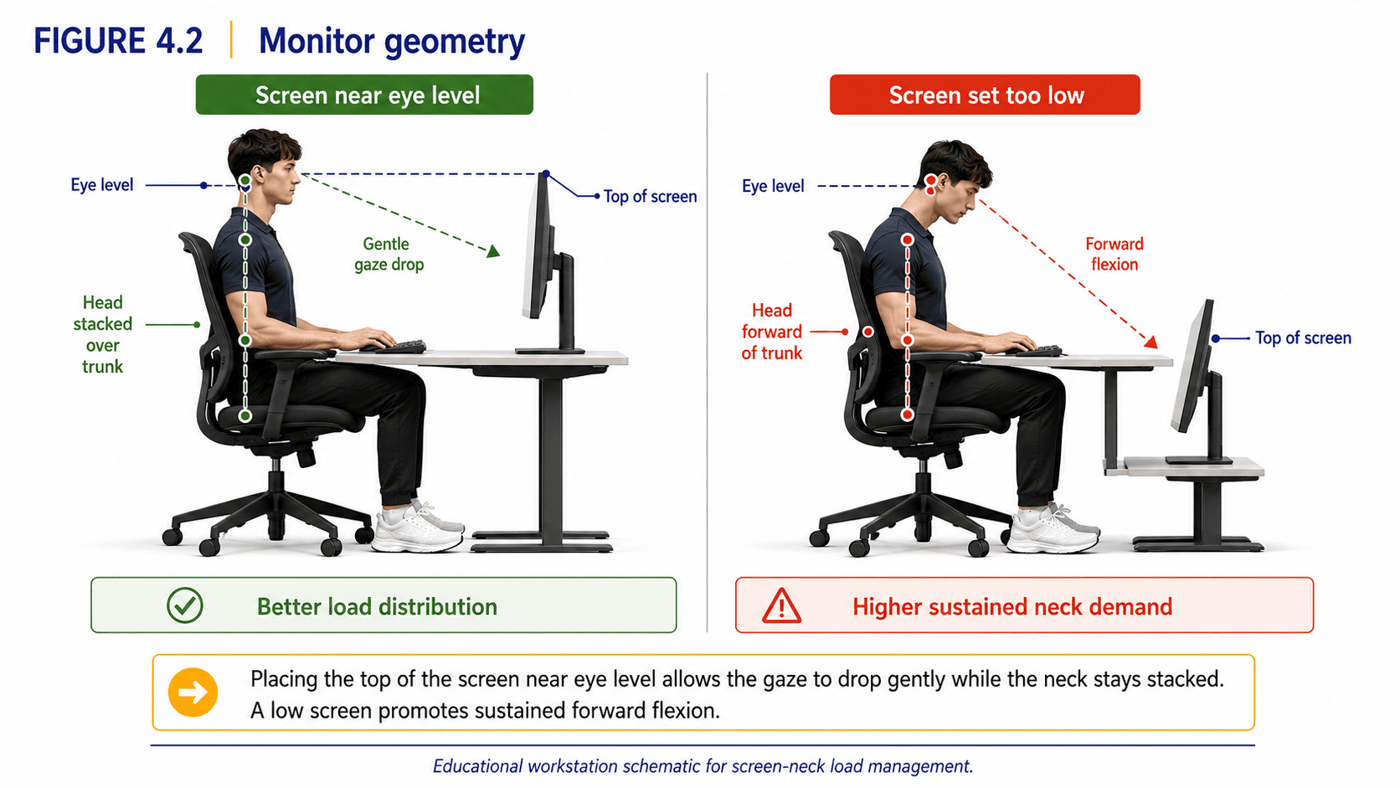
The mechanical logic here is not that one perfect screen height must be found and held — that would simply substitute a new fixed posture for the old one, and Part I has already explained why fixed postures are the problem. The point is to remove the structural obstacle that drives the head into sustained flexion in the first place. A well-placed screen makes a near-neutral neck the path of least resistance and frequent movement easy; a badly placed one makes deep flexion almost unavoidable for hours. Setup, properly understood, is about widening options rather than enforcing an ideal.
Two increasingly common arrangements deserve a mechanical note. A laptop used as a main machine is, by design, a compromise: screen and keyboard are fixed together, so the screen sits too low whenever the hands are well placed. Docking the laptop — raising it on a stand to bring its screen toward eye level and adding a separate keyboard and mouse — resolves the conflict and is among the highest-value changes a laptop-bound worker can make. Dual-monitor setups, meanwhile, reward a moment’s thought about which screen is used most: the primary display belongs directly in front at eye level, not off to one side, so the most-used screen does not require the neck to hold a sustained rotation as well as a forward tilt.
When the eyes pull the head forward
Not all forward-head posture begins in the neck; a surprising amount begins in the eyes. When text is too small, a screen too dim or too far, or the display marred by glare and reflections, the natural response is to lean in — to crane the whole head toward the screen to see more clearly. The neck then holds that forward position for hours, not because of any postural habit but because the visual conditions demanded it. A forward head, in other words, is sometimes a symptom of a visual problem wearing a musculoskeletal disguise.
This has a tidy practical upshot. Increasing the text size, raising the display brightness and contrast to a comfortable level, cleaning the screen and reducing glare, and sitting at a sensible viewing distance can quietly resolve a forward head that no amount of postural cueing would fix. Wearers of bifocal or progressive lenses deserve particular attention here: because the reading portion sits at the bottom of the lens, such glasses often drive a chin-up, head-forward posture at a standard screen, and a lower screen or dedicated computer glasses can spare the neck a great deal of sustained strain. Comfortable eyes make for a comfortable neck.
| Setup factor | Why it matters mechanically | Practical target |
|---|---|---|
| Screen height | Sets head-tilt angle and cervical load | Top of screen at/just below eye level |
| Screen distance | Too close drives forward head and eye strain | Roughly an arm’s length away |
| Laptop use | Fixed screen-keyboard forces a compromise | Raise laptop; add external keyboard |
| Phone habits | Lap-held phones cause the deepest flexion | Raise the phone; keep sessions short |
| Document position | Looking down to papers repeats neck flexion | Use a document holder near screen height |
Table 4.1. A neck-friendly screen setup removes the structural drivers of sustained forward flexion, making a near-neutral neck the easy default.
4.4 The Hidden Muscular Imbalance
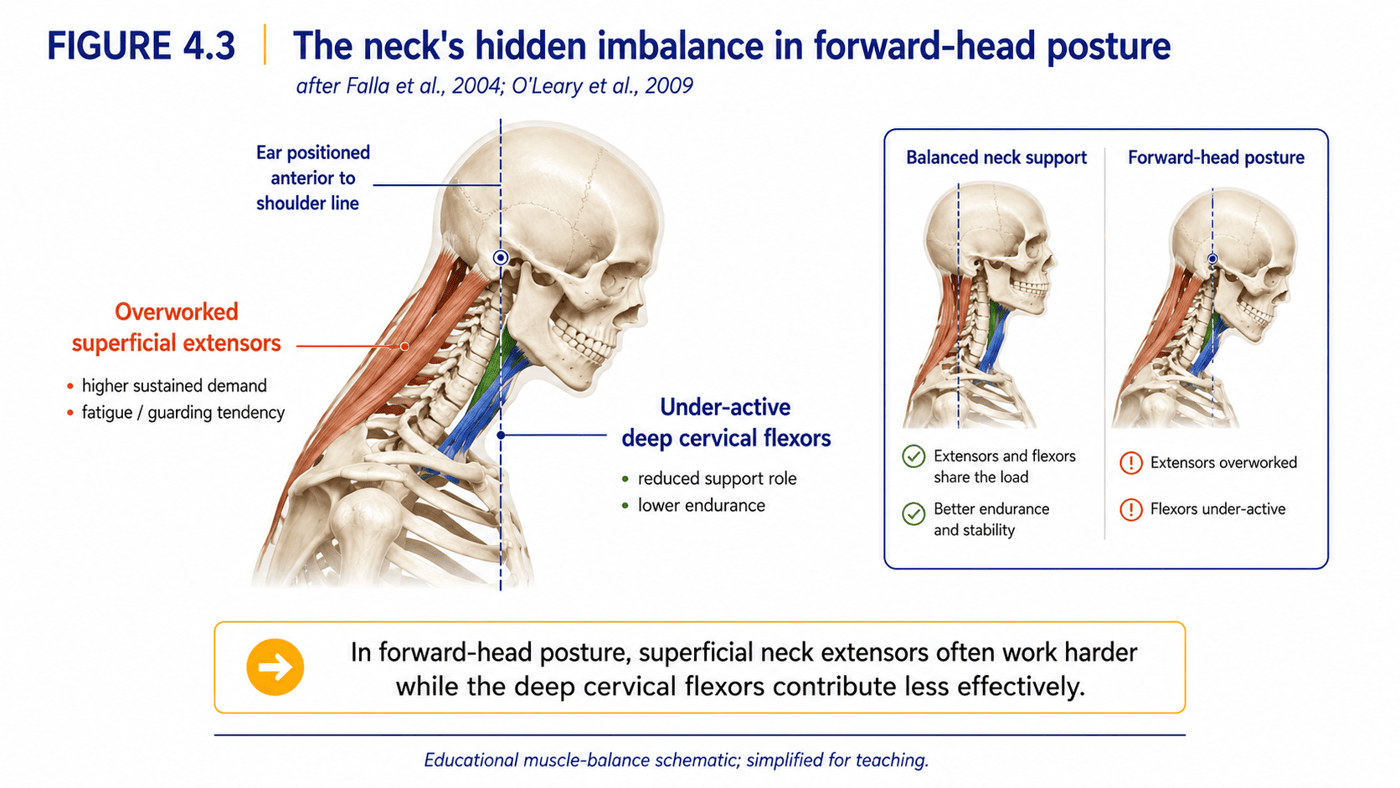
Sustained forward-head posture does more than load the neck; it changes how the neck’s muscles share their work. The deep muscles at the front of the cervical spine — the deep cervical flexors, chiefly longus colli and longus capitis — act as fine stabilisers, holding the individual vertebrae in good alignment. The more superficial muscles at the back and sides — the suboccipitals, upper trapezius, levator scapulae and splenius — are the larger movers that, in a forward-head posture, are recruited continuously to stop the head dropping.
Research on neck pain has consistently found a characteristic pattern in this division of labour. People with neck pain tend to show reduced activation and endurance of the deep cervical flexors, demonstrated using the craniocervical flexion test (Falla, Jull & Hodges, 2004), alongside altered, often heightened activity of the superficial muscles (Falla & Farina, 2008). O’Leary, Falla, Elliott and Jull (2009) summarised the implication for practice: the deep stabilisers become under-active while the superficial movers are overworked — the imbalance illustrated in Figure 4.3. This matters because it identifies a clear target. The neck does not simply need to be stretched or held straighter; it needs the deep stabilisers re-engaged and the whole system reconditioned.
There is a particular quality the neck needs, and it is easy to overlook: endurance, not merely strength. Holding the head steady through a long working day is an endurance task — a low-level demand sustained for hours — and the deep cervical flexors in people with neck pain tend to fatigue quickly rather than to lack peak force. This is why re-training them favours gentle, precise, well-controlled holds repeated patiently over hard maximal effort. The aim is a neck that can quietly do its postural job for hours without tiring — a different target from one that can produce a single strong contraction.
4.5 Duration Again: Why Holding Is the Real Problem
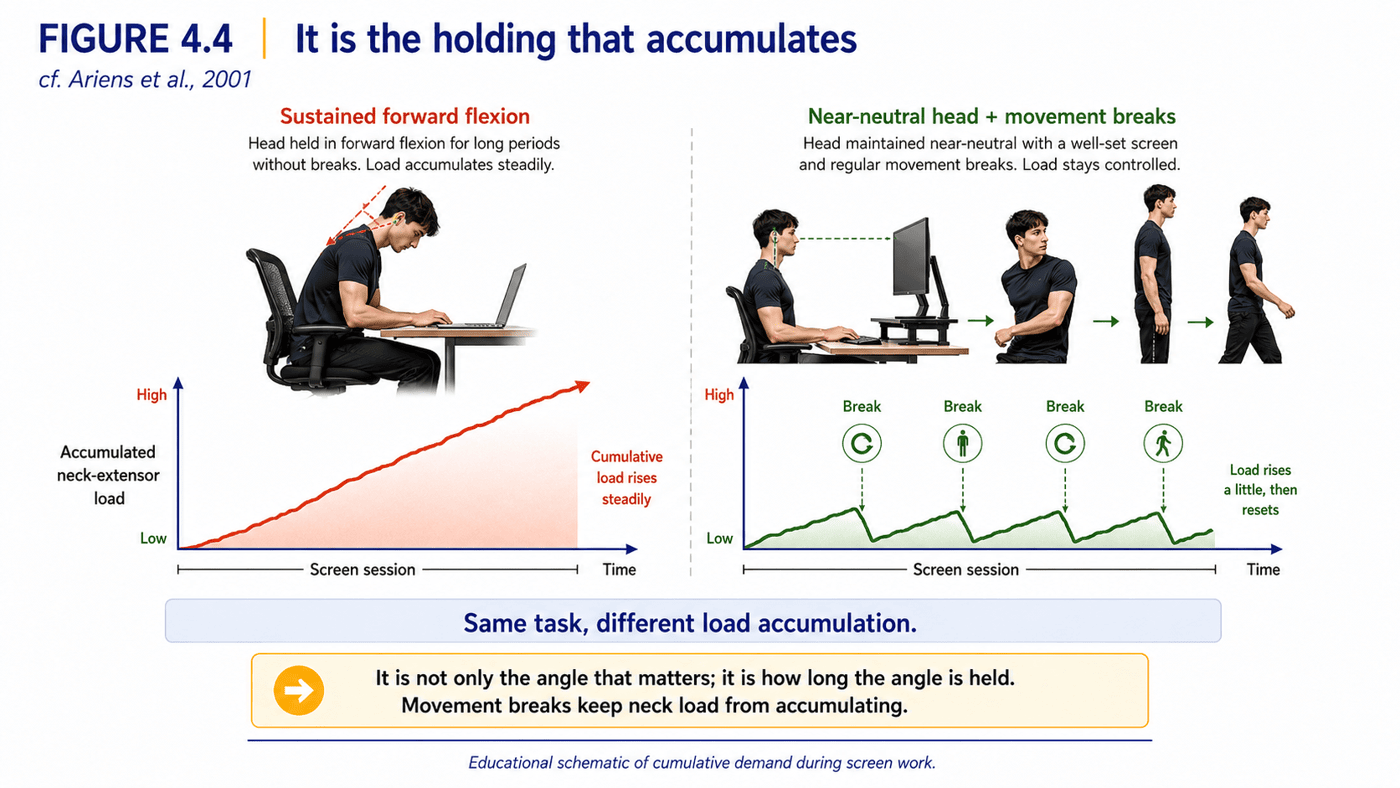
As with every region in this book, the decisive variable is not the angle of a posture but the length of time it is held. A neck flexed for a few seconds to read a message is trivial; the same neck flexed for forty unbroken minutes accumulates a very different load. Ariëns et al. (2001), in a prospective occupational study, identified prolonged neck flexion and prolonged sitting as risk factors for neck pain — the emphasis falling on prolonged. Szeto, Straker and Raine (2002), comparing symptomatic and asymptomatic office workers, found differences not so much in a single posture as in sustained muscle-activity patterns over time, with symptomatic workers showing more continuous low-level activation.
Figure 4.4 makes the point visible. A head held in sustained forward flexion lets neck-extensor load accumulate steadily; a head kept near neutral and moved frequently keeps that load low throughout the day. The same posture that is harmless for a minute becomes a problem when it is never interrupted. This is why the most effective single intervention for the screen-neck is not a posture correction at all, but a change in cadence — interrupting sustained loading often enough that no tissue is asked to hold the head in one place for long.
Sustained neck loading can also reach beyond the neck itself. The upper cervical joints and the suboccipital muscles — the small muscles at the base of the skull that work hard in forward-head posture — are richly connected to the structures that generate headache, and prolonged neck strain is a recognised contributor to so-called cervicogenic headache: head pain that actually originates in the neck. Many a desk worker’s late-afternoon ‘tension headache’ is in part a neck story, eased less by painkillers than by interrupting the sustained posture and moving the neck. Chapter 20, in Part VI, takes up headache and jaw patterns in detail; the point here is simply that the costs of a held neck posture are not always felt in the neck.
4.6 The “Text Neck” Question
No discussion of the screen-neck can avoid the term text neck, which has entered popular vocabulary to describe the flexed-neck posture of phone and screen use, often accompanied by alarming claims about premature spinal damage. It is worth addressing directly, because the fear it generates can do harm of its own. The mechanical observation behind the term is sound: looking down at a device does increase cervical load, as Section 4.2 described. But the leap from that observation to the claim that a particular neck posture causes lasting damage or pain is not well supported.
The evidence linking specific neck postures to neck pain is, in fact, mixed and often weak — consistent with the broader picture established in Chapter 3. Richards et al. (2016), studying neck-posture clusters in adolescents, found that the relationship between posture and pain was bound up with a range of physical and psychosocial factors rather than determined by alignment alone. Many people with pronounced forward-head posture have no neck pain; many people with neck pain do not have a notably forward head. As with the spine, posture is one contributor among several, and probably not the dominant one. The constructive reading is therefore not ‘your phone is destroying your neck’ but ‘sustained flexion is a load to be managed, and your neck is a robust structure that adapts to the demands you give it’. Catastrophic framing tends to breed exactly the fear and vigilance that, as the pain science in Chapter 3 showed, make symptoms more likely.
The concern is sometimes sharpened by the sight of young people bent over phones for hours, and it is reasonable to want them to look up and move more often. But the leap from ‘they look down a lot’ to ‘they are damaging their spines’ outruns the evidence, and framing ordinary device use as injurious may do more harm than the posture itself. A measured position serves everyone better: encourage frequent movement, varied positions and well-placed screens because they reduce sustained load and feel better — not because the neck is fragile or because a particular posture is a diagnosis waiting to happen.
4.7 Building a Neck That Tolerates Screens
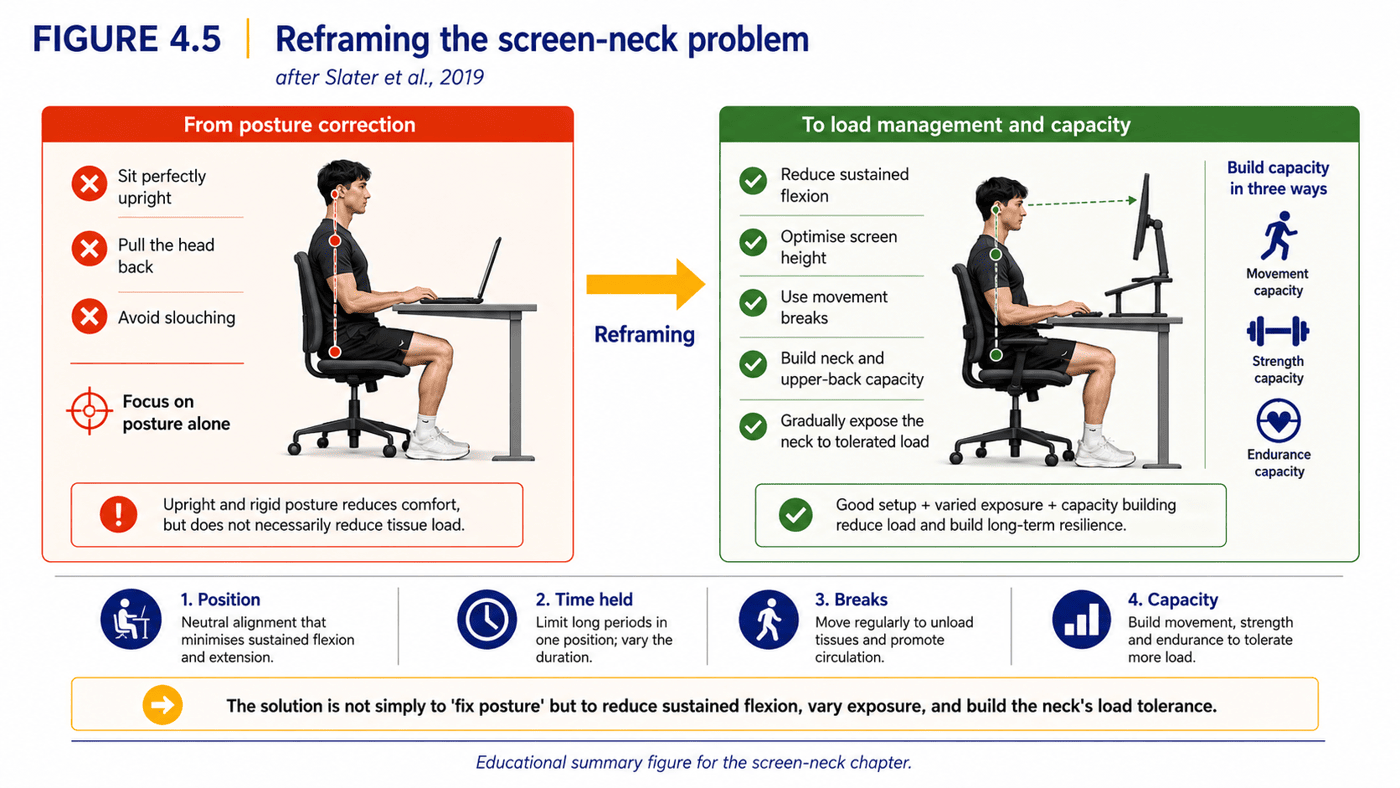
If sustained flexion is the load and low capacity is the vulnerability, then the solution has three strands, none of which is ‘sit up straight’. The first is to reduce the dose: place the screen well (Section 4.3) and break up sustained flexion frequently, so the neck is never held in one position for long. The second is to restore the balance: gently re-train the deep cervical flexors that have become under-active, re-establishing fine control of the cervical spine. The third is to build capacity: progressively strengthen the neck and the muscles that support the shoulder girdle, so the whole region tolerates the loads of a screen day with reserve to spare.
This last strand has direct evidence behind it. As Chapter 3 noted, targeted strengthening of the neck and shoulder muscles has been shown to reduce chronic neck pain in office workers — a result about building tolerance, not correcting alignment. Figure 4.5 sets the old framing against the new. The screen-neck is not a posture to be policed but a region to be conditioned: well-placed screens, frequent movement, re-engaged deep stabilisers and a stronger, more capable neck. The practical chapters in Parts VI and VII develop each of these into a concrete routine; the box below distils the essentials.
The strengthening strand is not a hopeful guess; it has direct trial evidence. Andersen et al. (2008) found that targeted strengthening of the neck and shoulder muscles produced clinically meaningful reductions in chronic neck pain among office workers — a result about raising tissue tolerance, not about correcting posture. For a region that must work continuously all day, a stronger, better-controlled, more enduring neck is what most reliably converts a painful screen day into a comfortable one.
Movement snacks for the neck
Because the active ingredient is frequent movement rather than a held posture, the most useful interventions are small and repeatable — ‘movement snacks’ scattered through the day rather than a single set routine. A slow, gentle nod, as though saying a quiet ‘yes’, re-engages the deep cervical flexors. An easy turn of the head to each side, and a gentle tip of the ear toward each shoulder, carry the neck through ranges a screen never asks for. A light ‘setting’ of the shoulder blades down and back, held briefly, reawakens the postural muscles of the upper back. None of these needs to be forceful, lengthy or perfectly performed; their value lies entirely in being done often. A few of them every twenty to thirty minutes will do more for a screen-tired neck than any amount of effort spent trying to hold a single ‘correct’ position.
| Common neck claim | What the evidence and mechanics suggest |
|---|---|
| ‘Text neck’ is destroying our spines | Looking down raises load, but a specific posture is not a proven cause of damage or pain (Richards et al., 2016). |
| Hold your head up straight all day | Sustained holding fatigues the surface muscles; duration, not alignment, drives accumulation (Ariëns et al., 2001). |
| Stretching the neck is the fix | The deep flexors are under-active and the neck under-conditioned; re-training and loading matter more (O’Leary et al., 2009). |
| A perfect chair will solve it | Screen geometry and movement cadence matter more than any single posture or product. |
Table 4.2. Common screen-neck claims set against current evidence and mechanical reasoning.
In summary
- The neck carries the head (~4–5 kg) all day; when the head drifts forward, the load on the neck rises steeply because the moment arm lengthens (Hansraj, 2014).
- Head-tilt angle is largely set by screen position — the lower and closer the screen, the deeper the flexion (Lee et al., 2015). A well-placed monitor is the single most powerful lever.
- Forward-head posture creates a muscular imbalance: under-active deep cervical flexors and overworked superficial extensors (Falla et al., 2004; O’Leary et al., 2009).
- As everywhere in this book, duration is decisive: prolonged neck flexion and sustained low-level muscle activity are the real drivers (Ariëns et al., 2001; Szeto et al., 2002).
- ‘Text neck’ is a useful caution but a poor diagnosis: the posture–pain link is mixed and weak, and alarmist framing can worsen symptoms (Richards et al., 2016).
- The solution is to reduce the dose (screen setup, frequent movement), restore the deep-flexor balance, and build neck capacity — not to hold the head ‘correctly’ all day.
References
Andersen, L. L., Kjaer, M., Søgaard, K., Hansen, L., Kryger, A. I., & Sjøgaard, G. (2008). Effect of two contrasting types of physical exercise on chronic neck muscle pain. Arthritis & Rheumatism, 59(1), 84–91.
Ariëns, G. A. M., Bongers, P. M., Douwes, M., Miedema, M. C., Hoogendoorn, W. E., van der Wal, G., Bouter, L. M., & van Mechelen, W. (2001). Are neck flexion, neck rotation, and sitting at work risk factors for neck pain? Results of a prospective cohort study. Occupational and Environmental Medicine, 58(3), 200–207.
Caneiro, J. P., O’Sullivan, P., Burnett, A., Barach, A., O’Neil, D., Tveit, O., & Olafsdottir, K. (2010). The influence of different sitting postures on head/neck posture and muscle activity. Manual Therapy, 15(1), 54–60.
Falla, D., & Farina, D. (2008). Neuromuscular adaptation in experimental and clinical neck pain. Journal of Electromyography and Kinesiology, 18(2), 255–261.
Falla, D. L., Jull, G. A., & Hodges, P. W. (2004). Patients with neck pain demonstrate reduced electromyographic activity of the deep cervical flexor muscles during performance of the craniocervical flexion test. Spine, 29(19), 2108–2114.
Hansraj, K. K. (2014). Assessment of stresses in the cervical spine caused by posture and position of the head. Surgical Technology International, 25, 277–279.
Hogg-Johnson, S., van der Velde, G., Carroll, L. J., Holm, L. W., Cassidy, J. D., Guzman, J., … Peloso, P. (2008). The burden and determinants of neck pain in the general population. Spine, 33(4 Suppl), S39–S51.
Lee, S., Kang, H., & Shin, G. (2015). Head flexion angle while using a smartphone. Ergonomics, 58(2), 220–226.
O’Leary, S., Falla, D., Elliott, J. M., & Jull, G. (2009). Muscle dysfunction in cervical spine pain: Implications for assessment and management. Journal of Orthopaedic & Sports Physical Therapy, 39(5), 324–333.
Richards, K. V., Beales, D. J., Smith, A. J., O’Sullivan, P. B., & Straker, L. M. (2016). Neck posture clusters and their association with biopsychosocial factors and neck pain in Australian adolescents. Physical Therapy, 96(10), 1576–1587.
Slater, D., Korakakis, V., O’Sullivan, P., Nolan, D., & O’Sullivan, K. (2019). “Sit up straight”: Time to re-evaluate. Journal of Orthopaedic & Sports Physical Therapy, 49(8), 562–564.
Szeto, G. P. Y., Straker, L., & Raine, S. (2002). A field comparison of neck and shoulder postures in symptomatic and asymptomatic office workers. Applied Ergonomics, 33(1), 75–84.