Part I · THE DESK BODY PROBLEM
Why Posture Advice Alone Fails
“Sit up straight” is the most common advice given to desk workers and one of the least effective. The problem is not that posture is irrelevant, but that the advice targets the wrong variable — a single position — while ignoring the duration, variety, capacity and beliefs that actually determine how a body feels.
3.1 The Posture–Pain Assumption
For most of the twentieth century, musculoskeletal pain was explained through what has been called the postural–structural–biomechanical model: the belief that pain is largely caused by deviations from an ideal alignment, and that correcting the alignment will resolve the pain. It is an intuitive idea with deep roots in orthopaedics, ergonomics and manual therapy. It fits the visible evidence — people in pain often do look slumped — and it offers a satisfyingly simple instruction that anyone can give and anyone can attempt to follow.
It is also, as a complete explanation, no longer supported by the weight of evidence. The model makes a strong, testable prediction: that people with worse alignment should have more pain, and that improving alignment should reduce it. When that prediction is examined carefully across large numbers of people, it holds far more weakly than the model requires. This chapter sets out what the evidence actually shows, identifies the variables that matter more, and replaces “sit up straight” with a strategy that the evidence does support. It is the hinge between the diagnosis of Part I and the solutions of the later parts.
3.2 What the Evidence Actually Shows
Edward Lederman set out the case directly in an influential paper describing the decline of the postural–structural–biomechanical model (Lederman, 2011). Reviewing the literature across a range of conditions, he found that the expected tight links between specific postural ‘faults’ and pain were weak, inconsistent, or absent. Many people with marked postural deviations have no pain; many people in significant pain have unremarkable posture. A model that cannot reliably predict who hurts is a poor foundation from which to tell people how to sit.
This is not the conclusion of a single contrarian. Christensen and Hartvigsen (2008), in a systematic critical review of the epidemiological literature on sagittal spinal curves and health, found the associations between the shape of the spine and pain or disability to be generally weak and inconsistent. Nourbakhsh and Arab (2002), examining mechanical and postural factors in relation to low-back pain, likewise found that the structural variables so often blamed explained little of who experienced pain. Across these independent lines of evidence the same picture emerges: posture is a far weaker predictor of musculoskeletal pain than the intuitive model assumes.
The most direct rebuttal of the specific instruction comes from researchers who study spinal pain for a living. Slater, Korakakis, O’Sullivan, Nolan and O’Sullivan (2019), in a paper pointedly titled “‘Sit up straight’: time to re-evaluate”, reviewed the assumption that a specific upright sitting posture protects against back and neck pain and found little support for it. Posture is far more variable between healthy, pain-free people than the advice assumes, and no single sitting posture has been shown to be protective for everyone. Richards, Beales, Smith, O’Sullivan and Straker (2016) illustrated the same point in adolescents, identifying several distinct neck-posture clusters whose relationship to pain was bound up with a range of physical and psychosocial factors rather than alignment alone.
The emerging picture is not that posture never matters to anyone, but that its contribution is smaller, more variable and more personal than the universal instruction to straighten up implies. Posture is one variable among many — not the master switch the advice treats it as.
Where the posture myth came from, and why it persists
If the evidence is so unsupportive, why is the posture myth so durable? Part of the answer is that it is genuinely intuitive. Pain and slumping often appear together, and the mind readily reads correlation as cause; a person in pain who is sitting awkwardly looks like an explanation in progress. Part of it is historical: early models of musculoskeletal health were built around structure and alignment, and generations of clinicians, coaches and teachers were trained to see posture as the primary lever. And part of it is that the advice is easy to give and feels responsible — ‘sit up straight’ is simple, actionable and culturally endorsed, which keeps it in circulation long after the evidence has moved on.
There is also a self-confirming quality to it. Because most postures changed often enough do feel better, and because attention to the body can briefly relieve discomfort, correcting posture sometimes appears to work in the moment — not because the alignment was the problem, but because the person moved. The apparent success is then credited to the posture rather than to the movement that accompanied it. Untangling these threads is exactly why a mechanical, evidence-led account matters: it lets us keep what is true — that movement and variation help — while discarding what is not, namely that one ideal alignment is the cure.
3.3 The Real Mechanical Culprit: Duration and Sameness
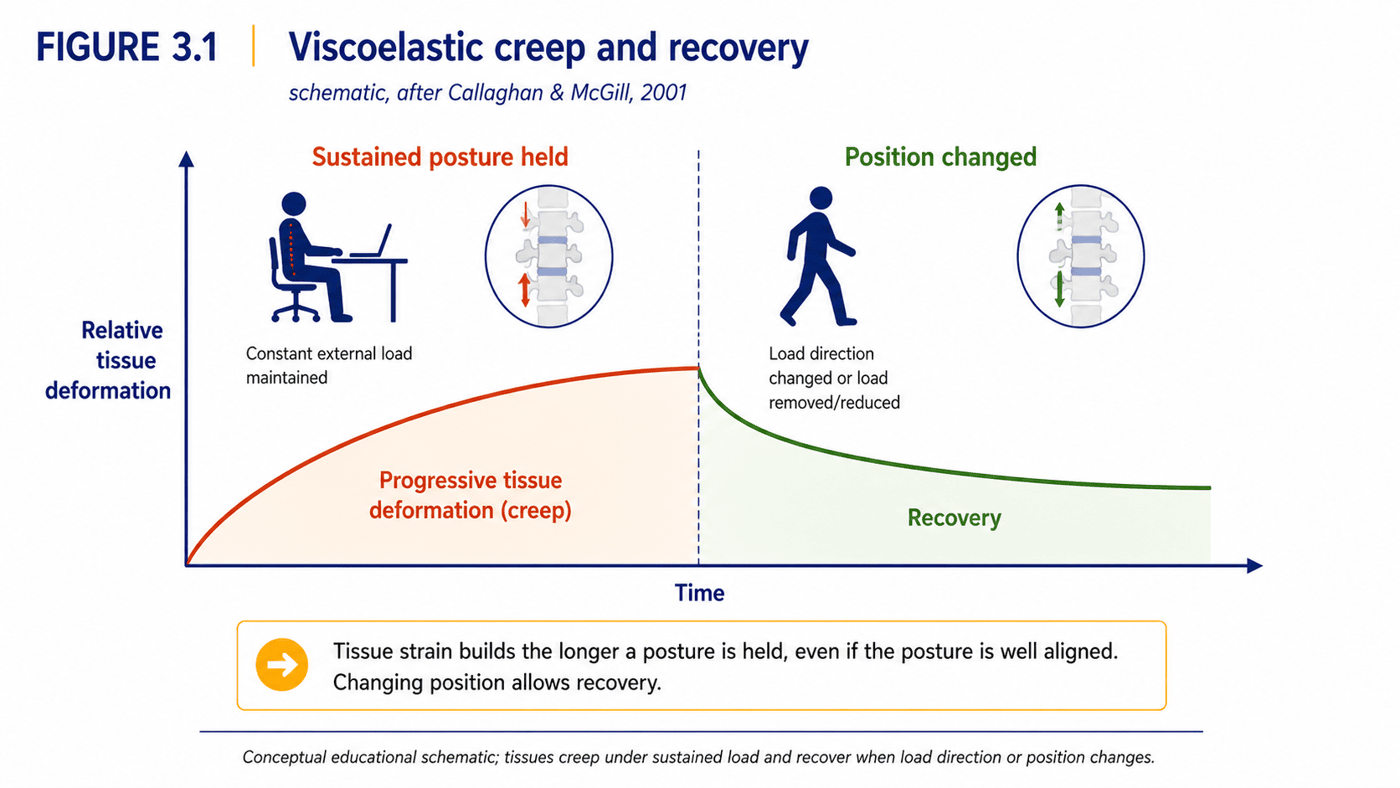
If a single posture is not the villain, what is? Part I has already named it: sustained, unvaried loading. The mechanism is viscoelasticity. Connective tissue deforms progressively under any constant load — a behaviour called creep — and recovers when the load changes. Callaghan and McGill (2001) documented this creep behaviour in the spine during prolonged sitting, and the key word in their finding is prolonged. It is not the angle of a posture but the duration for which it is held that drives tissue creep, reduces fluid exchange and accumulates the low-grade mechanical stress the body eventually registers as discomfort.
There is a neuromuscular layer to this as well. Solomonow (2004) showed that sustained loading of spinal ligaments produces not only creep in the tissue itself but measurable changes in the reflexive muscle activity that protects the joint — a temporary dulling of the system’s protective responses that resolves with rest and movement. The implication is consistent across the mechanical and the neuromuscular evidence: what tissues find difficult is not a particular alignment but the act of holding any alignment still for too long.
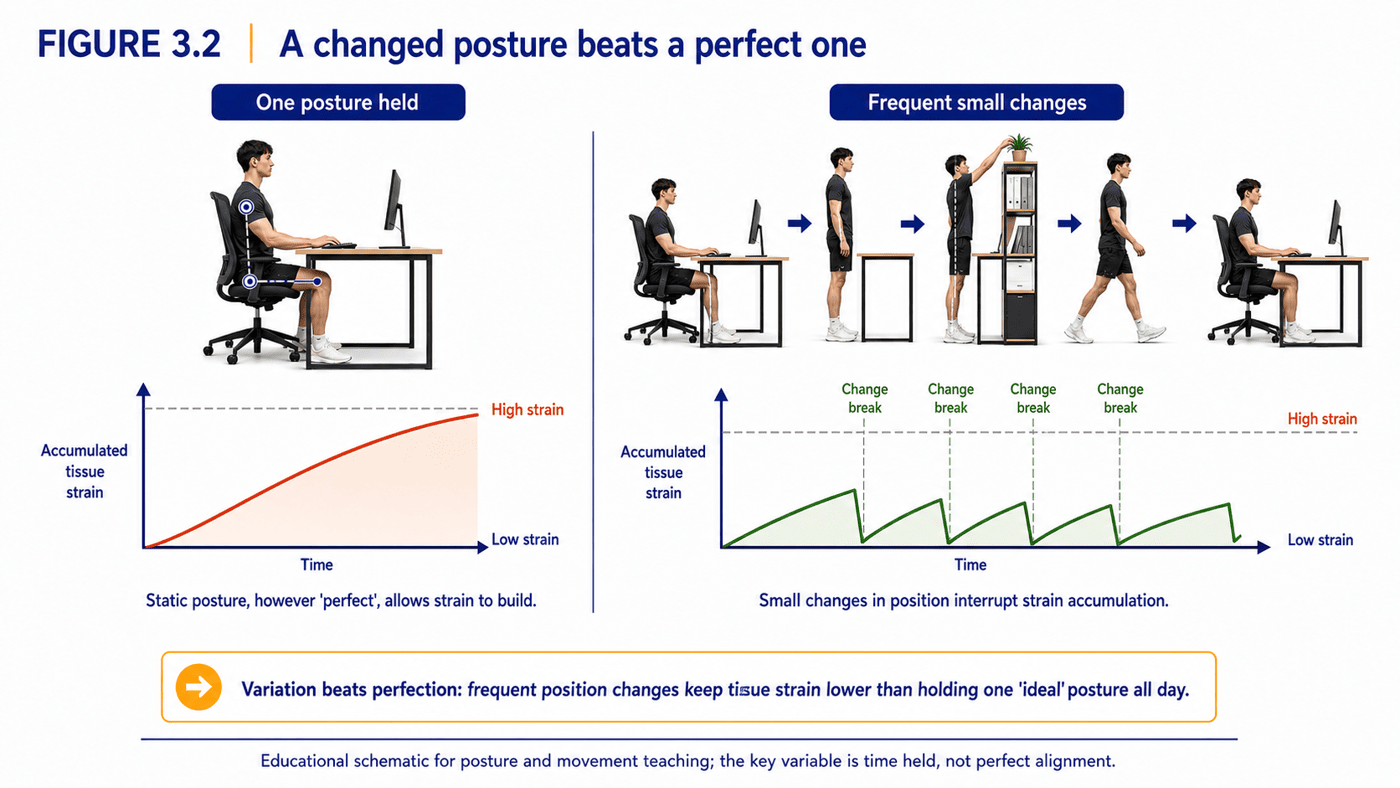
This reframes the whole problem. A ‘perfect’ posture held rigidly for two hours may trouble the tissues more than an ‘imperfect’ one that is changed every few minutes. Figure 3.1 shows the creep-and-recovery cycle for a single sustained posture; Figure 3.2 contrasts a perfect posture held for ninety minutes with a moderate posture changed every twenty, and makes the point visible — the frequently changed posture keeps accumulated strain low throughout. The clinical adage captures it exactly: the best posture is your next posture. Movement and variation, not alignment, are what break the creep cycle, which is precisely why advice that fixes a posture but never changes it is aimed at the wrong target.
3.4 Why “Good Posture” Cues Can Backfire
There is a second, subtler problem with posture correction: the act of holding a posture is itself work. Asking someone to brace into an upright position and maintain it adds sustained low-level muscle activity — the very kind of static loading, borne by the same continuously recruited fibres discussed in Chapter 1, that the desk body is already struggling with. A rigidly held ‘good’ posture can therefore become its own source of tension, trading a relaxed slump for an effortful stiffness that is no more comfortable and no easier to sustain. People sense this, which is why corrected posture so rarely lasts beyond the moment of being reminded.
There is also an attentional and psychological cost. Repeatedly told that their posture is dangerous, some people become hypervigilant about their backs and necks, monitoring every position for threat and interpreting ordinary sensations as signs of damage. Health information framed as a warning can function as a nocebo — an expectation of harm that makes symptoms more likely or more intense. As the next section describes, the way a person thinks about their body genuinely shapes how it feels, so advice intended to protect can, delivered as a warning about fragility, quietly amplify the very symptoms it meant to prevent.
3.5 The Missing Variable: Capacity
The deepest reason posture advice underperforms is that it leaves capacity untouched. As Chapter 2 argued, what most reliably separates a comfortable desk worker from an uncomfortable one is not how they sit but how much load their tissues can tolerate. Telling a low-capacity body to adopt a particular posture is like repainting a bridge that needs reinforcing: it changes the appearance without changing what the structure can bear, and the underlying shortfall remains.
Encouragingly, the variable that posture advice neglects is one that responds well to training. In one of the clearest demonstrations, Andersen et al. (2008) found that targeted strengthening of the neck and shoulder muscles produced meaningful reductions in chronic neck pain among office workers — a result about building tolerance, not about correcting alignment. This is why the interventions in later parts of this book are built around raising capacity: loading the neck, shoulders, spine and hips through range, restoring movement variety, and widening the body’s mechanical reserve, rather than around policing posture. A body with capacity can sit in many ways, for long stretches, including imperfectly, and remain comfortable. That resilience is the actual goal; posture is, at most, a minor supporting detail.
The same lesson holds at the level of prevention. In one of the largest reviews of what actually prevents low-back pain, Steffens et al. (2016) found that exercise — alone or combined with education — was among the few strategies with good evidence for reducing future episodes, while measures aimed at posture and external support, such as back belts and special insoles, were not. The protective ingredient, once again, is building a capable, well-loaded body rather than holding it in a prescribed shape.
| Common posture claim | What the evidence and mechanics suggest |
|---|---|
| A single ‘correct’ posture prevents pain | No one sitting posture is protective for everyone; healthy people vary widely (Slater et al., 2019). |
| Slouching causes back and neck pain | The link between specific postures and pain is weak and inconsistent (Lederman, 2011; Christensen & Hartvigsen, 2008; Richards et al., 2016). |
| Hold yourself upright all day | Sustained holding adds muscle load and fatigue; it is duration and stillness that drive creep (Callaghan & McGill, 2001; Solomonow, 2004). |
| Fix the posture and the pain resolves | Pain is multifactorial and biopsychosocial; capacity, activity and beliefs matter more than alignment (Hartvigsen et al., 2018). |
| My spine is fragile and needs protecting | Framing the body as fragile can worsen symptoms; graded loading builds tolerance (Andersen et al., 2008; Moseley & Butler, 2015). |
Table 3.1. Common posture claims set against current evidence and mechanical reasoning.
3.6 The Other Missing Variable: Pain Is Biopsychosocial
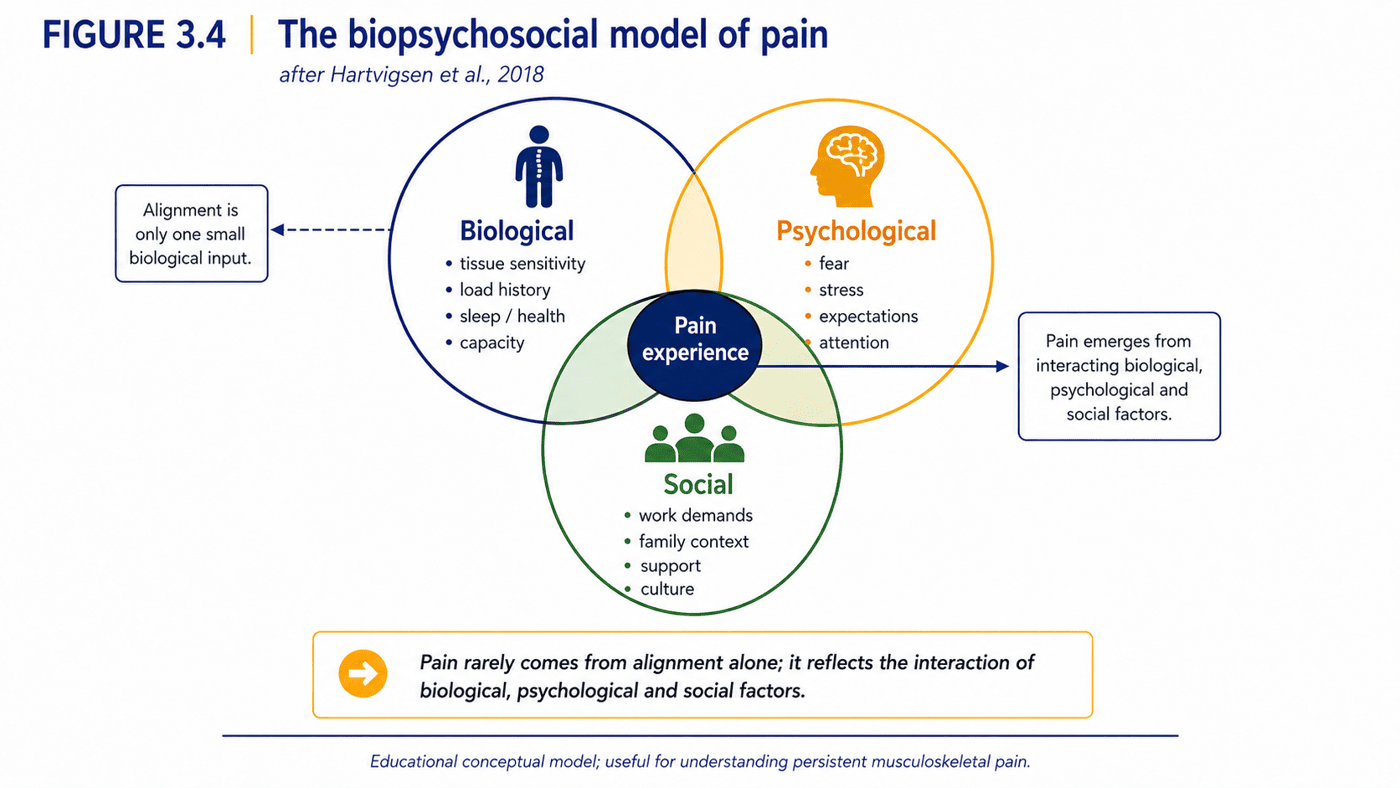
Posture advice quietly assumes that pain is a simple readout of tissue state — that if it hurts, something must be mechanically wrong, and if the mechanics are corrected, the hurt will stop. Decades of pain science have shown this assumption to be incomplete. Hartvigsen et al. (2018), summarising the evidence on low-back pain for The Lancet, describe it as a condition shaped by physical, psychological and social factors together, in which structural findings often correlate poorly with symptoms. Maher, Underwood and Buchbinder (2017), reviewing non-specific low-back pain, reach a compatible conclusion: in the large majority of cases no specific structural cause can be identified at all.
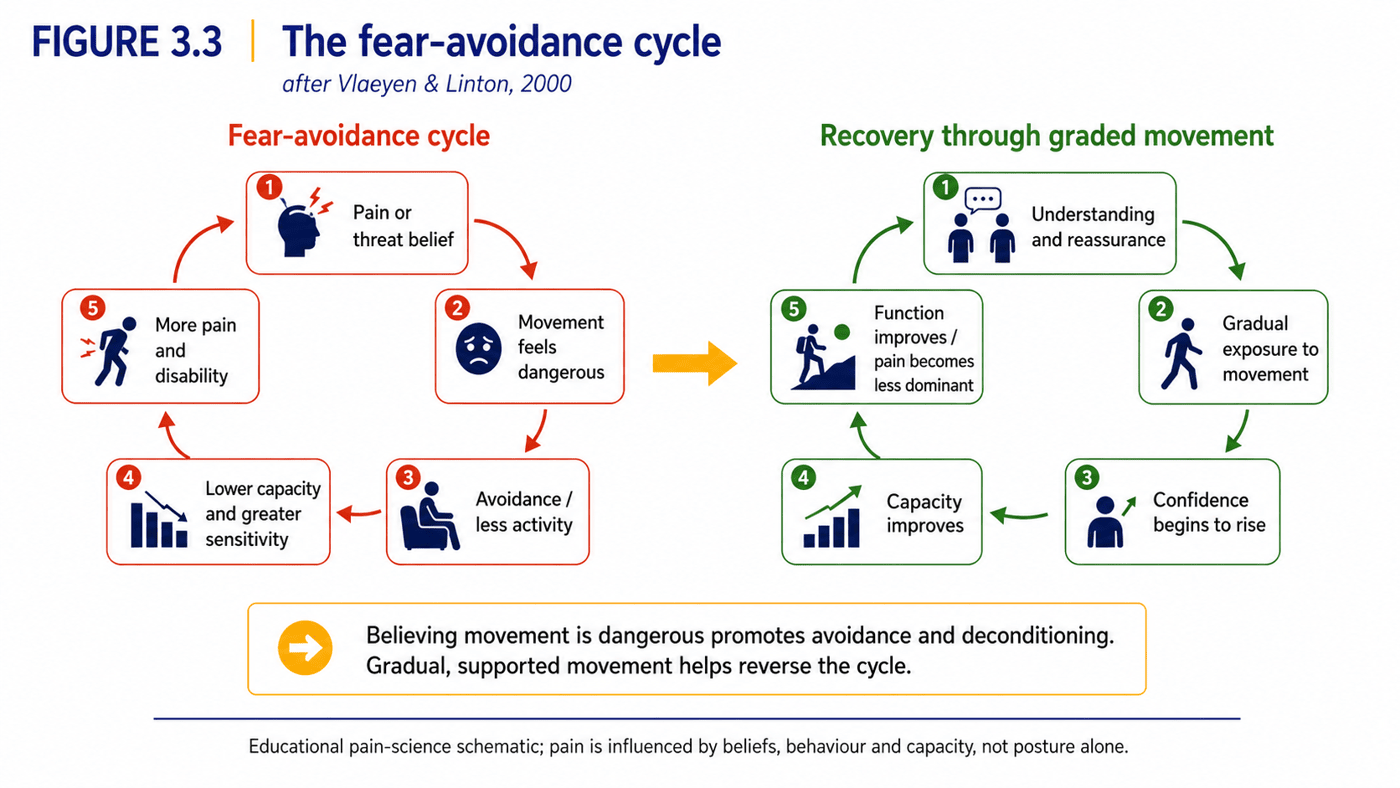
Two ideas from this literature matter especially for the desk worker. First, Vlaeyen and Linton (2000) described how fear and avoidance can turn a short-lived episode into a persistent problem: if movement is believed to be dangerous, it is avoided; avoidance leads to deconditioning and disability; and the resulting decline reinforces the pain — the fear-avoidance cycle shown in Figure 3.3. Second, Moseley and Butler (2015), reviewing fifteen years of pain education, demonstrated that understanding pain differently — learning that hurt does not reliably equal harm — can itself reduce it. Modern, evidence-based approaches to persistent musculoskeletal pain, such as cognitive functional therapy, are built directly on these insights, combining confident movement with a more accurate understanding of pain (O’Sullivan et al., 2018).
Posture warnings push in the wrong direction on both counts. By framing particular positions as hazardous and the body as fragile, they encourage exactly the fear, vigilance and avoidance that the evidence identifies as drivers of persistent pain. An approach that treats the body as robust and movement as safe is not merely kinder; it is better aligned with how pain actually behaves.
A further mechanism explains why pain can persist after the tissues themselves have settled. With prolonged or recurrent pain, the nervous system can become more sensitive — a process broadly termed central sensitisation — so that the pain alarm is triggered more readily and by smaller stimuli than before. The volume on the warning system, in effect, is turned up. This is not imagination and it is not weakness; it is a real, well-documented change in how the system processes signals, and it helps explain why the relationship between what is happening in the tissues and what a person feels is often loose rather than tight. It also reinforces the core message: because pain is produced by the whole person and not read directly off the tissues, an approach that addresses beliefs, fear and activity — not alignment alone — is the one most likely to help. Figure 3.4 places these biological, psychological and social contributors in a single picture.
3.7 Keeping the Balance: What Still Deserves Attention
Rejecting “sit up straight” as a slogan does not mean that how a workstation is arranged is irrelevant. A chair that forces a cramped, sustained position, a screen placed so low that the head must drop for hours, or a desk that holds the arms in a constant forward reach all increase the duration and sameness of loading on specific tissues — and that, as this chapter has argued, is the genuine mechanical problem. Sensible workstation setup, covered in Part V, remains worthwhile. Comfort matters too: a position that feels easy is one a person can vary from readily, whereas a braced, effortful one invites stiffness.
The distinction is therefore between posture as the cause to be corrected and posture as one variable to be managed. The first is the failed model; the second is simply good sense. The aim of ergonomic and postural attention, properly understood, is not to find and hold one perfect alignment but to make frequent, comfortable variation easy — to remove the obstacles to movement rather than to freeze the body into an ideal. Held in that frame, attention to setup supports the movement-and-capacity strategy rather than competing with it.
In practice this means treating workstation setup as a way to widen options rather than to lock in an ideal. A screen near eye level, a chair that supports a range of comfortable positions, and a layout that keeps the arms from a constant forward reach all reduce the worst of the sustained loading and make frequent movement easier — which is the real goal. A sit–stand desk, similarly, earns its place not because standing is intrinsically superior to sitting, but because it adds another position to rotate through; we examine that claim closely in Part V. The unifying idea is that good ergonomics serves movement, rather than substituting for it.
3.8 From Posture Correction to Movement Strategy
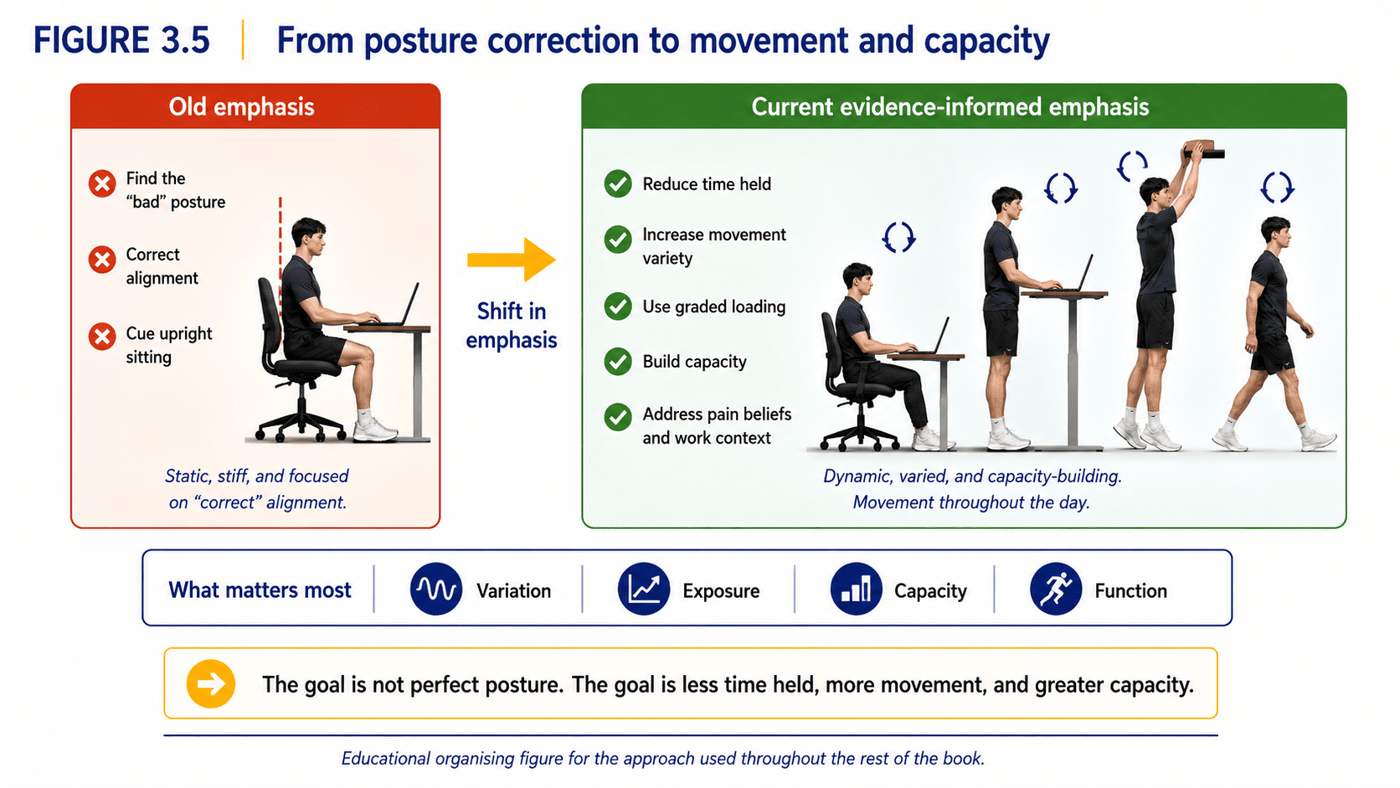
The alternative to “sit up straight” is not to ignore how people sit; it is to stop treating a single posture as the lever and to pull the levers that actually move the outcome. Four principles replace the old instruction, and they organise the practical chapters ahead. Vary the position frequently, so no tissue is loaded the same way for long. Move often through the day, restoring the volume the body expects. Load the vulnerable regions deliberately through range, rebuilding tolerance. And reframe the body as adaptable and robust rather than fragile and in need of constant correction.
Figure 3.5 contrasts the two approaches side by side. The posture-correction model asks for one effortful, static, hard-to-sustain ideal and casts the body as fragile. The movement-and-capacity model asks for variety, frequent movement and progressive loading, and treats the body as a system that grows stronger with appropriate use. Everything that follows in this book is an application of the second column — not a better way to sit still, but a way to need stillness less. The box below shows how to translate the most common pieces of posture advice into that more effective language.
| Old cue | Why it underperforms | Better cue |
|---|---|---|
| “Sit up straight.” | Targets one held posture; effortful, short-lived | “Change position often — your next posture is the best one.” |
| “Don’t slouch.” | Slouching is weakly linked to pain; warning breeds fear | “Move and load your spine in many ways through the day.” |
| “Pull your shoulders back.” | Adds static muscle work; rarely lasts | “Reach, rotate and load overhead regularly to build shoulder capacity.” |
| “Protect your back.” | Frames the body as fragile; invites avoidance | “Your back is robust — build its tolerance with graded movement.” |
Table 3.2. Reframing common posture advice into movement-and-capacity language that the evidence supports.
In summary
- The traditional postural–structural–biomechanical model — pain as a readout of misalignment — is no longer well supported (Lederman, 2011; Christensen & Hartvigsen, 2008; Nourbakhsh & Arab, 2002).
- No single sitting posture has been shown to protect against pain; healthy people vary widely (Slater et al., 2019; Richards et al., 2016).
- The real mechanical driver is sustained, unvaried loading: viscoelastic creep and reflexive muscle changes depend on duration, not on how ‘correct’ the posture is (Callaghan & McGill, 2001; Solomonow, 2004).
- Rigidly holding ‘good’ posture adds static muscle load and can heighten hypervigilance and nocebo effects — sometimes worsening symptoms.
- Capacity is the missing variable: a body with mechanical reserve tolerates many postures comfortably, and targeted strengthening reduces pain (Andersen et al., 2008). Building tolerance beats policing alignment.
- Pain is biopsychosocial; fear-avoidance and beliefs strongly shape it (Hartvigsen et al., 2018; Vlaeyen & Linton, 2000; Moseley & Butler, 2015).
- Sensible workstation setup still helps by easing frequent variation. The strategy is vary, move, load and reframe — not ‘sit up straight’.
References
Andersen, L. L., Kjaer, M., Søgaard, K., Hansen, L., Kryger, A. I., & Sjøgaard, G. (2008). Effect of two contrasting types of physical exercise on chronic neck muscle pain. Arthritis & Rheumatism, 59(1), 84–91.
Callaghan, J. P., & McGill, S. M. (2001). Low back joint loading and kinematics during standing and unsupported sitting. Ergonomics, 44(3), 280–294.
Christensen, S. T., & Hartvigsen, J. (2008). Spinal curves and health: A systematic critical review of the epidemiological literature dealing with associations between sagittal spinal curves and health. Journal of Manipulative and Physiological Therapeutics, 31(9), 690–714.
Hartvigsen, J., Hancock, M. J., Kongsted, A., Louw, Q., Ferreira, M. L., Genevay, S., … Woolf, A. (2018). What low back pain is and why we need to pay attention. The Lancet, 391(10137), 2356–2367.
Lederman, E. (2011). The fall of the postural–structural–biomechanical model in manual and physical therapies: Exemplified by lower back pain. Journal of Bodywork and Movement Therapies, 15(2), 131–138.
Maher, C., Underwood, M., & Buchbinder, R. (2017). Non-specific low back pain. The Lancet, 389(10070), 736–747.
Moseley, G. L., & Butler, D. S. (2015). Fifteen years of explaining pain: The past, present, and future. The Journal of Pain, 16(9), 807–813.
Nourbakhsh, M. R., & Arab, A. M. (2002). Relationship between mechanical factors and incidence of low back pain. Journal of Orthopaedic & Sports Physical Therapy, 32(9), 447–460.
O’Sullivan, P. B., Caneiro, J. P., O’Keeffe, M., Smith, A., Dankaerts, W., Fersum, K., & O’Sullivan, K. (2018). Cognitive functional therapy: An integrated behavioral approach for the targeted management of disabling low back pain. Physical Therapy, 98(5), 408–423.
Richards, K. V., Beales, D. J., Smith, A. J., O’Sullivan, P. B., & Straker, L. M. (2016). Neck posture clusters and their association with biopsychosocial factors and neck pain in Australian adolescents. Physical Therapy, 96(10), 1576–1587.
Slater, D., Korakakis, V., O’Sullivan, P., Nolan, D., & O’Sullivan, K. (2019). “Sit up straight”: Time to re-evaluate. Journal of Orthopaedic & Sports Physical Therapy, 49(8), 562–564.
Solomonow, M. (2004). Ligaments: A source of work-related musculoskeletal disorders. Journal of Electromyography and Kinesiology, 14(1), 49–60.
Steffens, D., Maher, C. G., Pereira, L. S. M., Stevens, M. L., Oliveira, V. C., Chapple, M., Teixeira-Salmela, L. F., & Hancock, M. J. (2016). Prevention of low back pain: A systematic review and meta-analysis. JAMA Internal Medicine, 176(2), 199–208.
Vlaeyen, J. W. S., & Linton, S. J. (2000). Fear-avoidance and its consequences in chronic musculoskeletal pain: A state of the art. Pain, 85(3), 317–332.