Part I · THE DESK BODY PROBLEM
What Is the Desk Body?
The desk body is not a character flaw, an age, or a slumped silhouette. It is a specific and largely predictable adaptation profile — a set of changes in tissue length, stiffness, motor control and capacity that follow logically from spending most of the day in a small number of seated positions. Naming it precisely is the first step toward changing it.
2.1 A Working Definition
Throughout this book the desk body is defined as a movement system that has adapted to being under-varied, under-loaded and over-repeated. Each word is doing specific work. Under-varied: the body cycles through only a handful of positions rather than the wide range it is built to use. Under-loaded: the forces involved are low, so tissues are never given a strong reason to maintain their capacity. Over-repeated: those few low-load positions are held again and again, for hours, day after day, year after year.
This definition is deliberately mechanical, and it deliberately avoids the language of blame. The desk body is not lazy and it is not broken. It is a system behaving exactly as the load-response window from Chapter 1 predicts: faced with a narrow, repetitive, low-intensity demand, it has narrowed its capacity to match. Defining the problem this way has an immediate practical pay-off. If the desk body were simply ‘bad posture’, the remedy would be to correct the posture. Because it is in fact a reduced-capacity, reduced-variety adaptation, the remedy is to restore capacity and variety — a different and more durable kind of intervention.
It is also worth stating what the desk body is not. It is not a diagnosis, and nothing in this chapter should be read as one. It is a descriptive profile: a way of anticipating how a body that sits for a living is likely to have adapted, so that movement professionals and the people they work with can reason about it clearly. Individuals vary, and many people who sit for long hours have no pain at all. The value of the profile is that it directs attention to the right variables — capacity and variety — rather than to the wrong one.
Defining the desk body this precisely is not pedantry; it is what distinguishes a rigorous account from a popular one. A vague notion of ‘bad posture from too much screen time’ leads naturally to vague remedies — sit straighter, stretch a little, buy a cushion. A mechanical definition in terms of variety, load and repetition leads to specific, testable interventions: increase the variety, raise the load, interrupt the repetition. The remainder of this chapter therefore takes the definition apart piece by piece — the cascade that produces the desk body, the regional pattern it follows, the role of motor control, and the central matter of capacity — so that each component points to something that can actually be done about it.
2.2 The Adaptive Cascade
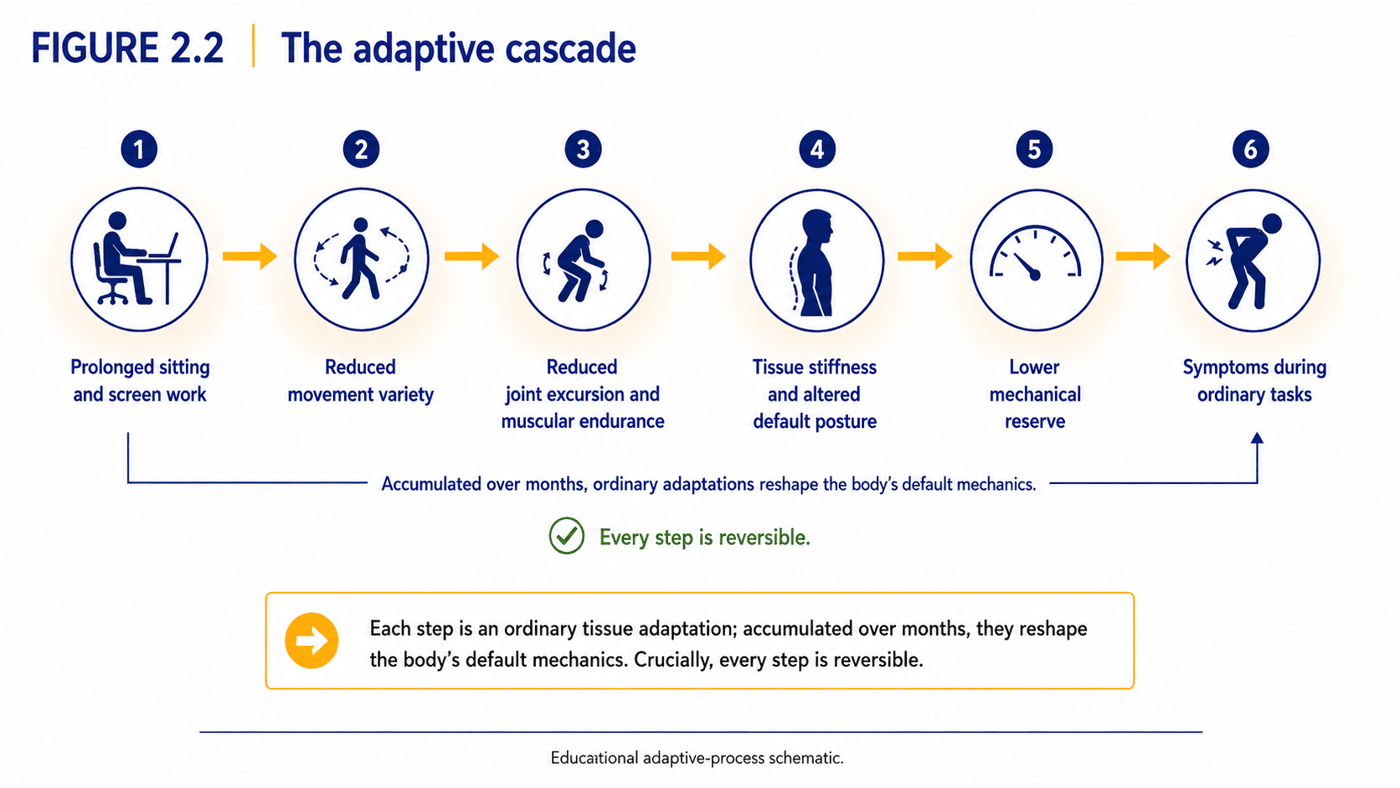
How does a few hours of sitting become a lasting change in how a body moves? Through ordinary tissue adaptation, accumulated. Living tissue is not inert scaffolding; it is continuously remodelled according to use, and the positions a body habitually occupies become the positions its tissues optimise for. The process is gradual and individually unremarkable, which is exactly why it is so easy to miss until its cumulative effect is obvious.
Adaptive shortening and lengthening
When a muscle is habitually held in a shortened position — the hip flexors in sitting are the classic example — it tends over time to adapt to that shorter working length by reducing the number of sarcomeres arranged in series, a change demonstrated directly in immobilisation studies (Williams & Goldspink, 1978). Its antagonist, held long, adapts in the opposite direction. The muscle is not necessarily weaker in absolute terms; it is re-tuned to produce its force in a narrower, shifted range. The everyday consequence is the familiar sense that certain positions — full hip extension when standing tall, for instance — feel tight or unavailable, because the tissue has quietly reset its comfortable range.
Stiffness and the connective-tissue contribution
Muscle is only part of the story. The connective tissues around habitually still joints — joint capsule, ligament, fascia — also remodel, tending to become less compliant where movement is rarely demanded. Because these tissues are viscoelastic, prolonged static positioning alters their behaviour over both the short term (within a sitting bout) and the long term (across months of habit). The combined effect of shortened muscle and stiffer connective tissue is a joint that moves comfortably through a smaller arc than it once did, and resists movement toward the ranges it has stopped visiting.
The movement-system view
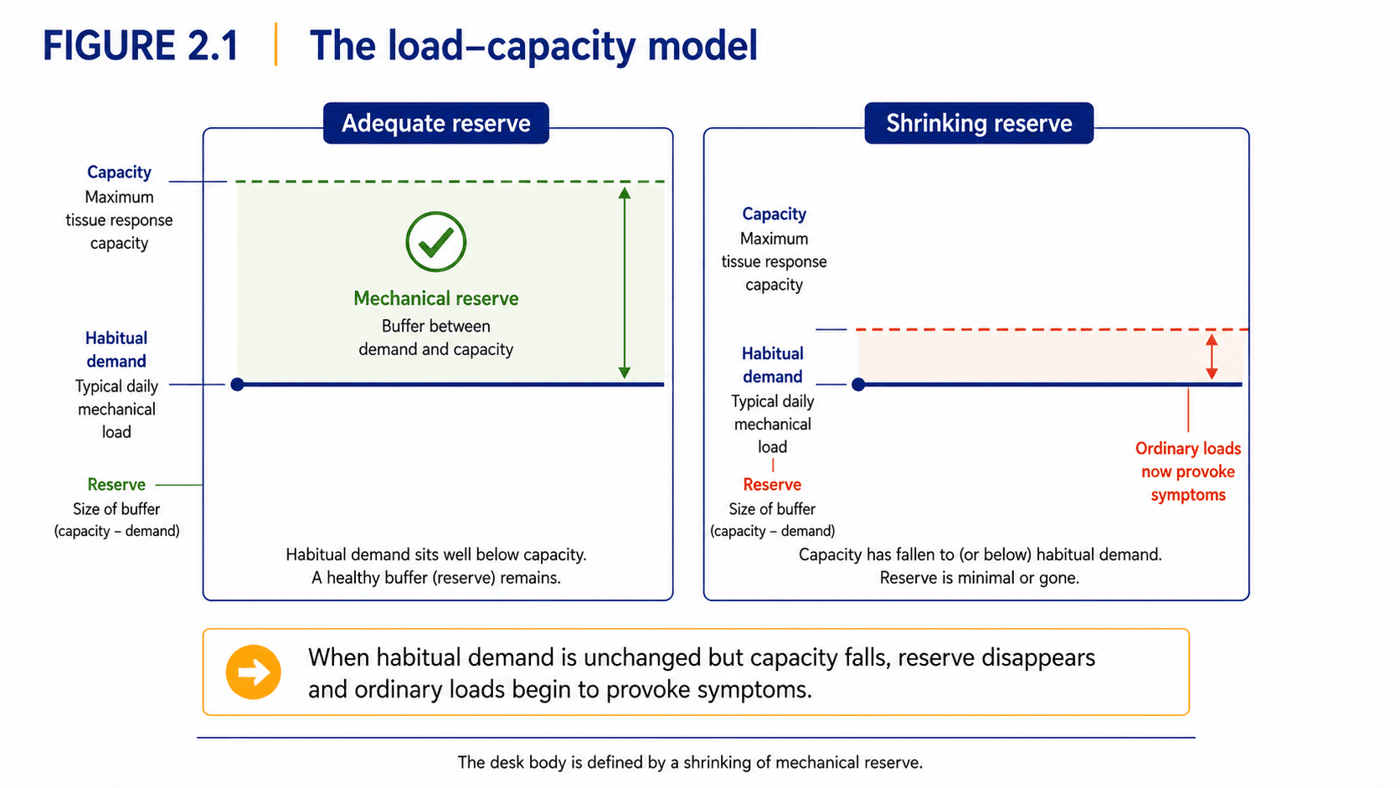
Sahrmann (2002) framed all of this elegantly: the body develops a movement system impairment, a tendency to move and rest in particular ways because those are the paths of least resistance the tissues have learned. In her account the body acquires a directional susceptibility — a set of preferred positions and a set of movements it now resists. The chair, on this view, does not so much injure the body as train it; and, as with any training, the effect is specific to what was practised. Figure 2.1 places the consequence of that training in the load–capacity terms that organise this book, and Figure 2.2 maps the cascade from sitting to a reshaped default.
It is worth naming the soft-tissue counterpart of Wolff’s law, sometimes called Davis’s law: soft tissues — muscle, tendon, ligament, fascia — remodel along the lines of stress habitually imposed on them. Held short, they consolidate short; loaded through range, they organise to tolerate that range. This is the same principle as the bone mechanostat, applied to the tissues that most concern the desk body, and it cuts both ways. The very responsiveness that lets a chair reshape these tissues is what lets deliberate movement reshape them back. The timeframes in Table 2.1 are therefore not a countdown to permanence; they describe how quickly the tissues will move in whichever direction they are loaded.
| Adaptation | Mechanism | Typical timeframe |
|---|---|---|
| Muscle shortening | Loss of sarcomeres in series; shifted length–tension | Weeks to months of habit |
| Muscle lengthening / weakening | Reduced use of antagonists held long | Weeks to months |
| Connective-tissue stiffening | Remodelling of capsule, ligament, fascia | Months |
| Motor-control change | De-practising of unused movement patterns | Days to weeks to alter; longer to consolidate |
| Capacity loss | Down-regulation under chronic low load | Progressive over months |
Table 2.1. The principal adaptations that constitute the desk body, with their mechanisms and approximate timeframes. All are bidirectional.
2.3 The Regional Signature: Upper Quarter
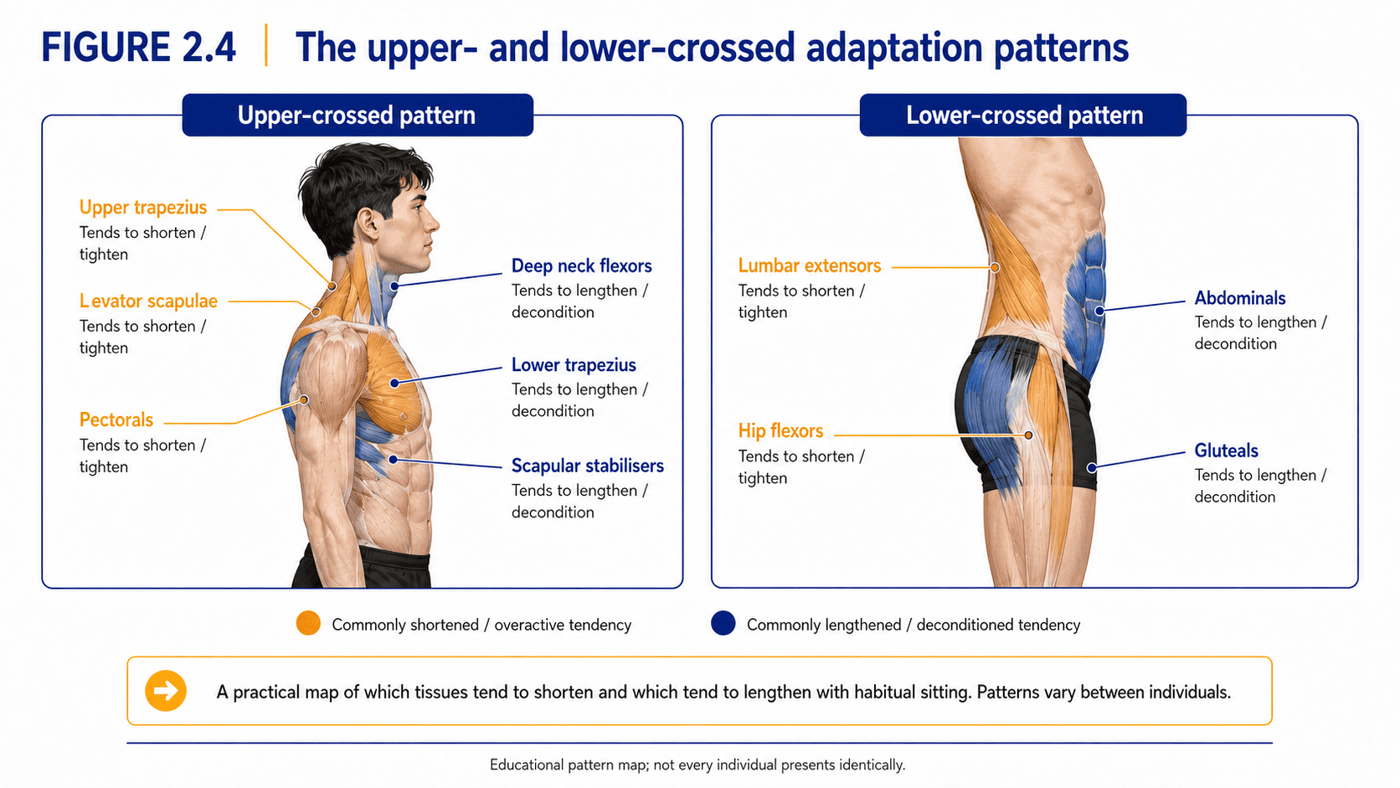
Because most chairs and screens position the body in similar ways, the desk body tends to show a recognisable regional pattern. Vladimir Janda described two complementary versions of it, made accessible to clinicians by Page, Frank and Lardner (2010) as the upper-crossed and lower-crossed patterns. In the upper quarter, the muscles of the chest and the back of the neck tend to tighten while the deep neck flexors and the muscles that stabilise the shoulder blade tend to lengthen and under-perform — the mechanical recipe for a forward head and rounded shoulders.
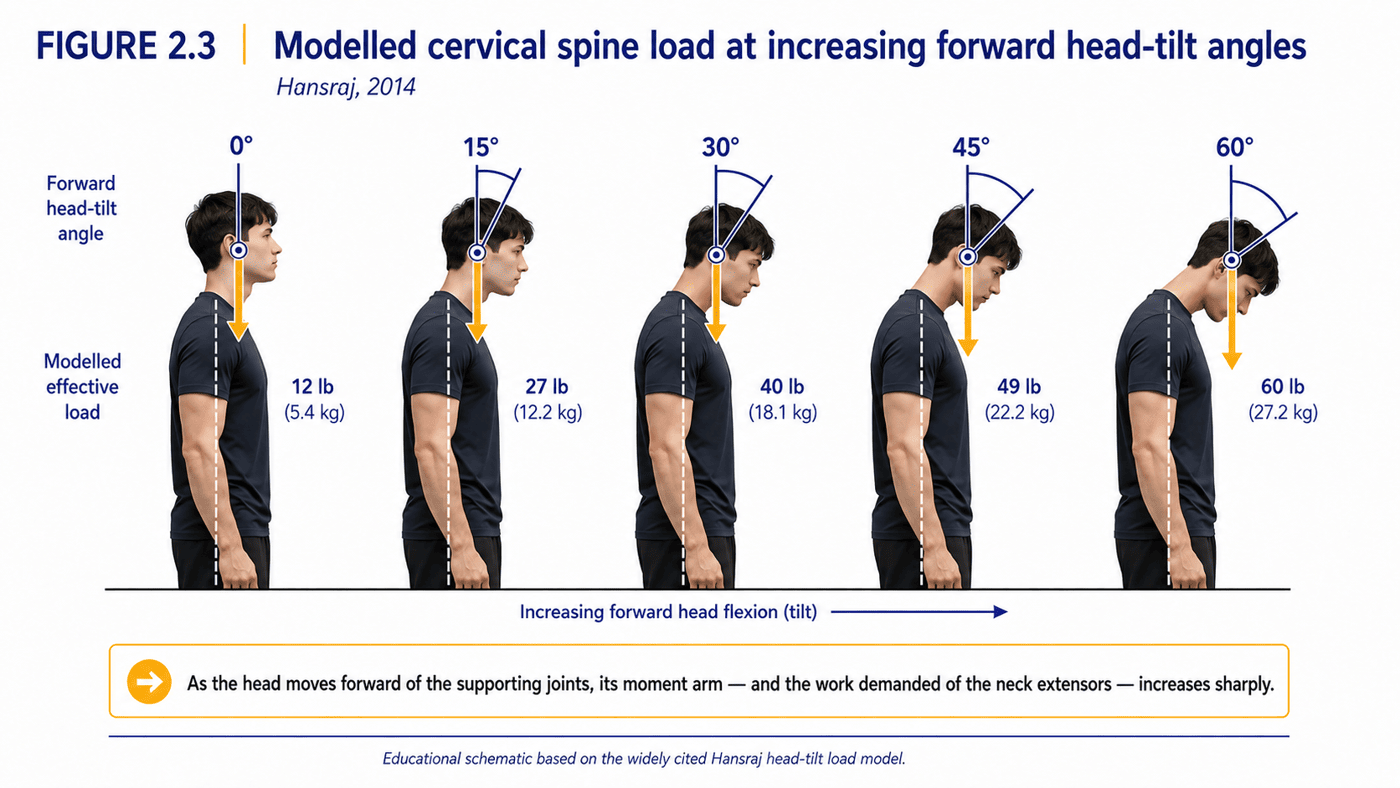
The forward head deserves particular attention because it illustrates the mechanics so clearly. The head is a substantial mass balanced on top of the cervical spine. When it sits over the shoulders, the load is carried efficiently down through the vertebral column with little muscular effort. As the head drifts forward — as it does toward a screen — its centre of mass moves in front of the supporting joints, lengthening the moment arm and forcing the muscles at the back of the neck to work much harder to stop the head dropping (Neumann, 2017). Hansraj (2014), using a computational model, estimated that the effective load on the cervical spine rises from roughly the true head-weight of about five kilograms in neutral to figures several times greater at common forward-tilt angles. The precise numbers from any single model should be read as illustrative rather than exact, but the direction and steepness of the relationship — shown in Figure 2.3 — are the durable lesson: small increases in forward tilt produce disproportionately large increases in the demand on the neck.
The shoulder follows the same logic. Habitual reaching forward to a keyboard and mouse, combined with a rounded upper back, allows the chest muscles to adopt a shortened resting length while the muscles that retract and stabilise the shoulder blade — the lower and middle trapezius, the serratus anterior, the rhomboids — spend their days lengthened and lightly used. The result is a shoulder girdle that sits forward and rotates inward, with a reduced ability to position the shoulder blade for efficient overhead movement. None of this is damage; it is the upper quarter optimising, faithfully, for the posture it is asked to hold.
The upper-quarter pattern reaches further than the neck and shoulders. A forward head and a rounded, flexed upper back also draw the rib cage downward and forward, which subtly restricts how freely the ribs can expand. Because efficient breathing depends on the rib cage and diaphragm moving through their full range, a chronically depressed, flexed thorax can nudge a person toward shallower, more upper-chest breathing over time. This is one reason the rib cage earns a chapter of its own later in this volume: it sits at the mechanical crossroads between posture, the shoulder girdle and respiration, and it is routinely overlooked in discussions of the desk body. For now the point is simply that the regional adaptations do not stay neatly in their regions — they interact.
2.4 The Regional Signature: Lower Quarter
Below the waist the mirror-image pattern develops. In sitting, the hip is held in flexion for hours, allowing the hip flexors — chiefly the iliopsoas and rectus femoris — to adopt a shortened working length. Simultaneously the large hip extensors, the gluteal muscles, are switched into a supporting role they barely perform: a seated person is, in effect, resting on their gluteals rather than contracting them. Over time the gluteals can become not weak so much as under-recruited — slow to switch on, and easily deferred to by other muscles during the movements they should lead.
This pairing of tight, shortened hip flexors with under-used gluteals is the heart of the lower-crossed pattern, and it has consequences that ripple up and down the chain. When the gluteals do not contribute fully to hip extension, the hamstrings and the low-back extensors are recruited to take up the slack, which can leave the posterior thigh feeling chronically tight and the lumbar extensors working harder than they should during everyday tasks such as standing from a chair or lifting. The everyday experience is of hips that feel stiff after rising, a posterior chain that never quite loosens, and a sense that the strong muscles that should drive movement from the hips have gone quiet. Table 2.2 summarises both regional signatures in a form that can be referred back to throughout the regional chapters.
| Region | Tend to shorten / tighten | Tend to lengthen / weaken | Everyday consequence |
|---|---|---|---|
| Neck | Suboccipitals, levator scapulae, upper trapezius | Deep neck flexors | Forward-head loading; neck ache |
| Shoulder | Pectoralis major / minor | Lower & middle trapezius, serratus anterior, rhomboids | Rounded shoulders; reduced overhead reach |
| Trunk | Thoracolumbar erectors | Deep abdominals (transversus) | Poor load-sharing across the spine |
| Hip | Iliopsoas, rectus femoris, TFL | Gluteus maximus & medius | Hip stiffness; under-used posterior chain |
Table 2.2. Typical desk-body adaptation signature by region, after the Janda crossed-pattern model (Page, Frank & Lardner, 2010). A map to anticipate findings, not a fixed rule.
2.5 Motor Control and “Use It or Lose It”
Adaptation is not only a matter of tissue length and stiffness. The nervous system also specialises in what it repeatedly practises. Movements rehearsed thousands of times become smooth, automatic and preferred; movements rarely performed become unfamiliar and effortful. A body that spends years rarely reaching overhead, rarely rotating fully through the spine and rarely loading the hips through deep range does not merely become tight in those directions — it becomes unpractised in them. The option remains physically available, but it is no longer a pattern the system reaches for by default.
There is a representational dimension to this as well. The brain maintains maps of the body that are themselves shaped by use, and these maps can become less precise for regions that are rarely moved with intent — a blurring that researchers studying chronic pain have described as cortical ‘smudging’ (Moseley & Flor, 2012). In the neck specifically, altered activity and control of the deep flexor muscles is a well-documented feature associated with neck pain (Falla & Farina, 2008). The practical reading of this literature is encouraging rather than alarming: because the nervous system is plastic, the precision and the patterns can be rebuilt with deliberate, attentive practice in the directions that were lost.
Position sense is part of what fades. The same receptors and neural maps that tell the brain where a joint is in space are calibrated by movement, and joints that are rarely taken through their full range tend to report their position less precisely. The practical effect is subtle but real: a desk body can feel slightly less sure of itself in unfamiliar positions, not because anything is injured but because the proprioceptive picture has grown a little coarse from disuse. Like the other adaptations in this chapter, it sharpens again with deliberate movement through the neglected ranges.
This is why the desk body so often reports feeling “stiff” in the morning or “clumsy” in unfamiliar positions despite having no injury. The sensation reflects a movement vocabulary that has quietly shrunk to fit the demands of the chair. Restoring it is less like repairing damage and more like relearning a language — the capacity returns with repeated, deliberate practice, and it returns faster than most people expect.
How fast is fast? Tissue length and connective-tissue compliance shift over weeks; the re-learning of a movement pattern can begin within a single session and consolidate over days to weeks of repetition. This is why a person who reintroduces neglected ranges often notices, within the first week or two, that positions which felt foreign start to feel available again. The early gains are largely neural — the nervous system re-finding patterns it had stopped using — followed by the slower structural adaptation of the tissues themselves. Both run in the helpful direction the moment the loading changes.
2.6 Capacity, Not Posture: The Central Reframe
Pulling these threads together gives the reframe at the heart of this book. The desk body is best understood not as a body in the wrong shape, but as a body with a reduced mechanical reserve — a smaller gap between what an ordinary day demands and what the tissues can comfortably supply. Figure 2.1 captures this directly: when capacity falls toward the level of habitual demand, the margin that used to absorb life’s small mechanical surprises disappears, and tasks that were once unremarkable begin to provoke symptoms.
Seen this way, two people sitting in identical chairs with identical posture can have entirely different experiences, because they bring different capacities to the same demand. One has reserve to spare; the other is already operating near the limit of what the tissues will tolerate. This is also why the destination of this book is capacity, not posture perfection. A body with ample reserve tolerates a great variety of positions — including imperfect ones — for long periods without complaint. That tolerance, not a particular silhouette, is what we are trying to rebuild, and it is what reliably distinguishes a comfortable desk worker from an uncomfortable one (Mueller & Maluf, 2002).
A brief illustration makes the reframe concrete. Imagine two analysts who sit in identical chairs, in near-identical postures, for the same eight hours. One spends her evenings walking, gardening and lifting weights; the other does very little beyond the desk. Their posture is the same, yet their experience of the workday differs entirely, because the first brings a large mechanical reserve to the same demand while the second is already operating near her limit. No amount of posture correction would close that gap, and no postural fault explains it. The difference is capacity — precisely the variable that posture advice cannot see, and the one this book sets out to build.
An analogy helps the concept land. Mechanical reserve behaves like a savings buffer. Two households with the same monthly income can meet an identical surprise expense very differently: the one with savings absorbs it without distress, while the one living at the edge is thrown into crisis. Capacity is the body’s savings against the unexpected mechanical demands of a life — the awkward lift, the long flight, the weekend of activity after a still week. The desk body has quietly drawn that account down, so demands it would once have absorbed now register as strain. The work of the later chapters is, in effect, to rebuild the savings.
One feature of capacity is worth stating plainly because it shapes everything that follows: capacity is specific. A body builds tolerance in the tissues and ranges it actually loads, and little elsewhere. Loading the neck builds neck tolerance; taking the hips through deep range builds hip range; strengthening the muscles that stabilise the shoulder blade builds shoulder capacity. This is why a general exhortation to ‘be more active’, though helpful, is not the whole answer for the desk body, and why the regional chapters target the specific tissues and ranges that sitting most reliably under-uses.
2.7 The Desk Body Is Not Uniform
Having described a recognisable profile, it is important to resist over-applying it. The crossed patterns and the regional signatures are tendencies, not laws, and real bodies depart from the textbook in every direction. Age, training history, previous injury, body proportions, the specific demands of a given job and a large measure of individual variability all shape how a particular person adapts to sitting. Some desk workers show the full picture; many show only fragments of it; a few show almost none. Population studies of office workers confirm that neck and back complaints arise from a web of physical and work-related factors rather than from a single posture (Cagnie, Danneels, Van Tiggelen, De Loose & Cambier, 2007).
The right way to use the desk-body profile, then, is as a set of hypotheses to be checked against the individual in front of you, not as a template to be stamped onto them. Its purpose is to direct attention efficiently — to suggest where shortened tissue, under-used muscle and lost movement variety are likely to be found — while leaving the final reading to observation. A profile that anticipates the common case without dictating it is exactly what a movement professional needs.
Several factors modify how strongly the desk body develops in a given person. Age shifts the baseline — tissues adapt and recover at different rates across the lifespan — though, as the next section shows, capacity remains trainable at every age. A history of sport or physical work tends to confer reserve that buffers the effects of sitting, while previous injury can leave a region more susceptible. Body proportions matter too: a taller person at a poorly arranged desk may be driven into more extreme sustained angles than a shorter colleague at the same station. And the specific job plays its part — a role that combines sitting with frequent walking loads the body very differently from one that does not. These modifiers are the reason the profile must always be read against the individual rather than assumed.
2.8 Why the Desk Body Is Reversible
Every mechanism described in this chapter runs in both directions. Muscle that shortened can lengthen; connective tissue that stiffened can become more compliant under graded loading; movements that fell out of use can be re-practised; capacity that eroded under a narrow demand can be rebuilt under a broader one. The desk body is not a sentence. It is a snapshot of a system that has adapted to its recent history and stands ready to adapt again the moment that history changes.
That is the optimistic engine beneath the rest of this book, and it is the reason the practical chapters ask for movement and loading rather than vigilance and restriction. The body is exceptionally good at exactly the thing required of it: given a richer, more varied, more frequently loaded set of demands, it grows back into the capacity it never truly lost the ability to hold. The box below shows how the chapter’s concepts translate into a structured, non-diagnostic way of ‘reading’ a desk body in practice.
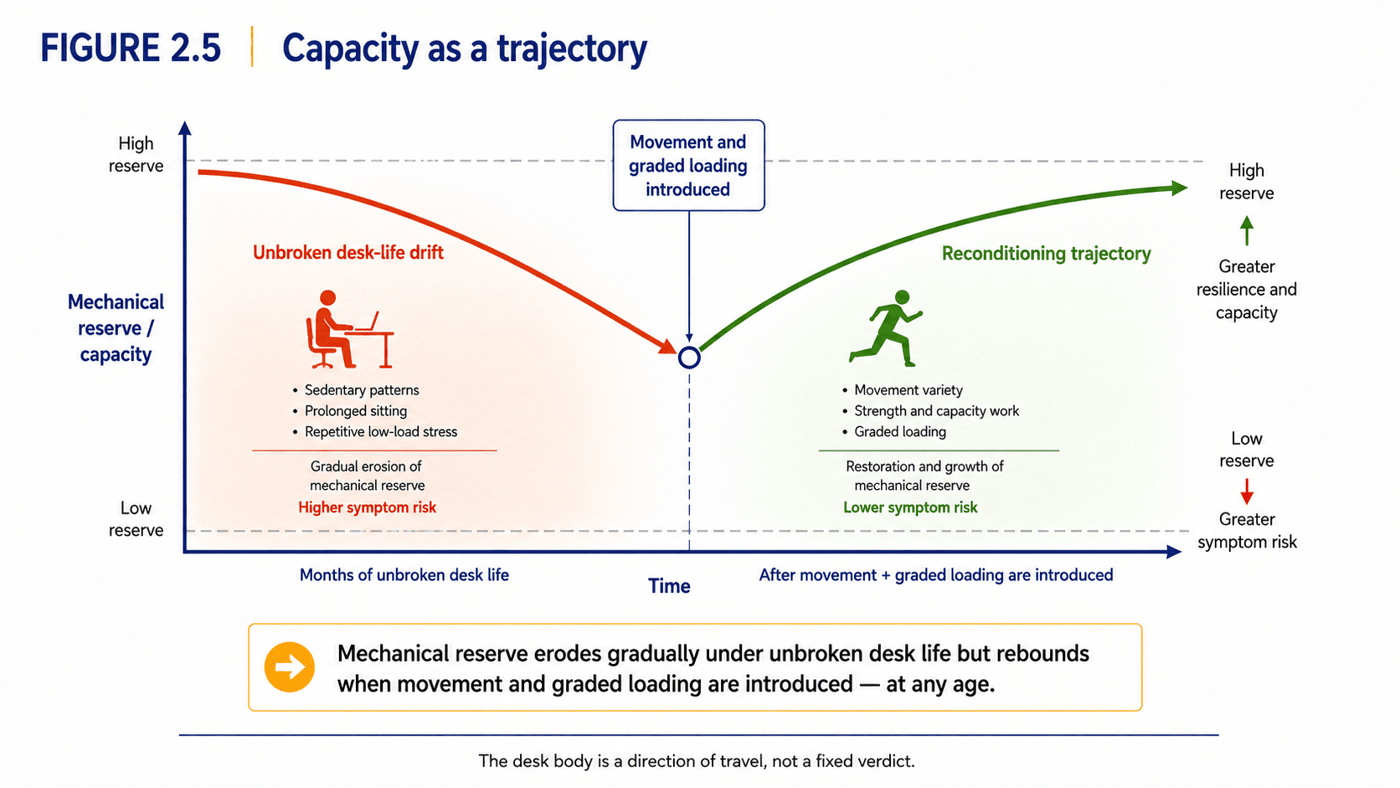
Figure 2.5 is the most important picture in this chapter, because it reframes the whole problem in terms of time and direction. Capacity is not a fixed quantity a person either has or lacks; it is a trajectory that responds to what the body is asked to do. Years of unbroken desk life bend that trajectory slowly downward, which is why decline can feel like an inevitable consequence of ageing or of office work. It is neither. The moment the inputs change — more movement, more variety, deliberate loading — the trajectory bends back upward, and it does so whether a person is twenty-five or sixty-five. Capacity responds to the present, not the past; the desk body is always a body in motion toward something, and the direction is ours to set.
In summary
- The desk body is defined mechanically as an under-varied, under-loaded and over-repeated movement system — a reduced-reserve adaptation, not a moral failing or a fixed posture.
- Sustained positions drive ordinary, bidirectional tissue adaptation: habitually shortened muscles shorten, lengthened muscles weaken, still joints stiffen — a movement system impairment (Sahrmann, 2002; Williams & Goldspink, 1978).
- The upper quarter tends toward a forward head and rounded shoulders; modelled cervical load rises steeply with forward tilt (Hansraj, 2014). The lower quarter tends toward tight hip flexors and under-recruited gluteals.
- Motor control de-practises rarely used movements and can blur the body’s cortical maps; the desk body’s movement vocabulary shrinks to fit the chair, which feels like stiffness without injury (Moseley & Flor, 2012; Falla & Farina, 2008).
- The central reframe: the desk body is a reduced-reserve body, defined by a narrow margin between demand and capacity rather than by its silhouette.
- The profile is a set of hypotheses, not a template — individuals vary widely (Cagnie et al., 2007). Every adaptation is reversible with added load, variety and movement practice.
References
Cagnie, B., Danneels, L., Van Tiggelen, D., De Loose, V., & Cambier, D. (2007). Individual and work related risk factors for neck pain among office workers: A cross-sectional study. European Spine Journal, 16(5), 679–686.
Falla, D., & Farina, D. (2008). Neuromuscular adaptation in experimental and clinical neck pain. Journal of Electromyography and Kinesiology, 18(2), 255–261.
Hansraj, K. K. (2014). Assessment of stresses in the cervical spine caused by posture and position of the head. Surgical Technology International, 25, 277–279.
Moseley, G. L., & Flor, H. (2012). Targeting cortical representations in the treatment of chronic pain: A review. Neurorehabilitation and Neural Repair, 26(6), 646–652.
Mueller, M. J., & Maluf, K. S. (2002). Tissue adaptation to physical stress: A proposed “physical stress theory” to guide physical therapist practice, education, and research. Physical Therapy, 82(4), 383–403.
Neumann, D. A. (2017). Kinesiology of the musculoskeletal system: Foundations for rehabilitation (3rd ed.). Elsevier.
Page, P., Frank, C. C., & Lardner, R. (2010). Assessment and treatment of muscle imbalance: The Janda approach. Human Kinetics.
Sahrmann, S. A. (2002). Diagnosis and treatment of movement impairment syndromes. Mosby.
Williams, P. E., & Goldspink, G. (1978). Changes in sarcomere length and physiological properties in immobilized muscle. Journal of Anatomy, 127(Pt 3), 459–468.