Part I · THE DESK BODY PROBLEM
The Body Was Not Designed for Stillness
The human musculoskeletal system is not a structure that merely tolerates movement; it is a structure that requires it. To understand desk-related pain we have to begin with the kind of machine the body is — and recognise that prolonged stillness, not physical effort, is the genuinely unusual demand that modern work places upon it.
1.1 The Movement Inheritance
For almost the entire span of human existence, staying alive required moving. Foraging, walking long distances, carrying loads, climbing, digging, squatting to rest and rising again were not a fitness programme; they were the ordinary texture of a day (Tudor-Locke et al., 2011). Estimates of habitual activity in contemporary hunter-gatherer and subsistence populations consistently describe several hours of light-to-moderate physical activity daily, punctuated by frequent postural change and very little uninterrupted sitting. The body that evolved under those conditions is the body we still carry into the office.
That inheritance is visible in our anatomy. Bramble and Lieberman (2004) catalogued a suite of features — long compliant tendons that store and return elastic energy, a spring-like longitudinal arch in the foot, enlarged gluteal muscles for trunk stabilisation, decoupling of the head and shoulder girdle, and an exceptional capacity to shed heat — that together point to a long evolutionary history of sustained, varied, weight-bearing locomotion. We are, quite literally, assembled out of the movements our ancestors could not avoid. Tissues were selected to perform well under regular loading, and that loading was assumed.
This matters because biology is economical: it tends to keep only what is used. Lieberman (2013) describes many modern complaints as mismatch conditions — problems that arise when a body shaped by one environment is placed in a very different one. The desk is among the most extreme environmental novelties our species has met. In the space of a few generations, a system tuned for frequent movement has been asked to spend most of its waking hours almost perfectly still. The genome has not changed; only the environment has. The body cannot redesign itself within a lifetime, but it can and does adapt — and it adapts to precisely what we repeatedly ask of it.
The argument of this chapter is therefore not nostalgic. We are not trying to live like foragers. We are establishing a mechanical baseline: the human body is a movement-dependent system, and the central novelty of desk life is not that it is strenuous but that it is still. Everything that follows — the definition of the desk body, the failure of posture advice, the regional pain patterns, the reset system — rests on this single premise.
1.2 What “Designed for Movement” Means Mechanically
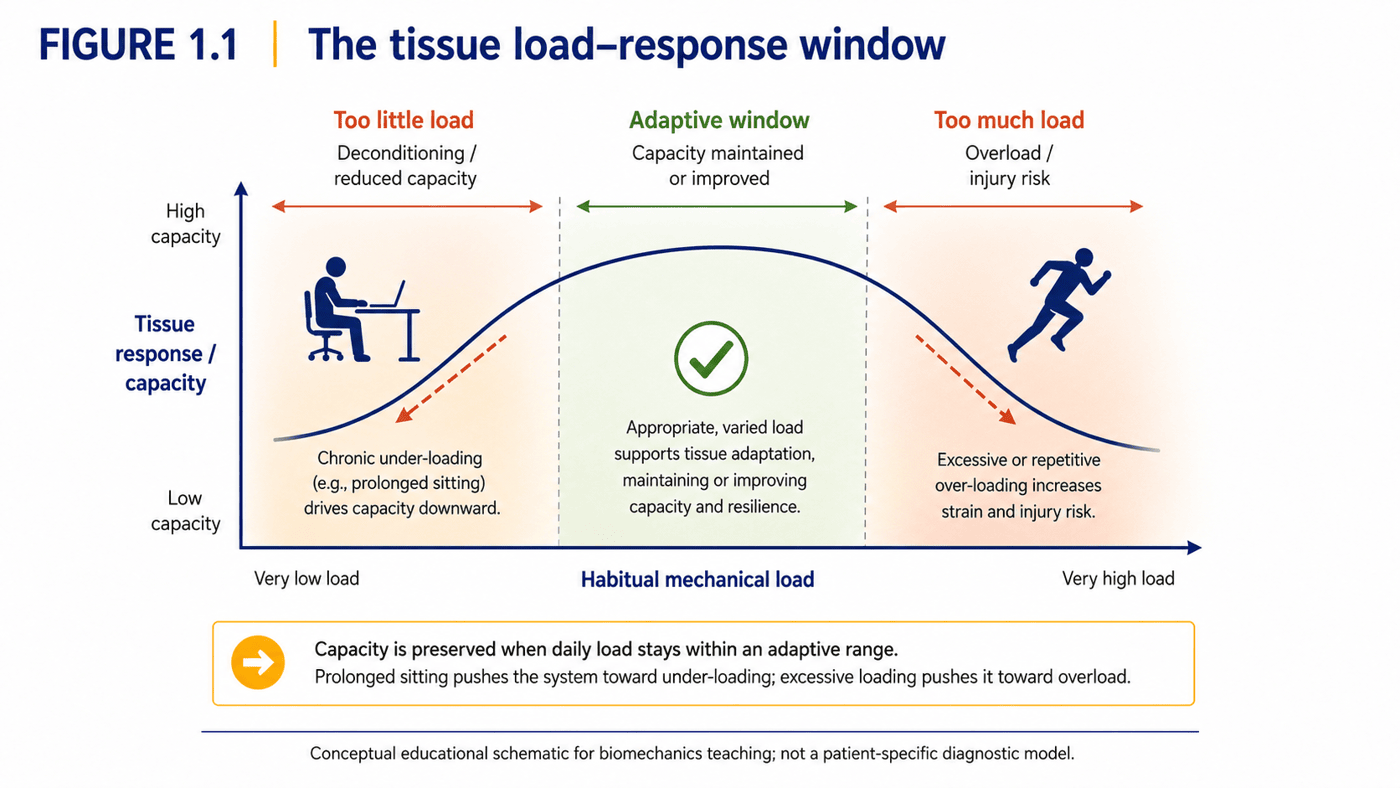
It is easy to treat “the body needs movement” as a wellness slogan. Mechanically, it is a precise statement about how living tissue is maintained. Mueller and Maluf (2002) formalised this as the Physical Stress Theory: every biological tissue has a preferred range of mechanical stress. Their framework describes five possible tissue responses to the level of stress it receives. Stress well below the habitual level produces decreased tolerance — the tissue atrophies and weakens. Stress within the normal range produces maintenance. Stress somewhat above the habitual level, applied progressively, produces increased tolerance — the tissue adapts and strengthens. Stress far above tolerance produces injury, and extreme stress produces tissue death. Health is not the absence of load; it is load delivered within the right range, often enough to register.
The crucial and counter-intuitive implication is that the first response — decreased tolerance from too little stress — is just as real as injury from too much. A tissue that is chronically under-loaded does not simply stay the same; it actively remodels downward. This is the response that dominates the desk body. The office worker is rarely overloaded. Far more often the tissues are sitting on the far left of the curve, losing capacity not because anything dramatic is happening but because almost nothing is.
How different tissues express the same rule
Each tissue obeys this logic in its own idiom. Bone deposits and resorbs according to the strains it habitually experiences; weight-bearing and muscular pull maintain density, while unloading erodes it (Frost, 2003). Muscle held habitually short adapts by removing sarcomeres in series, resetting its length–tension relationship so that it generates force best in the shortened range it now occupies (Williams & Goldspink, 1978); muscle held long adapts in the opposite direction. Tendon remodels its collagen in response to the tension it routinely carries, becoming stiffer and stronger under appropriate loading and more compliant and vulnerable without it. Articular cartilage has no blood supply; it depends on cyclic loading and unloading to drive fluid, nutrients and waste across its matrix, so a joint that never moves through range is a joint that is poorly fed. The intervertebral disc behaves similarly, exchanging fluid with its surroundings as load varies across the day (Adams & Hutton, 1983). In every case the same principle holds: movement is not wear and tear to be minimised; it is the maintenance signal the tissue is waiting for.
| Tissue | Response to appropriate cyclic loading | Response to chronic unloading / stillness |
|---|---|---|
| Bone | Maintains or increases density (mechanostat) | Resorption; loss of density and strength |
| Muscle | Maintains length, strength and sarcomere number | Adaptive shortening or weakening; altered length–tension |
| Tendon | Increased stiffness and load tolerance | Reduced stiffness; lower tolerance to sudden load |
| Cartilage | Fluid exchange drives nutrition; matrix maintained | Impaired nutrition; matrix thinning over time |
| Disc | Diurnal fluid exchange; height and hydration maintained | Sustained compression; reduced fluid exchange |
Table 1.1. Principal musculoskeletal tissues respond in opposite directions to appropriate loading and to chronic stillness. The desk body is dominated by the right-hand column.
1.3 The Physiology of Stillness
The cost of sitting is not only mechanical, and the metabolic story reinforces the mechanical one. Hamilton, Hamilton and Zderic (2007) demonstrated that prolonged sitting markedly suppresses the activity of lipoprotein lipase, an enzyme central to fat metabolism, in a way that a separate bout of exercise does not fully reverse. The physiology of inactivity, in other words, is not simply the absence of the physiology of exercise; it is its own distinct biological state. A person can complete a workout and still spend the remaining fifteen waking hours in a metabolically suppressed condition if those hours are spent sitting.
Levine (2002) drew attention to a complementary idea: non-exercise activity thermogenesis, or NEAT — the energy spent on the standing, pacing, fidgeting and general restlessness of an active day. Desk work strips most of this away. The difference between a person who moves often throughout the day and one who does not is large, and most of it is invisible, accumulated in hundreds of small movements rather than in formal exercise. Owen, Healy, Matthews and Dunstan (2010) proposed that this distribution of activity be studied in its own right, coining the framing of sedentary behaviour as a distinct health exposure rather than merely a shortfall of exercise.
Two further findings matter for the desk worker. First, Healy et al. (2008) found that people who frequently break up their sitting show better metabolic markers — waist circumference, triglycerides, glucose tolerance — than those who sit in long unbroken stretches, even when total sitting time is similar. How sitting is distributed appears to matter, not only how much there is. Second, prolonged uninterrupted sitting has measurable vascular effects: Thosar et al. (2015) showed that several hours of sitting impaired blood-vessel function in the legs, and that short walking breaks prevented the impairment. The mechanical and the physiological arguments converge on the same prescription — interrupt the stillness, and do so often.
A practical corollary follows, and it surprises many people: a single daily workout does not cancel a sedentary day. Someone who exercises for an hour and then sits for the remaining fifteen waking hours — sometimes called an active couch potato — still carries much of the metabolic and mechanical burden of prolonged sitting, because the suppression described above operates throughout all those seated hours regardless of the workout (Owen et al., 2010). Exercise is necessary but not sufficient. The dose that matters is spread across the whole day, which is why the strategy of this book is built around frequent movement rather than a single concentrated session of it.
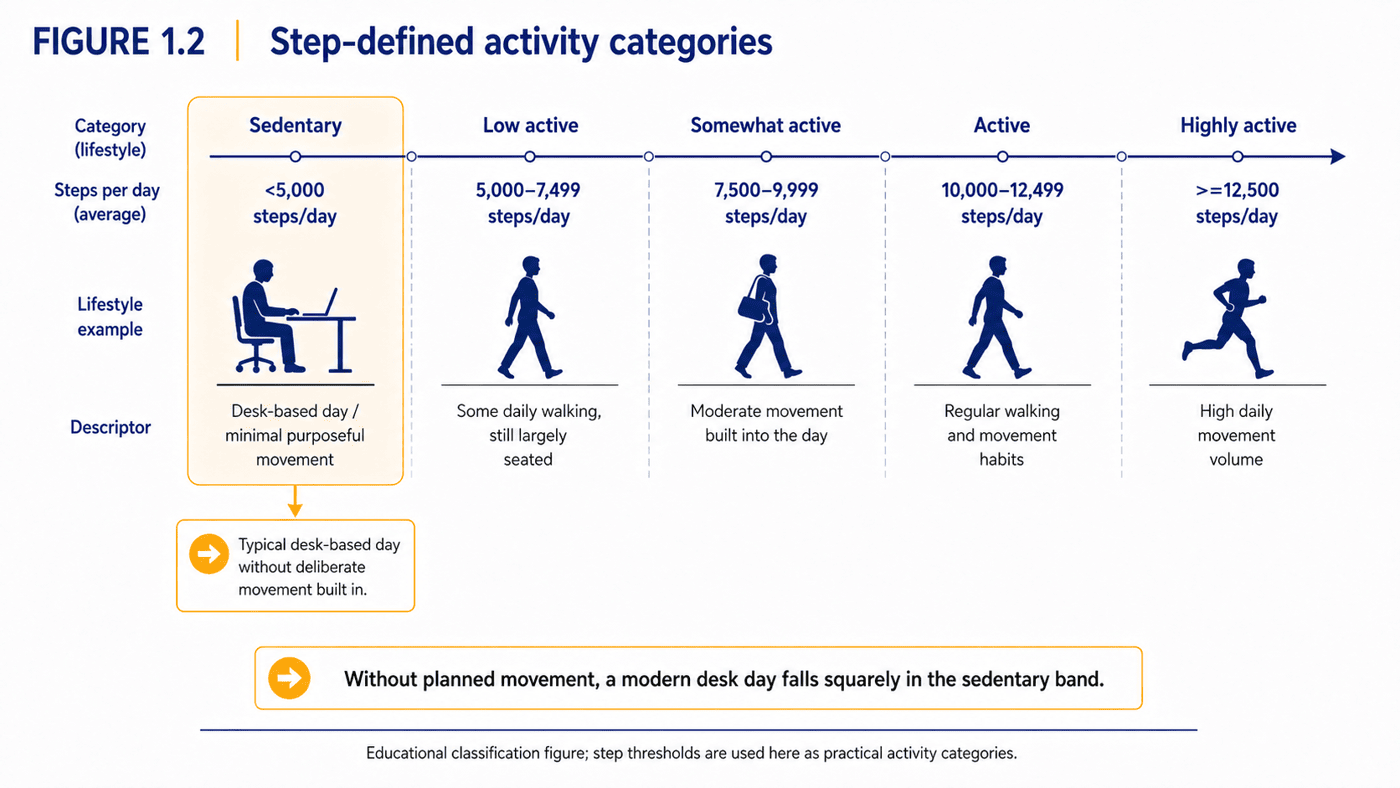
1.4 Sitting as a Mechanical Event
From a purely mechanical standpoint, sitting is a sustained, low-magnitude loading task. The classic teaching, derived from Nachemson’s (1981) early pressure measurements, was that sitting dramatically increases lumbar disc pressure compared with standing. Later in-vivo measurement complicated that picture: Wilke et al. (1999), recording pressure directly from a living disc across everyday activities, found that relaxed sitting was not dramatically worse than standing, and that posture and muscle activity mattered considerably. The headline figure — that sitting roughly doubles disc pressure — was an oversimplification. But the deeper point survived intact: sitting holds the spine, hips and shoulders within a narrow range for long periods, and it is the duration and sameness of that load, far more than its peak magnitude, that the tissues register.
The disc across a day
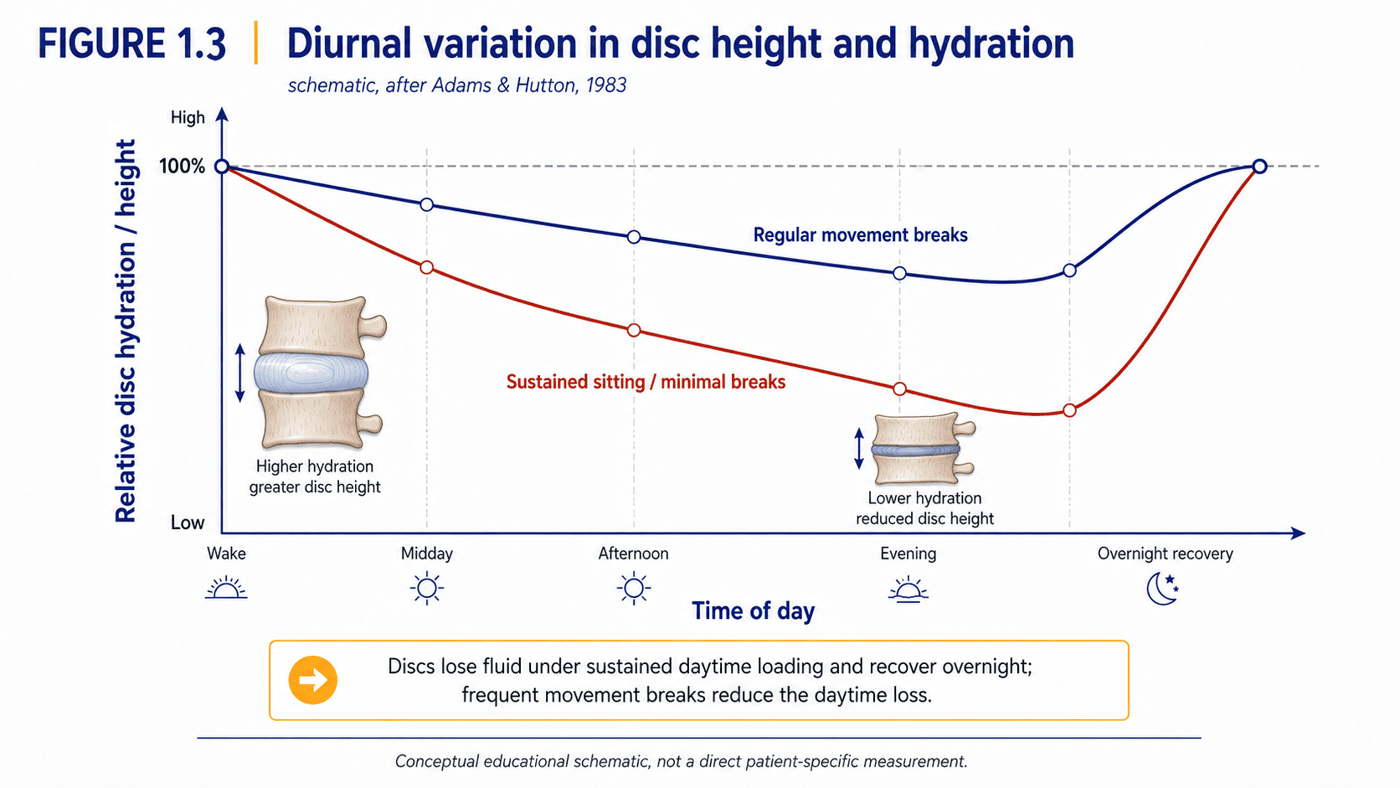
The intervertebral disc makes the duration point vivid. Across a day of upright and seated loading the discs slowly lose fluid and a little height — enough that most people are measurably taller in the morning than at night — and they reabsorb that fluid overnight when the spine is unloaded in lying (Adams & Hutton, 1983). Sustained sitting accelerates the daytime loss; frequent changes of position and short bouts of movement blunt it by restoring the cycles of loading and unloading the disc depends upon. Figure 1.3 shows the pattern schematically. The lesson is not that sitting deflates the spine — the overnight recovery is reliable — but that an unbroken day of stillness removes the very fluctuations that keep the disc nourished, whereas a day broken by movement preserves them.
There is also a quieter muscular cost. Maintaining any posture requires continuous low-level activity in postural muscles, and sustained low-level contraction is metabolically demanding in a way that is easy to underestimate. A long-standing explanation for the aching that accompanies static work — sometimes called the Cinderella hypothesis (Hägg, 1991) — holds that the same small motor units are recruited first and released last, so that during hours of apparently effortless sitting a subset of muscle fibres works almost continuously, accumulating fatigue and metabolic stress while larger fibres rest. The discomfort of a long desk session, on this view, is not weakness; it is the predictable result of asking a few fibres to hold a position for a very long time.
This is the central mechanical insight of the chapter. The desk body is not damaged by a single heavy event. It is shaped by thousands of hours of a load that is individually trivial and collectively decisive: the same joints held at the same angles, the same muscles held at the same lengths, the same fibres recruited continuously, the same tissues denied the variation they are built to expect.
1.5 The Three Dimensions of Movement Dose
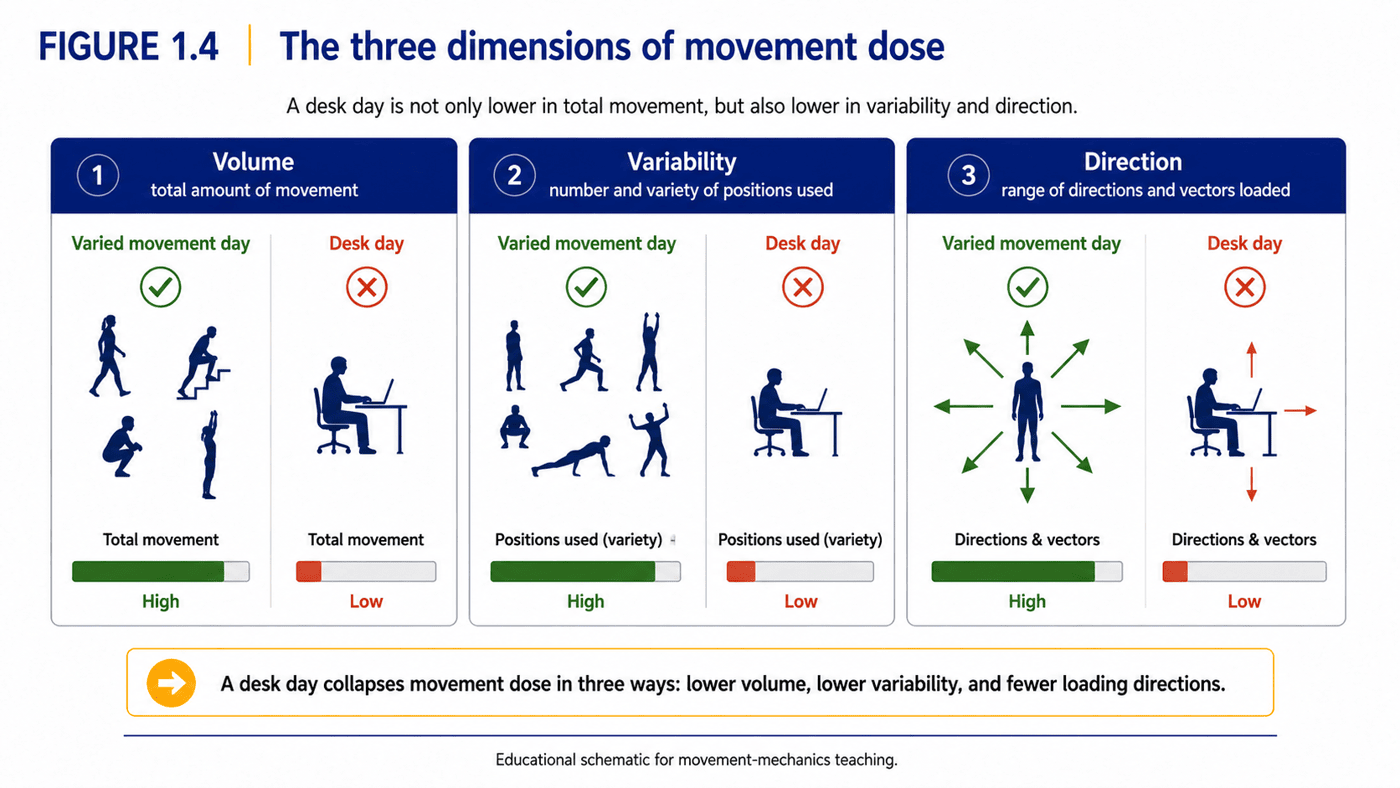
If mechanical load is a kind of nutrient, then like any nutrient it has a dose, and that dose has more than one dimension. Three are decisive for the desk body. The first is volume — simply how much loading the tissues receive across a day. Desk work lowers it sharply, replacing hours of upright, weight-bearing, locomotor activity with hours of supported sitting. The second is variability — the range of positions, angles, speeds and intensities the body moves through. Desk work collapses it, cycling endlessly through a small set of nearly identical postures. The third is direction — whether the body is loaded in the many planes and ranges it is built to use, or only in the narrow few a chair permits.
Movement variability is worth dwelling on because it is so easily overlooked. A healthy musculoskeletal system does not perform the same movement identically every time; it distributes load across slightly different tissues and motor strategies, which spreads wear and preserves options. A day that repeats the same few postures removes this natural rotation of load. The tissues that bear the seated posture bear it constantly; the tissues that would share the work in a varied day are never called upon. The result is concentration of a low load rather than distribution of a moderate one — and concentration, sustained, is what tissues find difficult.
A useful way to summarise an entire day of desk work, then, is that it is high in duration but low in all three dose dimensions at once. The body is not asked to do anything difficult; it is asked to do almost the same easy thing for hours. Over months and years the tissues respond exactly as the load-response window predicts: capacity narrows to match the narrow demand. This is why the solution previewed throughout this book is rarely “do less” and almost always “do more, and more varied, more often”.
1.6 The Deconditioning Spiral
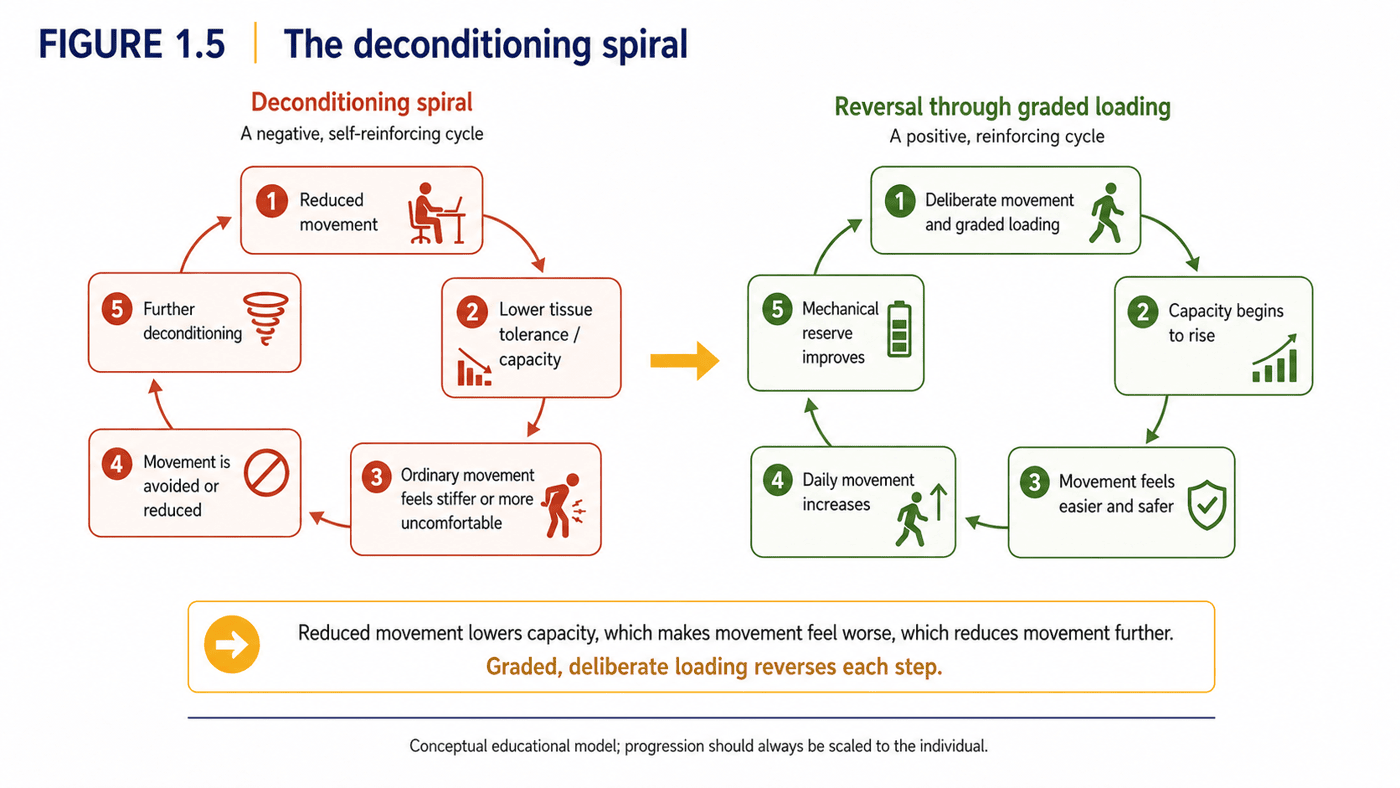
The mechanics of stillness would matter less if they were self-limiting. They are not; they tend to compound. As capacity falls, ordinary loads begin to feel less comfortable. Movements that were once unremarkable — rising from the floor, reaching overhead, a brisk flight of stairs — start to feel effortful or provoke a twinge. The natural human response to a movement that feels unpleasant is to avoid it. Avoidance reduces the load further, which reduces capacity further, which makes the next attempt feel worse still. A low-grade, self-reinforcing loop establishes itself, often without the person ever deciding to become inactive.
This deconditioning spiral, shown in Figure 1.5, is the quiet engine behind a great deal of desk-related decline. It is rarely dramatic at any single step, which is exactly why it is so effective: nothing alarming happens on any given day, and yet the trajectory over a year is unmistakable. Recognising the loop is also the key to interrupting it. Because each arrow is reversible, a deliberate, graded reintroduction of movement reverses the direction of travel — capacity rises, movement feels easier, and easier movement invites more of it. The same mechanism that drove the decline can be made to drive recovery.
1.7 The Health Signal Behind the Mechanics
The mechanical argument does not stand alone; it sits inside a large epidemiological literature on sedentary behaviour and health. Biswas et al. (2015), in a systematic review and meta-analysis, linked prolonged sedentary time with elevated risk of several chronic diseases and of death. Katzmarzyk, Church, Craig and Bouchard (2009) reported associations between daily sitting time and mortality that were not fully explained by leisure-time exercise. Booth, Roberts and Laye (2012) argued, in an extensive review of physiology, that physical inactivity should be recognised as a primary cause of chronic disease in its own right rather than a mere correlate.
One large analysis offers a particularly useful nuance. Ekelund et al. (2016), pooling data from more than a million people, found that high volumes of daily physical activity appeared to blunt much of the mortality risk associated with long sitting times. The message is not that sitting is uniquely toxic, but that movement is genuinely protective — and that the modern problem is the specific combination of a great deal of sitting with very little else. This is precisely the situation the desk worker must design around. It is also why current public-health guidance has changed: the World Health Organization’s 2020 guidelines explicitly advise both achieving regular activity and reducing and breaking up sedentary time, treating the two as related but separate targets (Bull et al., 2020).
None of this is a counsel of fear, and it should not be taught as one. The point is not that a chair is dangerous; it is that the mechanical and physiological dose of an ordinary working day deserves to be taken seriously, because that dose is what the tissues quietly adapt to. The desk body is, at root, a dose problem — and dose problems have dose solutions.
1.8 Putting It Together: The Mechanical Audit of a Day
The ideas in this chapter become usable the moment they are applied to a real schedule. Consider a composite desk worker — we will call her Anya, a software analyst — whose working day, described mechanically rather than morally, looks like the timeline in the box below. Read this way, the problem is not that any single block is harmful, but that the dimensions of movement dose are low across almost the entire day. The audit also reveals where the opportunities lie: every transition between blocks is a chance to reintroduce volume, variability and direction at almost no cost to the schedule.
1.9 Implications: Why This Changes How We Intervene
If the desk body is fundamentally a dose problem, then the shape of the solution follows directly, and it differs from the advice people usually receive. The aim is not to find a single protective posture, nor to rely on one daily workout to undo many sedentary hours, nor to frame sitting as a danger to be feared. The aim is to restore the three dimensions of movement dose — volume, variability and direction — across the whole day, in small, frequent, sustainable instalments. Everything in the practical parts of this book is, at root, an attempt to raise that daily dose without demanding that anyone abandon desk work.
Three common misconceptions are worth dispelling before we proceed, because each sends people toward the wrong remedy. The first is that sitting itself is harmful; it is not the act of sitting but the uninterrupted accumulation of it that drives the adaptations described here, which is why breaking it up matters so much. The second is that a workout fixes a sedentary day; as the active couch-potato finding shows, concentrated exercise is valuable but does not neutralise the many hours of stillness around it. The third is that the problem is weakness or poor posture; more often it is reduced capacity and lost movement variety — quantities of movement, not qualities of alignment.
Reframed correctly, the desk body becomes a tractable engineering problem rather than a source of anxiety. The tissues have adapted, predictably, to a low and monotonous mechanical dose; raise and diversify that dose, consistently, and they will adapt back. The chapters that follow build the case region by region and then assemble a practical system. But the foundation is laid here: the body was not designed for stillness, it has quietly adapted to the stillness we have given it, and that adaptation is both the diagnosis and the route to its reversal.
In summary
- Human anatomy reflects a long history of frequent, varied, weight-bearing movement; sustained stillness — not effort — is the genuinely novel demand of desk life (Bramble & Lieberman, 2004; Lieberman, 2013).
- Tissues are maintained by mechanical load within an adaptive window (Physical Stress Theory). Too little load lowers capacity just as surely as too much load injures (Mueller & Maluf, 2002).
- Bone, muscle, tendon, cartilage and disc each adapt downward under chronic unloading; cartilage and disc in particular depend on cyclic loading for their nutrition.
- Prolonged sitting has a distinct physiology — suppressed fat metabolism, reduced NEAT, impaired vascular function — and frequently breaking up sitting improves markers even when total sitting is unchanged (Hamilton et al., 2007; Healy et al., 2008; Thosar et al., 2015).
- Sitting is a low-magnitude, long-duration, low-variability load, sustained by continuously recruited ‘Cinderella’ fibres. Its harm lies in dose and sameness, not in any single dramatic event.
- Movement dose has three dimensions — volume, variability and direction — and a desk day is low in all three. Low dose drives a self-reinforcing deconditioning spiral that graded movement reverses.
- Large-scale evidence links high sitting with low movement to worse health, while abundant daily movement is protective (Ekelund et al., 2016; Bull et al., 2020). The desk body is a dose problem best solved by more, more varied and more frequent movement.
References
Adams, M. A., & Hutton, W. C. (1983). The effect of posture on the fluid content of lumbar intervertebral discs. Spine, 8(6), 665–671.
Biswas, A., Oh, P. I., Faulkner, G. E., Bajaj, R. R., Silver, M. A., Mitchell, M. S., & Alter, D. A. (2015). Sedentary time and its association with risk for disease incidence, mortality, and hospitalization in adults: A systematic review and meta-analysis. Annals of Internal Medicine, 162(2), 123–132.
Booth, F. W., Roberts, C. K., & Laye, M. J. (2012). Lack of exercise is a major cause of chronic diseases. Comprehensive Physiology, 2(2), 1143–1211.
Bramble, D. M., & Lieberman, D. E. (2004). Endurance running and the evolution of Homo. Nature, 432(7015), 345–352.
Bull, F. C., Al-Ansari, S. S., Biddle, S., Borodulin, K., Buman, M. P., Cardon, G., … Willumsen, J. F. (2020). World Health Organization 2020 guidelines on physical activity and sedentary behaviour. British Journal of Sports Medicine, 54(24), 1451–1462.
Ekelund, U., Steene-Johannessen, J., Brown, W. J., Fagerland, M. W., Owen, N., Powell, K. E., Bauman, A., & Lee, I.-M. (2016). Does physical activity attenuate, or even eliminate, the detrimental association of sitting time with mortality? A harmonised meta-analysis of data from more than 1 million men and women. The Lancet, 388(10051), 1302–1310.
Frost, H. M. (2003). Bone’s mechanostat: A 2003 update. The Anatomical Record Part A, 275(2), 1081–1101.
Hägg, G. M. (1991). Static work loads and occupational myalgia — a new explanation model (the Cinderella hypothesis). In P. A. Anderson, D. J. Hobart, & J. V. Danoff (Eds.), Electromyographical kinesiology (pp. 141–144). Elsevier.
Hamilton, M. T., Hamilton, D. G., & Zderic, T. W. (2007). Role of low energy expenditure and sitting in obesity, metabolic syndrome, type 2 diabetes, and cardiovascular disease. Diabetes, 56(11), 2655–2667.
Healy, G. N., Dunstan, D. W., Salmon, J., Cerin, E., Shaw, J. E., Zimmet, P. Z., & Owen, N. (2008). Breaks in sedentary time: Beneficial associations with metabolic risk. Diabetes Care, 31(4), 661–666.
Katzmarzyk, P. T., Church, T. S., Craig, C. L., & Bouchard, C. (2009). Sitting time and mortality from all causes, cardiovascular disease, and cancer. Medicine & Science in Sports & Exercise, 41(5), 998–1005.
Levine, J. A. (2002). Non-exercise activity thermogenesis (NEAT). Best Practice & Research Clinical Endocrinology & Metabolism, 16(4), 679–702.
Lieberman, D. E. (2013). The story of the human body: Evolution, health, and disease. Pantheon Books.
Mueller, M. J., & Maluf, K. S. (2002). Tissue adaptation to physical stress: A proposed “physical stress theory” to guide physical therapist practice, education, and research. Physical Therapy, 82(4), 383–403.
Nachemson, A. L. (1981). Disc pressure measurements. Spine, 6(1), 93–97.
Owen, N., Healy, G. N., Matthews, C. E., & Dunstan, D. W. (2010). Too much sitting: The population health science of sedentary behavior. Exercise and Sport Sciences Reviews, 38(3), 105–113.
Thosar, S. S., Bielko, S. L., Mather, K. J., Johnston, J. D., & Wallace, J. P. (2015). Effect of prolonged sitting and breaks in sitting time on endothelial function. Medicine & Science in Sports & Exercise, 47(4), 843–849.
Tudor-Locke, C., Craig, C. L., Brown, W. J., Clemes, S. A., De Cocker, K., Giles-Corti, B., … Blair, S. N. (2011). How many steps/day are enough? For adults. International Journal of Behavioral Nutrition and Physical Activity, 8, 79.
Williams, P. E., & Goldspink, G. (1978). Changes in sarcomere length and physiological properties in immobilized muscle. Journal of Anatomy, 127(Pt 3), 459–468.
Wilke, H. J., Neef, P., Caimi, M., Hoogland, T., & Claes, L. E. (1999). New in vivo measurements of pressures in the intervertebral disc in daily life. Spine, 24(8), 755–762.