Chapter 120: Evidence map and bibliography
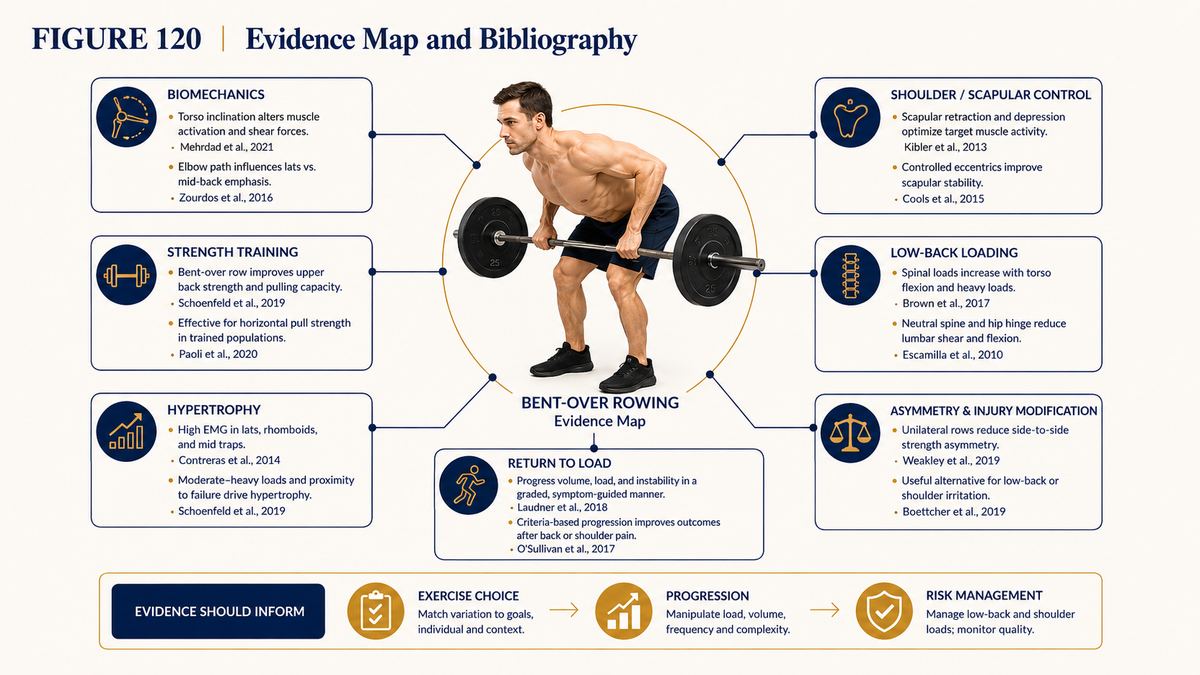
In plain language, evidence map and bibliography asks whether the athlete can row while preserving the mechanical problem that the coach or clinician actually wants to train. Bent-over rowing is not simply the movement of a weight toward the body. It is a load-transfer decision between the hand, implement, elbow, shoulder, scapula, trunk, pelvis, hip hinge and floor.
The MMSx view treats this chapter as a decision about defining the exact movement problem before changing load, grip or range. The useful question is not only whether the rep was completed. The useful question is whether the rep can be repeated with the same start position, same path, same finish standard and an acceptable recovery response.
The main caution is random variation selection, vague cueing and confusing muscle-feel with mechanical quality. Therefore the field action is to name the variation, name the body angle, name the row path and choose one pass standard. This keeps the exercise inside the intended movement family and prevents the session from drifting into random effort or compensation.
A strong chapter decision combines observation with history. Bar path, dumbbell path, scapular motion, rib-cage position, hip-hinge quality, tempo, symptom response and next-session readiness are all useful signals; none of them is the whole answer by itself.
- American College of Sports Medicine. (2009). Progression models in resistance training for healthy adults. Medicine & Science in Sports & Exercise, 41(3), 687-708. https://doi.org/10.1249/MSS.0b013e3181915670
- Currier, B. S., et al. (2026). American College of Sports Medicine Position Stand: Resistance training prescription for muscle function and hypertrophy in healthy adults. Medicine & Science in Sports & Exercise.
- Desmeules, F., et al. (2016). Efficacy of exercise therapy in workers with rotator cuff tendinopathy: A systematic review. Journal of Occupational Health.
- Edelburg, H. (2017). Electromyographic analysis of the back muscles during eight back exercises. University of Wisconsin-La Crosse.
- Fenwick, C. M. J., Brown, S. H. M., & McGill, S. M. (2009). Comparison of different rowing exercises: Trunk muscle activation and lumbar spine motion, load, and stiffness. Journal of Strength and Conditioning Research, 23(5), 1408-1417.
- Hickey, D., Solvig, V., Cavalheri, V., Harrold, M., & McKenna, L. (2018). Scapular dyskinesis increases the risk of future shoulder pain by 43% in asymptomatic athletes: A systematic review and meta-analysis. British Journal of Sports Medicine, 52(2), 102-110.
- Lehman, G. J. (2004). Variations in muscle activation levels during traditional latissimus dorsi weight training exercises: An experimental study. Dynamic Medicine, 3, 4.
- Melo, A. S. C., et al. (2024). Effectiveness of specific scapular therapeutic exercises in patients with shoulder pain: Systematic review with meta-analysis. Journal of Clinical Medicine.
- Michaud, F., Perez Soto, M., Lugris, U., & Cuadrado, J. (2021). Lower back injury prevention and sensitization of hip hinge with neutral spine using wearable sensors during lifting exercises. Sensors, 21(16), 5487. https://doi.org/10.3390/s21165487
- Ramirez, V. J., et al. (2022). Low back biomechanics during repetitive deadlifts. Journal of Biomechanics / related open-access report.
- Ravichandran, H., et al. (2020). Effect of scapular stabilization exercise program in patients with subacromial impingement syndrome: A systematic review. Journal of Exercise Rehabilitation.
- Schory, A., Bidinger, E., Wolf, J., & Murray, L. (2016). A systematic review of the exercises that produce optimal muscle ratios of the scapular stabilizers in normal shoulders. International Journal of Sports Physical Therapy, 11(3), 321-336.
- Silveira, A., et al. (2024). Shoulder specific exercise therapy is effective in reducing pain and improving function in chronic shoulder pain: A network meta-analysis. British Journal of Sports Medicine / open-access report.
- Vila-Dieguez, O., et al. (2023). Exercise for rotator cuff tendinopathy: Proposed mechanisms of action. British Journal of Sports Medicine / open-access review.
- Youdas, J. W., et al. (2020). Recruitment of shoulder complex and torso stabilizer muscles during rows performed with suspension straps. International Journal of Sports Physical Therapy, 15(6), 1003-1014.
- McGill, S. M. (2007). Low Back Disorders: Evidence-Based Prevention and Rehabilitation. Human Kinetics.
- McGill, S. M. (2016). Back Mechanic. Backfitpro Inc.
- Kibler, W. B., & Sciascia, A. (2010). Current concepts: Scapular dyskinesis. British Journal of Sports Medicine.
- Ludewig, P. M., & Reynolds, J. F. (2009). The association of scapular kinematics and glenohumeral joint pathologies. Journal of Orthopaedic & Sports Physical Therapy.
- Escamilla, R. F., et al. (2009). Shoulder muscle activity and function in common shoulder rehabilitation exercises. Sports Medicine.
- Aasa, U., et al. (2015). Deadlift training for patients with mechanical low back pain: A single-subject experimental design. International Journal of Sports Physical Therapy.
- Strömbäck, E., Aasa, U., Gilenstam, K., & Berglund, L. (2018). Prevalence and consequences of injuries in powerlifting: A cross-sectional study. Orthopaedic Journal of Sports Medicine.
- Schoenfeld, B. J. (2010). The mechanisms of muscle hypertrophy and their application to resistance training. Journal of Strength and Conditioning Research.
- Schoenfeld, B. J., et al. (2021). Resistance training volume enhances muscle hypertrophy: Evidence and practice considerations. Sports Medicine.
- Behm, D. G., et al. (2010). The use of instability to train the core musculature. Applied Physiology, Nutrition, and Metabolism.
- Escamilla, R. F., et al. (2018). Core muscle activation during Swiss ball and traditional abdominal exercises. Journal of Orthopaedic & Sports Physical Therapy.
- Wirth, K., et al. (2017). Analysis of weightlifting movements and strength exercises: Practical implications for coaching. Sports Medicine.
- Page, P., Frank, C. C., & Lardner, R. (2010). Assessment and Treatment of Muscle Imbalance: The Janda Approach. Human Kinetics.
- Cools, A. M., et al. (2014). Rehabilitation of scapular dyskinesis: From the office worker to the elite overhead athlete. British Journal of Sports Medicine.
- Baskurt, Z., et al. (2011). The effectiveness of scapular stabilization exercise in patients with subacromial impingement syndrome. Journal of Back and Musculoskeletal Rehabilitation.
- Eraslan, L., et al. (2023). Utilizing scapula retraction exercises with or without glenohumeral rotation exercises in subacromial pain syndrome. Journal of Clinical Medicine.
MMSx decision question
Can the athlete preserve the intended row problem while load, range, support, tempo and symptom response remain controlled?
Field action
Change one variable at a time: support, body angle, grip, range, tempo, load, volume or frequency.
Clinical caution
Do not progress difficulty when pain, neurological symptoms, loss of control, unexplained weakness or post-surgical limits are present.